Gold ETF or metal in hand: which pays more, how it behaves in a crash and what happens in a crisis
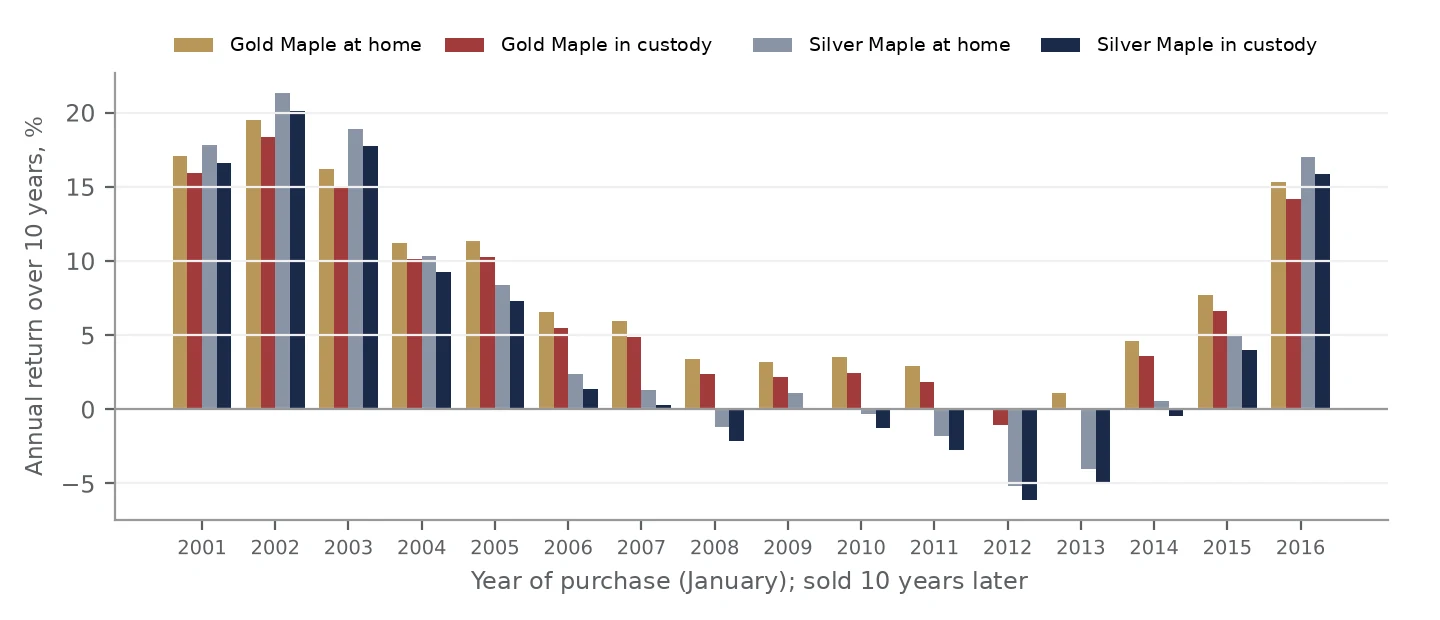
On cost, a cheap gold ETF beats the coin for many years. But with Andorra Metals' spot buy-back, a gold Maple kept at home would have returned the same as the GLD ETF over the past ten years, and it reduces your dependence on banks, issuers and exchanges. Holding the price of the metal is not the same as holding the metal, but no option removes every risk: the coin at home has risks of its own (theft, authenticity and buy-back price). Custody at 1% a year is the most expensive physical format, and in silver the entry premium weighs more than any fee.
Declaration of interest. This article is published by Andorra Metals, which sells physical gold and silver. We use our own buying and buy-back prices, which are commercial terms of our store and not independent market data. The coin returns are simulations, not observed client results. This is an informative article, not a personal recommendation.
What the data from 2000 to today says:
- The context increases the risks that metal is usually held against. An energy crisis with Hormuz almost closed, peak oil and peak diesel, a very strong El Niño through 2027 and record world debt. Central banks are buying gold at a record pace. That does not guarantee the price will rise.
- USD 10,000 in gold in November 2016 is worth today: Maple at home 33.4k, GLD 33.2k, IAU 33.7k, PHYS (Sprott) 31.9k, Maple in custody at 1% 30.2k. Gold with no cost at all, 34.7k.
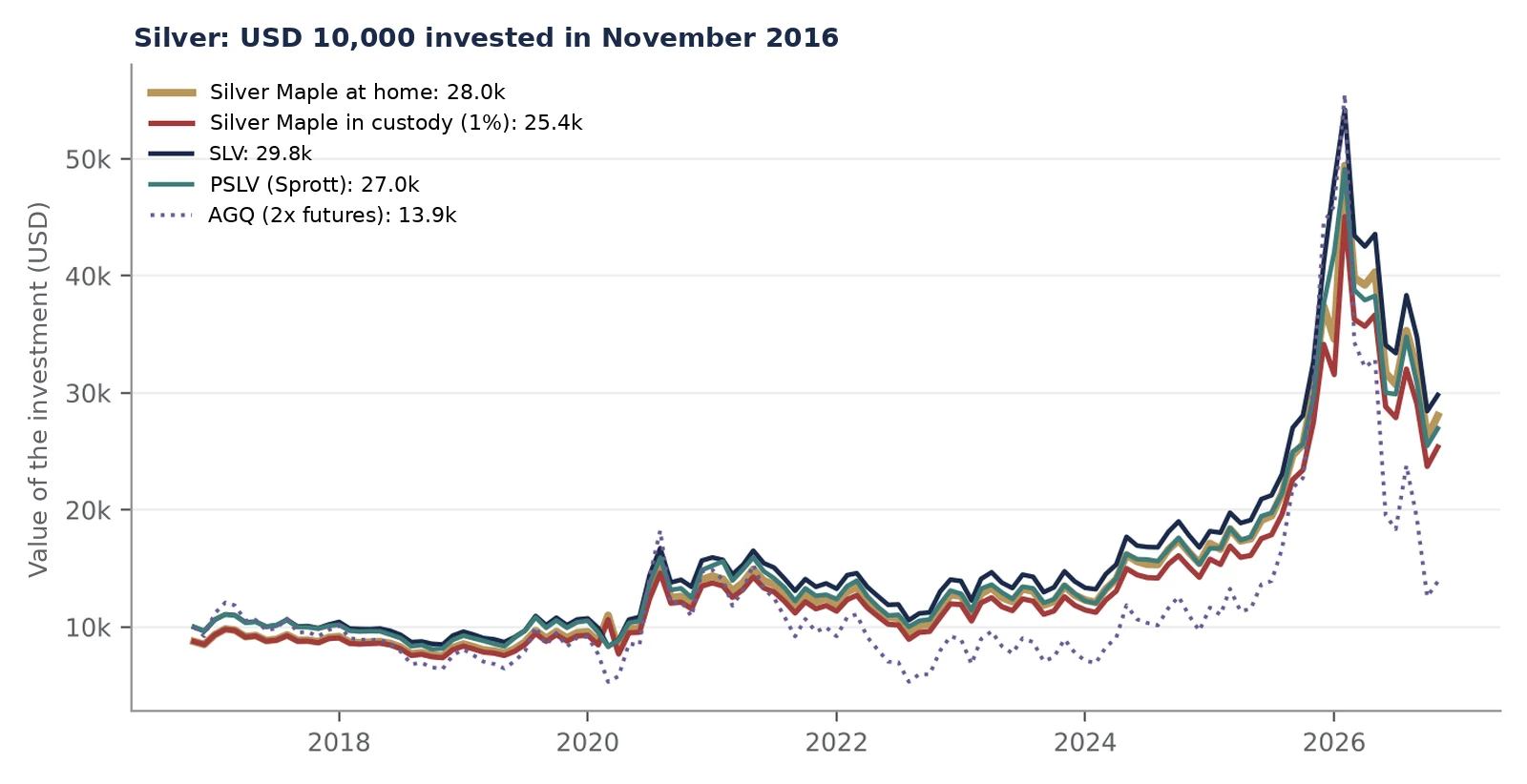
- In silver: SLV 29.8k, Maple at home 28.0k, PSLV 27.0k, Maple in custody 25.4k. Silver with no costs, 32.0k.
- In a crash, physical falls as much as spot. In 2008, 2020 and 2026, the coin, the physical ETFs and Sprott fell almost exactly the same in percentage terms. The products with no metal fell more: in 2026, leveraged silver (AGQ) was down as much as 77% and gold miners (GDX) 36%, against 26% for gold.
- In a crisis of the system, physical has broken away from paper: according to accounts from the time, several of them from dealers, in 2008 and 2020 there were stores buying back above spot. These are not prices from documented transactions, and a high selling price does not guarantee a high buy-back.
- Sprott is the closest thing to holding the metal, along with the MoraBanc fund, but it trades at a premium or a discount: today, −4.6% in silver and −2.4% in gold.
- Coins with a collector premium (Libertad, Panda) only pay more if someone pays that premium when you sell; the Centenario behaves like investment gold.
- Everything that is gold moves together (correlation of 0.99–1.00 between GLD, IAU, PHYS and UGL; 0.79 between gold and silver). The difference between formats lies in the cost, the leverage and who holds the metal if something fails.
1. The context: a global problem that is not a small one
This article compares investment formats, but the underlying question is a different one: why hold metal at all. As of 6 November 2026, several risks are adding up at the same time, and almost all of them push in the same direction: more inflation, more debt, more fragile markets and a higher chance that something stops working.
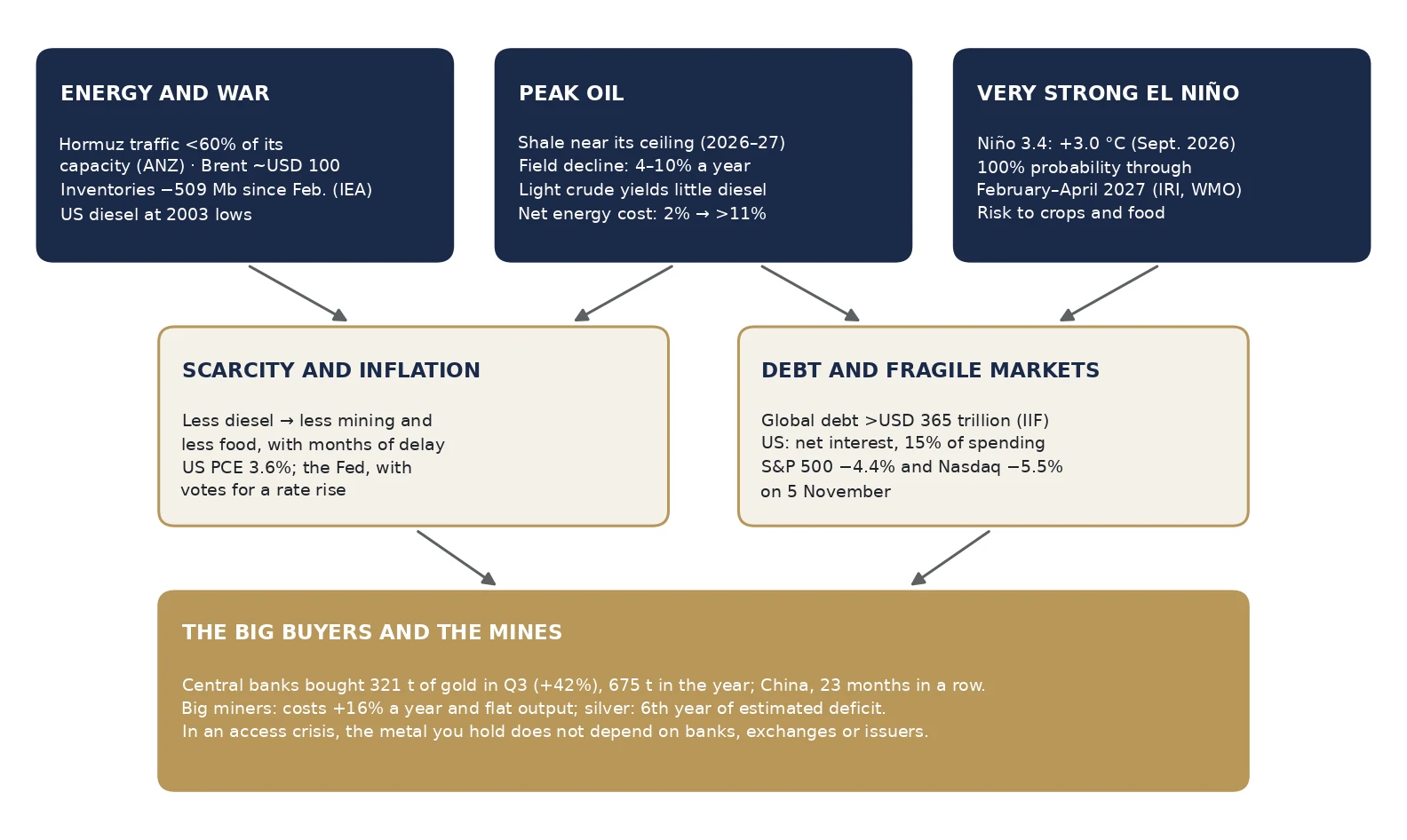
- Energy and war. According to ANZ, traffic through the Strait of Hormuz is below 60% of its capacity, and Iran's Revolutionary Guard declares it closed to anyone who does not coordinate with Tehran; Brent is back at USD 100. More than 40 energy facilities have been damaged in the Middle East and 8 of the 10 largest Russian refineries. World inventories have fallen by 509 million barrels since February (IEA) and US diesel reserves are at their lowest since 2003 (EIA). Some 40 countries have moved from saving campaigns to fuel restrictions.
- Peak oil and peak diesel. Shale oil, which has underpinned world supply since 2012, would be approaching its ceiling between 2026 and the end of 2027 (Laherrère, Coyne). Existing fields lose between 4% and 10% of production a year (IEA), and light shale crude yields little diesel. As Antonio Turiel (CSIC) explains, the missing diesel is not first felt at the pump but in mines and harvests: it turns into a shortage of raw materials months later.
- El Niño. It is active and very strong: the Niño 3.4 index reached +3.0 °C in September, and the models give a 100% probability that it will last until February–April 2027 (IRI). The WMO expects it to reach a “very strong” intensity peaking at the end of 2026. An episode like this alters rainfall and temperatures in many regions, which adds a risk to harvests and food prices in a world where diesel and fertilisers are already expensive.
- Debt and rates. World debt is above USD 365 trillion (IIF). In the United States, debt is past USD 40 trillion and net interest is already 15% of federal spending. With PCE inflation at 3.6%, the Federal Reserve is holding rates with two votes in favour of raising them. On 5 November, the S&P 500 fell 4.4% and the Nasdaq 5.5%.
- The big buyers have already moved. Central banks bought 321 tonnes of gold in the third quarter (+42%) and 675 over the year, almost two thirds of it undeclared (WGC); China has been buying for 23 months in a row. On the mining side, the cost of producing an ounce at the large producers is rising 16% a year and their output has been flat for a decade; that does not include recycling or future projects. In silver, the Silver Institute estimates a sixth year of deficit (46.3 Moz in 2026, forecast).
Why this matters for the format. If these risks materialise, the problem may not be only the price but access: closed trade routes, sanctions, banks shutting for a few weeks, exchanges suspending trading or platforms freezing withdrawals, as happened with several leveraged and unregulated “virtual” gold platforms in Shenzhen in 2026 (not comparable to a regulated ETF, but they illustrate platform risk). In that scenario, the metal in your hands does not depend on those intermediaries, although selling it will still depend on there being a buyer and at what price. It is an argument for considering that part of the metal should be physical, not a guarantee of protection.
What the context does not guarantee. Metals do not rise in a straight line in a crisis. When stock markets collapse, many investors sell whatever they can sell, gold included, to cover losses or margin on other assets: in 2008 gold was down as much as 25% (monthly closes) and on 30 January 2026 it fell close to 10% in a single day. There is also no way of knowing when or how the war or the energy crisis will be resolved, and the context data mixes observations, estimates and forecasts. Metals are insurance for a portfolio, not a short-term bet.
2. How ETFs get hold of the metal and what you pay
When you buy a physical gold ETF or ETC you are not buying metal: you are buying units of a fund that already holds it. The ones who bring the metal to the fund are the authorised participants, large banks that buy London Good Delivery bars of around 400 ounces in the London wholesale market and deliver them in exchange for new units. In redemptions it works the other way round: the bank hands back units and takes out bars.
At what price do they buy the metal? There is a cost, but the fund does not pay it, and per ounce it is very small. According to the 2007 GLD prospectus (the terms in force may have changed):
- The bank delivers the gold (minimum fineness 995), which is valued at the London afternoon auction price (LBMA PM).
- It pays USD 2,000 per creation or redemption order, capped at 0.10% of the value of the basket. A basket of 100,000 units today contains some 9,160 ounces, around USD 37 million: USD 2,000 is 0.005%.
- The bank takes on the cost and the risk of buying the gold and getting it to the vault. That cost, the wholesale market spread and the transport, it recovers in the bid-ask spread of the units on the exchange.
There is nothing odd about it: it is scale. A 400-ounce bar (around USD 1.6 million) costs almost the same to make, transport and verify as a one-ounce coin. That is why the fund gets in practically at spot and a store does not. At Sprott, the trust buys the metal directly with the money from each new issue, at market price. What you pay in an ETF is something else:
- The annual fee (from 0.10% to 0.50%). No invoice reaches you: the fund sells a fraction of the metal every day, so the ounces backing each unit go down year after year.
- The broker fee and the spread when buying and selling, minimal in the large products.
- The currency conversion. Almost all of them are quoted in dollars; depending on the broker, converting euros costs between 0.1% and 0.5% per transaction.
- When you sell you receive money, never metal. Only the Sprott trusts (from around 400 oz of gold or 10,000 oz of silver, according to their documentation; it is worth checking the minimums in force), the MoraBanc fund and two German notes deliver metal to a private investor. The fact that physical redemption exists does not mean it is practical for a small portfolio.
We have analysed the prospectus of each product in Gold and silver ETFs: real physical metal or paper?.
3. How we made the comparison
We simulate buying a 1 oz Maple Leaf coin of mixed year at Andorra Metals prices and selling it back to the same store, against buying each fund on the exchange. We apply today's commercial terms to the whole period, so that the comparison depends on the format and not on what premiums were like in each era. It is a hypothetical reconstruction: it does not reflect what any particular client obtained and it does not guarantee future results.
| Assumption | Gold | Silver |
|---|---|---|
| Maple buying premium (before tax) | +4.0% over spot* | +20% over spot (ranking of 2 Nov 2026: 19.8–20.3%) |
| Buy-back price at Andorra Metals | Spot, if the coin is in good condition | Spot + 5% |
| Cost of keeping it | At home: 0 · Custody: 1% a year on the value | At home: 0 · Custody: 1% a year on the value |
| ETFs and funds | Market price (fees already deducted) + 0.3% round trip between broker and spread | Same |
| Currency and taxes | All in dollars; no taxes (investment gold is exempt) | No taxes in the base case; see section 4 |
* Gold Maple premium assumed between that of the Krugerrand (+3.7%) and that of the 1 oz bar (+4.5%) in the Andorra Metals ranking; each additional point of premium takes around 1% off the final result. Data: monthly closes from Yahoo Finance via digrin.com; silver spot = front-month COMEX future; gold spot = price implied in GLD net of its fee (before November 2004, World Bank monthly average).
4. Ten years simulated with real prices: Maple at home, in custody and funds
The metal and fund prices are real; the Maple result is a hypothetical simulation that applies today's Andorra Metals premiums and buy-back to the whole period. The premiums of ten years ago, and above all those of 2008 and 2020, were different, so the real result for a buyer back then would have been different.
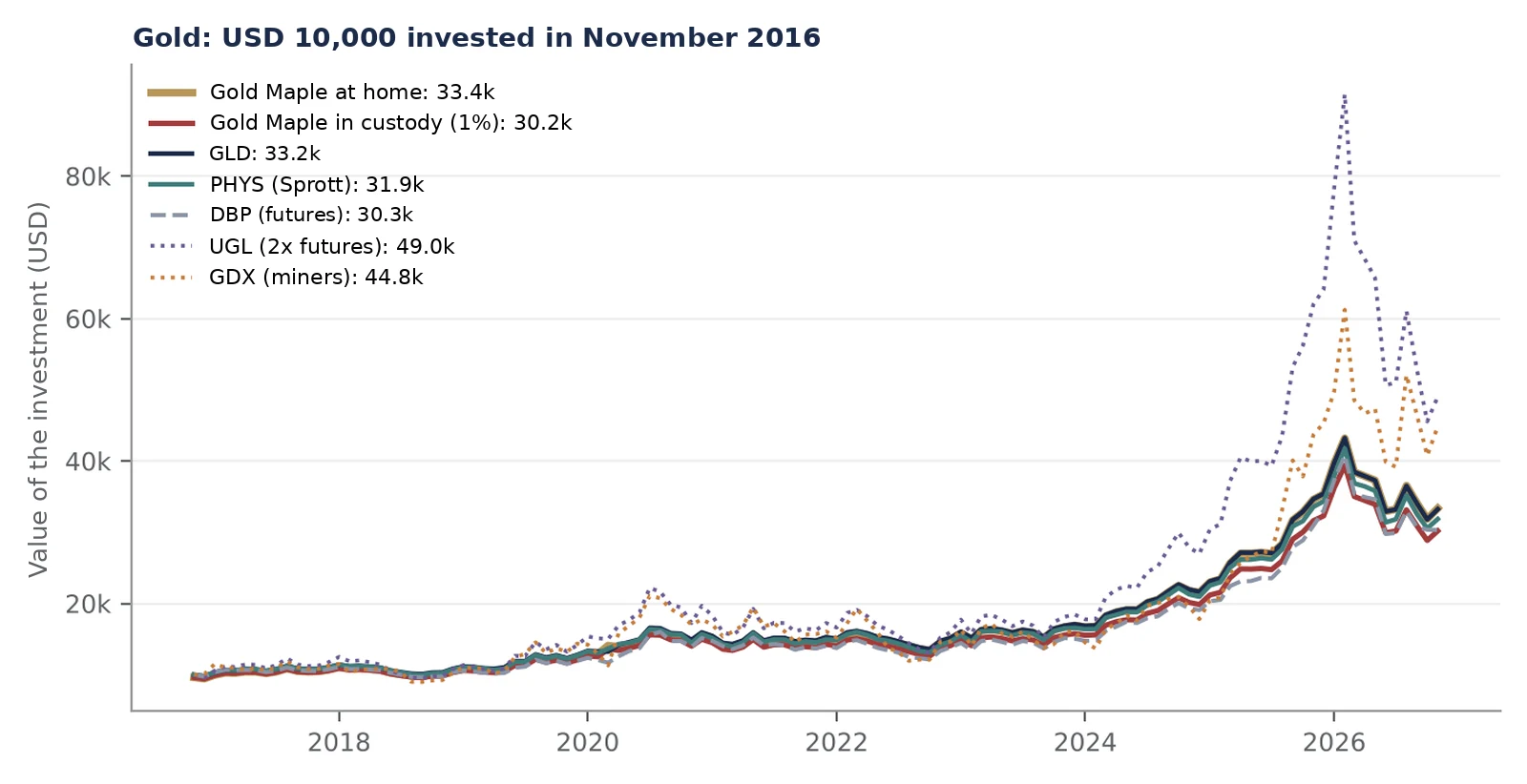
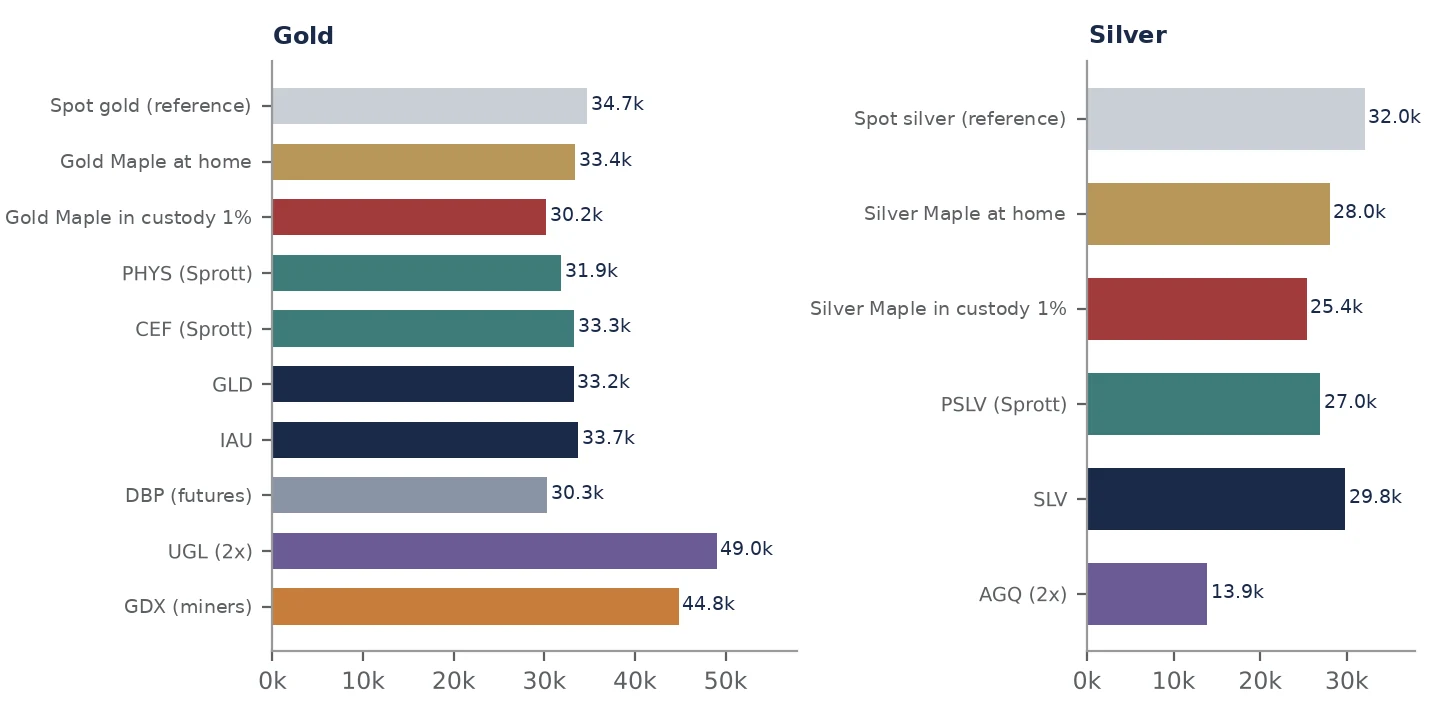
Gold. The Maple at home (33.4k) ends up level with GLD (33.2k) and barely below IAU (33.7k), which charges less. Custody at 1% costs 9.6% of the capital over ten years: it is the most expensive physical format, behind even a futures fund.
Silver. The entry gap (buying at +20% and selling at +5%) is 12.5%, and SLV takes around 17 years to lose that to fees and tracking difference. But PSLV, the trust that delivers metal, has ended up below the Maple at home because of its fee and the discount at which it trades today. If tax is added to the Maple price, the result falls in the same proportion: with IGI at 4.5% it would be around 26.8k; for a resident in Spain paying 21% VAT, around 23.2k. Taxation depends on residence, the product and the transaction: buying in Andorra does not remove the tax or customs obligations of taking the metal to Spain or another EU country.
| Vehicle | What do you hold? | Do they give you the metal? | USD 10,000 → (Nov 2026) | Worst drawdown in 10 years |
|---|---|---|---|---|
| Gold Maple at home | The coin | You already have it | 33.4k | −26.3% |
| Gold Maple in custody 1% | The coin, kept by someone else | Yes, under contract | 30.2k | −26.7% |
| PHYS (Sprott) | A unit in a trust with unencumbered gold | From ~400 oz | 31.9k | −26.8% |
| GLD / IAU | A unit in a trust with allocated gold | No | 33.2k / 33.7k | −26.5% |
| DBP | Gold and silver futures | No: there is no metal | 30.3k | −27.1% |
| UGL | 2x the daily change in gold, with swaps and futures | No | 49.0k | −50.2% |
| GDX | Shares in gold miners | No: they are companies | 44.8k | −43.3% |
| Silver Maple at home | The coin | You already have it | 28.0k | −47.0% |
| Silver Maple in custody 1% | The coin, kept by someone else | Yes, under contract | 25.4k | −47.4% |
| PSLV (Sprott) | A unit in a trust with unencumbered silver | From ~10,000 oz | 27.0k | −48.1% |
| SLV | A unit in a trust with allocated silver | No | 29.8k | −47.5% |
| AGQ | 2x the daily change in silver | No | 13.9k | −77.4% |
Worst drawdown: from peak to trough using monthly closes between November 2016 and November 2026; in every case it happened in 2026. With daily closes or intraday prices the drawdowns are larger (in silver, in the order of 50–60% from the January peak); they are not interchangeable figures and here we use the same monthly series for all of them.
Sensitivity: how much the result changes with other terms
The result of the coin depends on the buying premium, on the buy-back price and on the cost of keeping it. For USD 10,000 invested in November 2016:
| Gold Maple · buying premium | Buy-back at spot | Buy-back at spot −1% | Buy-back at spot −2% |
|---|---|---|---|
| +3% | 33.7k | 33.3k | 33.0k |
| +4% (base case) | 33.4k | 33.0k | 32.7k |
| +5% | 33.0k | 32.7k | 32.4k |
| Silver Maple · buying premium | Buy-back at spot +5% | Buy-back at spot | Buy-back at spot −5% |
|---|---|---|---|
| +15% | 29.3k | 27.9k | 26.5k |
| +20% (base case) | 28.0k | 26.7k | 25.4k |
| +25% | 26.9k | 25.6k | 24.4k |
References over the same period: GLD 33.2k, IAU 33.7k, SLV 29.8k, PSLV 27.0k. Custody of the gold Maple at 0.5% a year: 31.7k; at 1%: 30.2k. A safe deposit box with a fixed rent of USD 300 a year would cost USD 3,000 over ten years: on USD 10,000 it would leave 30.4k, but on USD 100,000 its weight would be ten times smaller. That is why we do not claim that the coin always ends up level with GLD: it depends on the specific terms.
5. What each option costs depending on how long you hold it
The ten simulated years depend on what the price did. To separate out the effect of the format, we work out what share of the amount invested goes on costs depending on the holding period, leaving aside the path of the metal, which is the same for everyone.
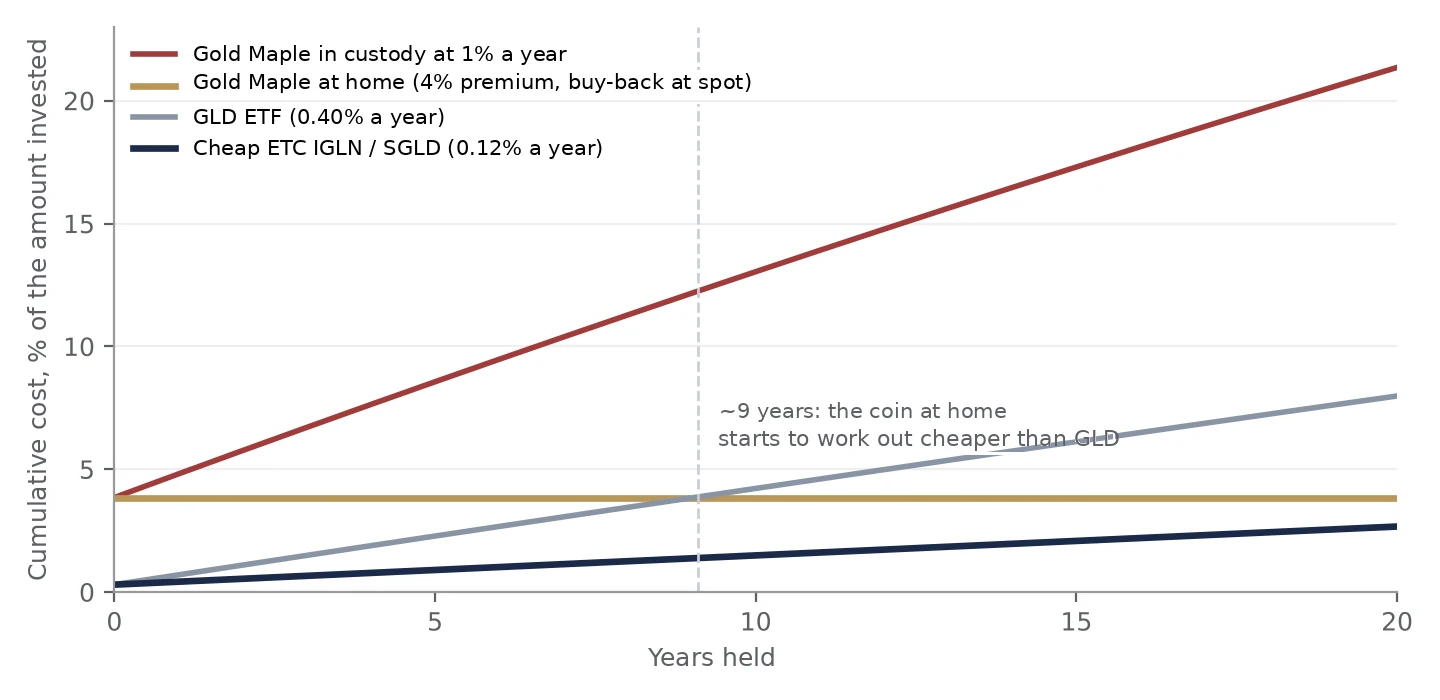
| Gold | 1 year | 5 years | 10 years | 20 years |
|---|---|---|---|---|
| Cheap ETC (IGLN, SGLD), 0.12% | 0.4% | 0.9% | 1.5% | 2.7% |
| GLD ETF, 0.40% | 0.7% | 2.3% | 4.2% | 8.0% |
| Gold Maple at home | 3.8% | 3.8% | 3.8% | 3.8% |
| Gold Maple in custody at 1% a year | 4.8% | 8.6% | 13.0% | 21.4% |
The coin at home pays its cost only once, when you buy it; the funds, every year. That is why the coin catches up with GLD from around 9 years, as the ten-year simulation confirms. The 0.12% ETC is so cheap that the coin does not catch up with it until around 30 years. Custody at 1% catches up with none of them: with €100,000 that is €1,000 a year, against €120 for an ETC. Keeping the coin at home calls for a safe and, if you want one, insurance; these are fixed costs that do not grow with the value of the gold, just like the rent of a safe deposit box at a bank.
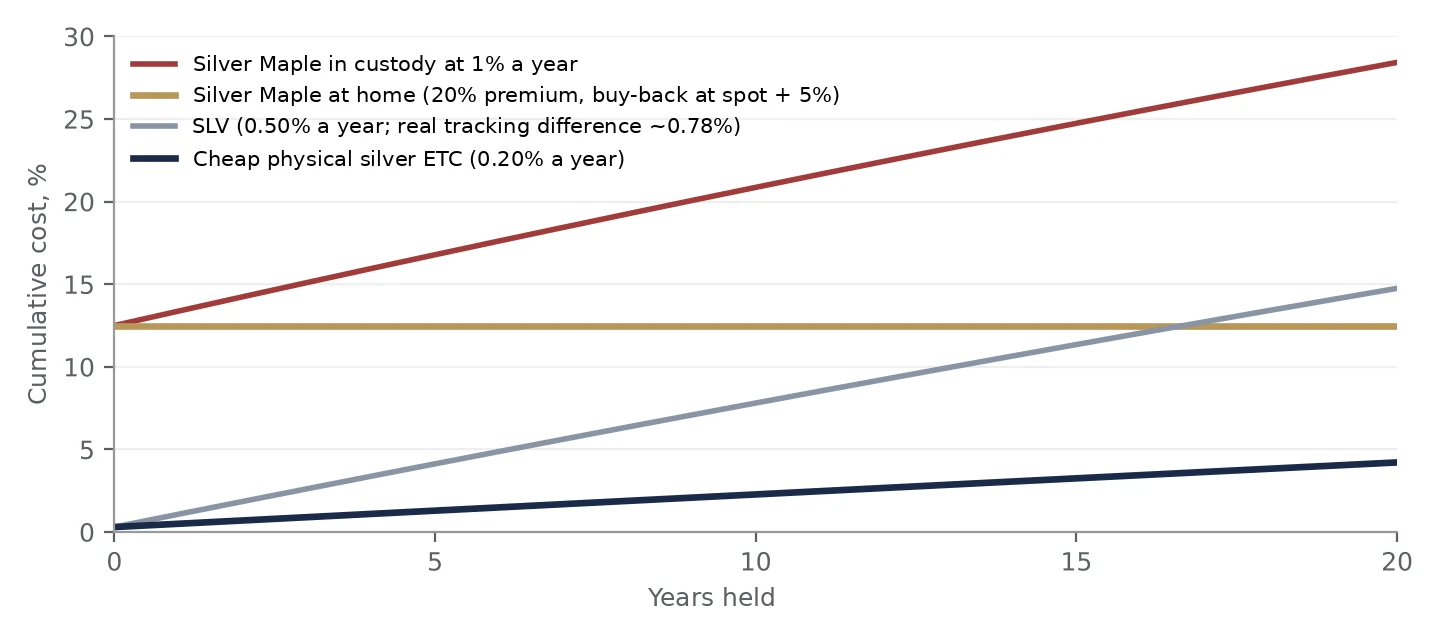
The rule of thumb. In gold, the coin at home is as efficient as an expensive ETF from around 9 years, and with no counterparty. In silver, on cost, it only makes sense as insurance and over many years: to track the price, for positions of a few months or to rebalance with the gold/silver ratio, a physical silver ETC is far more efficient and, for a resident in Spain, it also avoids the 21% VAT.
6. Ranking from most physical to least physical, since 2000
Only the metal and the CEF trust have existed since the year 2000; the other funds were born later. That is why we give two cut-off dates: from January 2000 for whatever has existed since then, and from November 2010, the first month in which all of them exist.
| Format (from most to least physical) | Since Jan 2000 | Since Nov 2010 | Since its launch | The metal over that same period |
|---|---|---|---|---|
| Gold | ||||
| Gold Maple at home | +10.27% | +6.69% | — | — |
| Gold Maple in custody 1% | +9.17% | +5.63% | — | — |
| Mora Physical Gold Fund (MoraBanc) | No public series | No public series | — | — |
| PHYS (Sprott) | — | +5.88% | +7.19% (2010-02) | +8.02% |
| CEF (Sprott, gold and silver) | +9.56% | +4.53% | +9.57% (2000-01) | A mix |
| GLD | — | +6.51% | +10.07% (2004-11) | +10.51% |
| IAU | — | +6.66% | +10.61% (2005-01) | +10.93% |
| DBP (gold and silver futures) | — | +4.99% | +7.66% (2007-01) | +9.44% (gold) |
| UGL (2x gold) | — | +5.91% | +9.85% (2008-12) | +8.92% |
| GDX (gold miners) | — | +3.14% | +4.73% (2006-05) | +9.39% |
| Spot gold, with no costs | +10.43% | +6.96% | ||
| Silver | ||||
| Silver Maple at home | +8.82% | +3.11% | — | — |
| Silver Maple in custody 1% | +7.74% | +2.09% | — | — |
| PSLV (Sprott) | — | +2.28% | +3.32% (2010-10) | +4.85% |
| SLV | — | +3.38% | +6.11% (2006-04) | +6.83% |
| AGQ (2x silver) | — | −10.13% | −1.46% (2008-12) | +8.98% |
| Spot silver, with no costs | +9.38% (Aug 2000) | +3.98% |
Compound annual return in dollars to 5 November 2026, with the purchase and sale of each format included; for the Maple, simulated with today's commercial terms. The MoraBanc fund is, along with Sprott, one of the closest things to holding the metal: it delivers bars from 100 g in Andorra and it is designed to survive the insolvency of the bank; we have not found a public historical series of its value to include it in the calculations.
How to read it. The more physical, the closer the return is to that of the metal, less the premium and the custody. The products with no metal break away: DBP has returned 1.8 points a year less than gold since 2007, because of the cost of rolling futures and because of its silver share; UGL has gained more in the long gold rally, but with 50% drawdowns; AGQ has destroyed value (−1.5% a year since 2008, with silver at +9%), and the miners have returned half as much as gold with more than twice the volatility.
7. How physical behaves in a crash
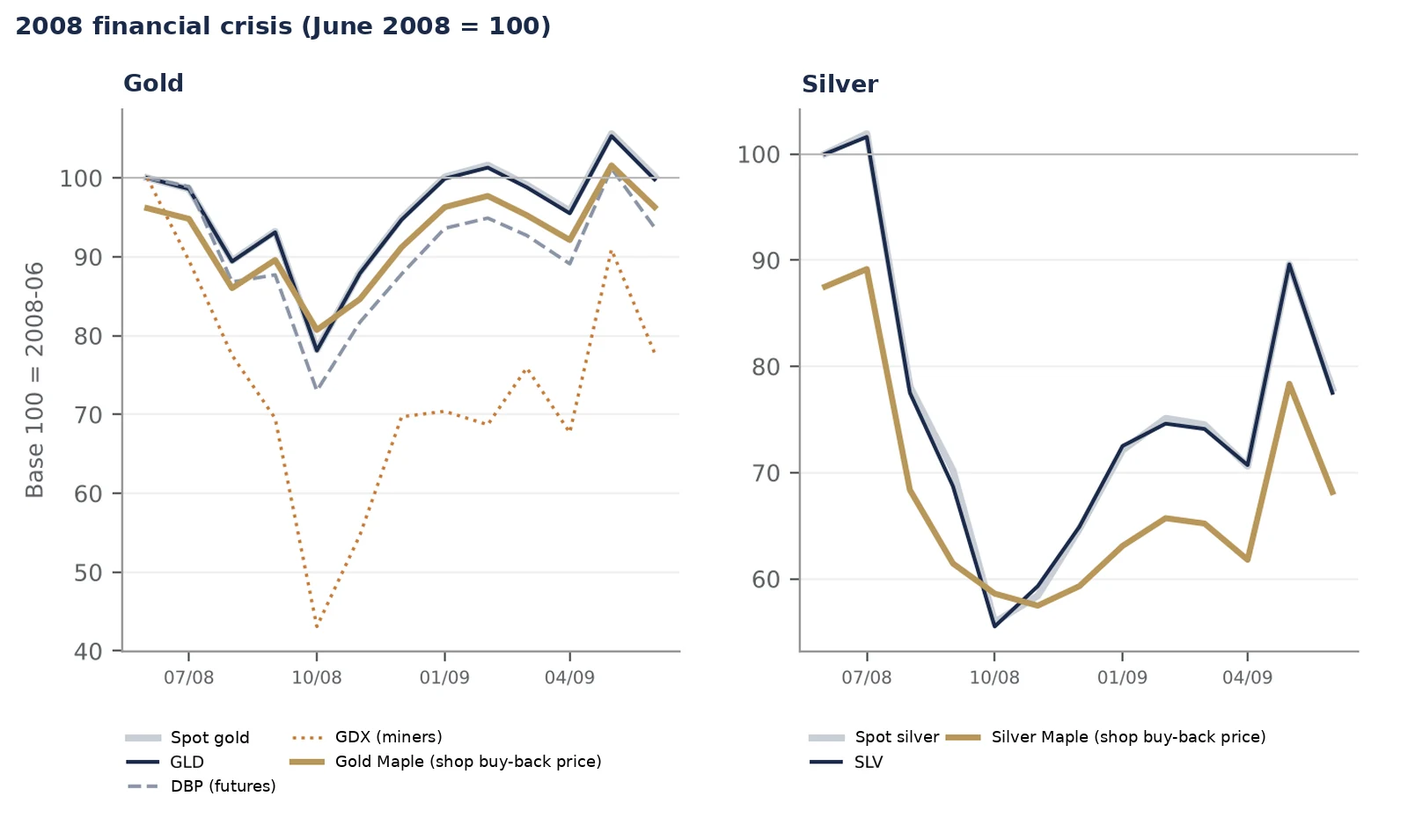
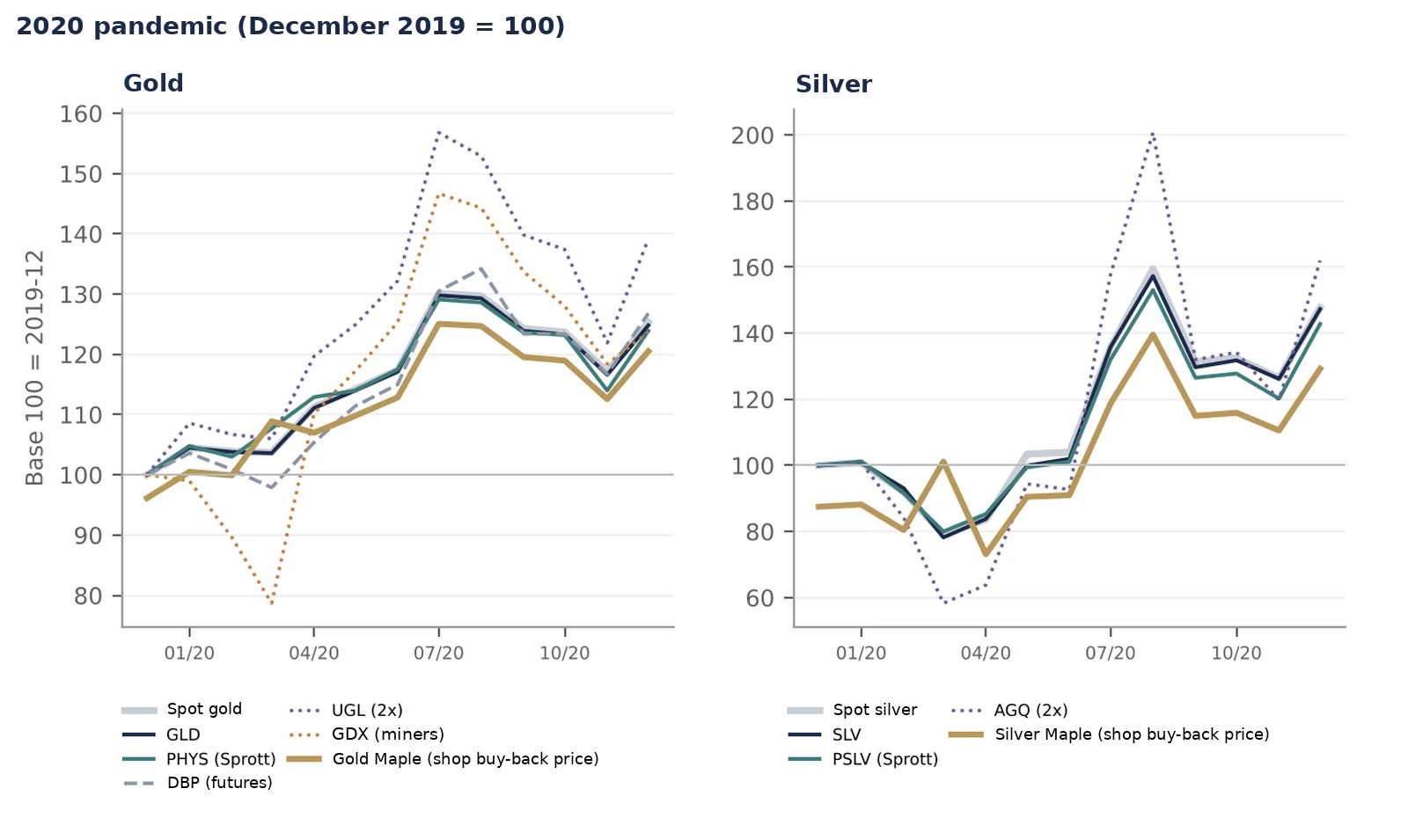
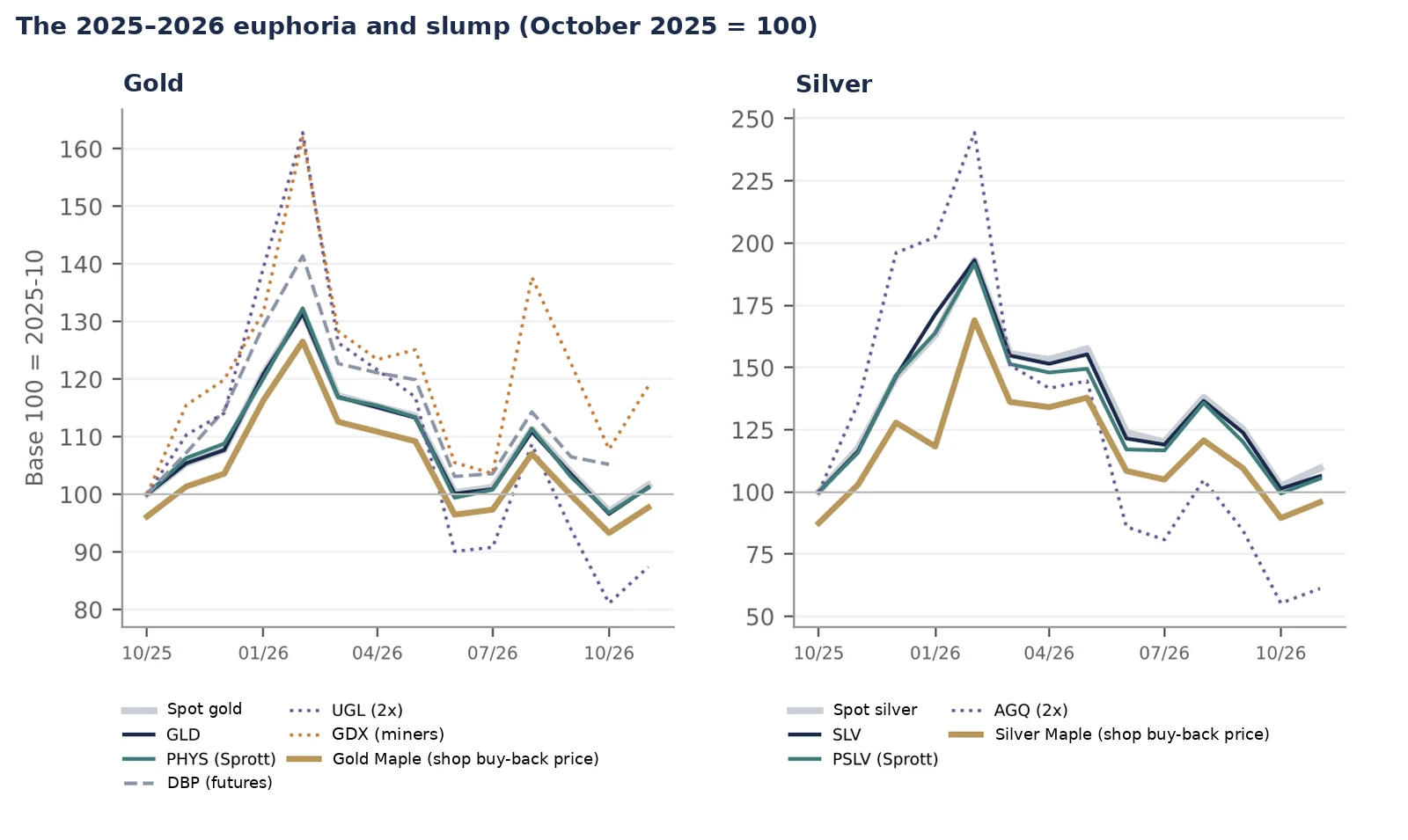
We compare the metal, the Maple valued at its shop buy-back price and the different funds in three crises. The gold line of the Maple starts below 100 because it takes in the gap of the premium. In normal months it uses Andorra Metals' usual buy-back and moves just like the metal. In the crisis months with published data it reflects what happened in the shops: in 2008 and in March 2020 physical was bought back above spot, and in January 2026, below it. We estimate that crisis buy-back from the selling price documented at each moment, less the shop's normal margin (4 points on gold and 15 on silver); for December 2008 and January 2026 we use the published buy-back. On that calculation, in March 2020 the silver Maple would have been bought back at around 50% above spot and the gold one at around 9%, and in October 2008, 26% and 7%. It is an estimate: it assumes the shops kept their usual margin, something that is not documented.
| Maximum drawdown, % (monthly closes) | Gold | Silver | GLD / IAU | SLV | PHYS | PSLV | CEF | DBP | UGL | AGQ | GDX |
|---|---|---|---|---|---|---|---|---|---|---|---|
| 2008 (Feb–Dec) | −25.6 | −50.9 | −25.8 | −51.3 | — | — | −34.9 | −31.9 | — | — | −60.6 |
| 2020 (Jan–Apr) | −0.8 | −21.5 | −0.9 | −22.4 | −1.7 | −21.0 | −5.2 | −5.4 | −2.3 | −42.2 | −20.5 |
| 2026 (Jan–Nov) | −26.3 | −47.0 | −26.5 | −47.5 | −26.8 | −48.1 | −34.7 | — | −50.2 | −77.4 | −36.0 |
With the standard buy-back, the Maple falls in percentage terms as much as its metal (Gold and Silver columns). All the figures use monthly closes; with daily or intraday data they would be larger. DBP 2026: series available to October.
The premium is misleading: who loses more after buying at the peak
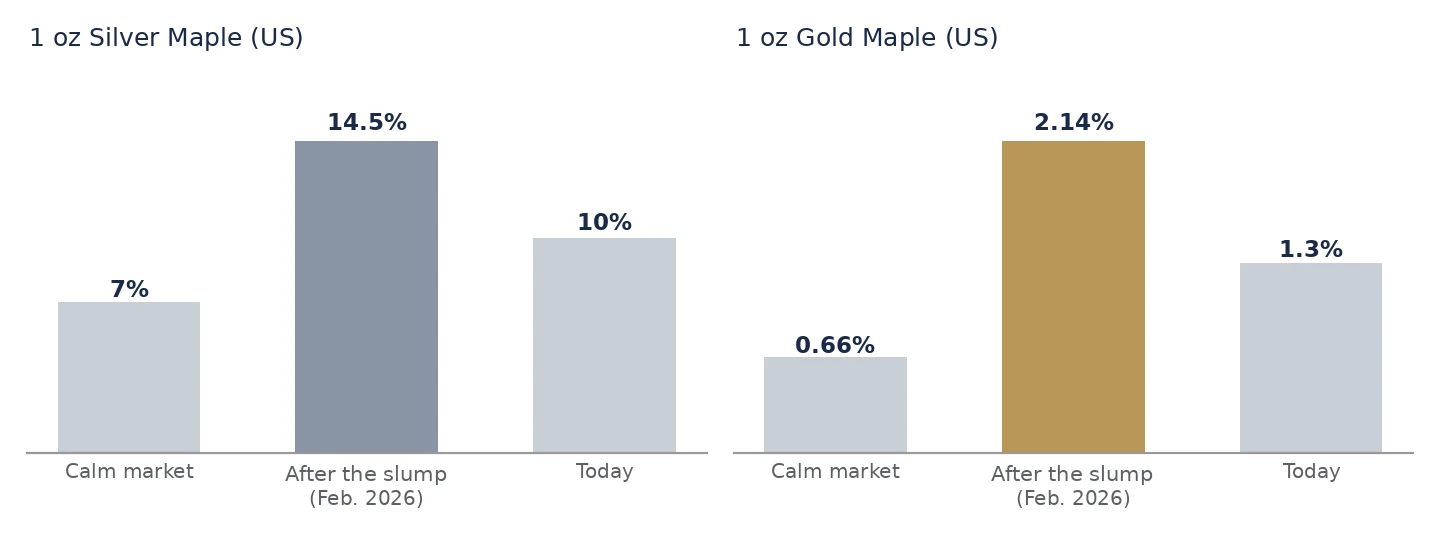
In a crash, the buying premium at the stores rises for a few weeks. If you look at the label, physical seems to fall less, because that label is the price at which the store sells. What matters to whoever holds the coin is the price at which the store buys, and nobody gives you back the premium you paid.
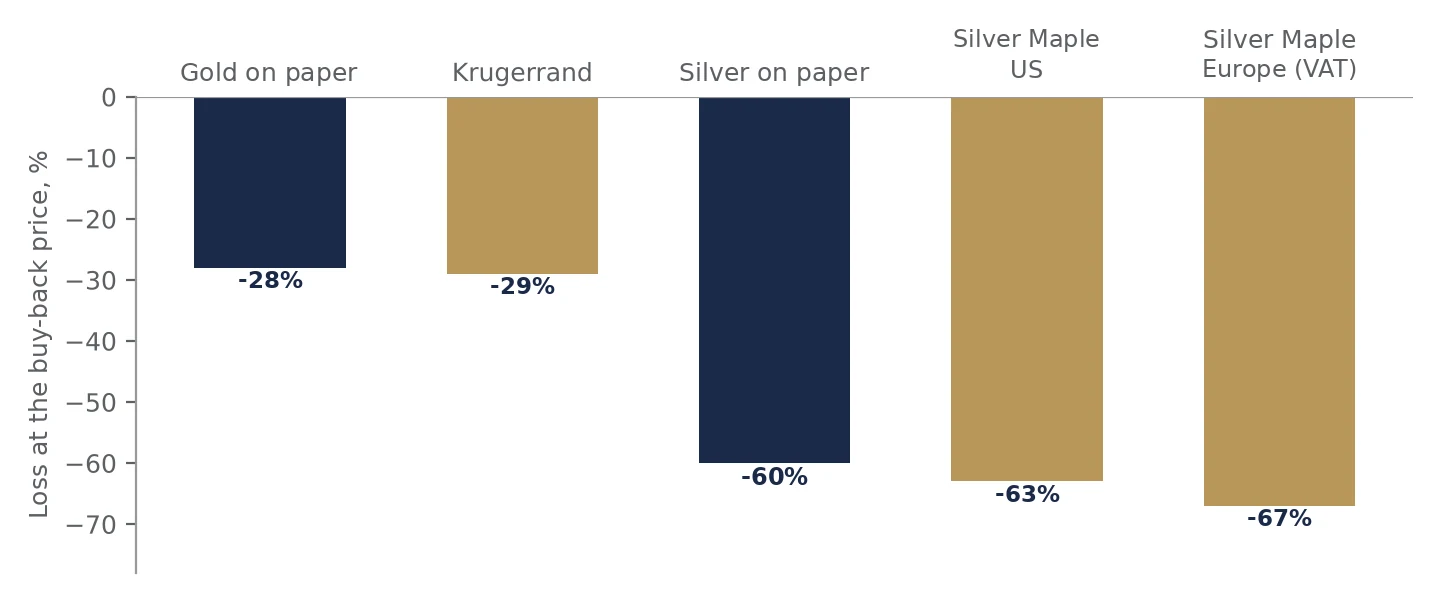
Selling and buy-back prices in the middle of a crisis
What the stores pay when they buy back changes with the type of crisis. In a price crash there is metal to spare and the buy-back gets worse; in a supply crisis metal is scarce and the buy-back rises above spot.
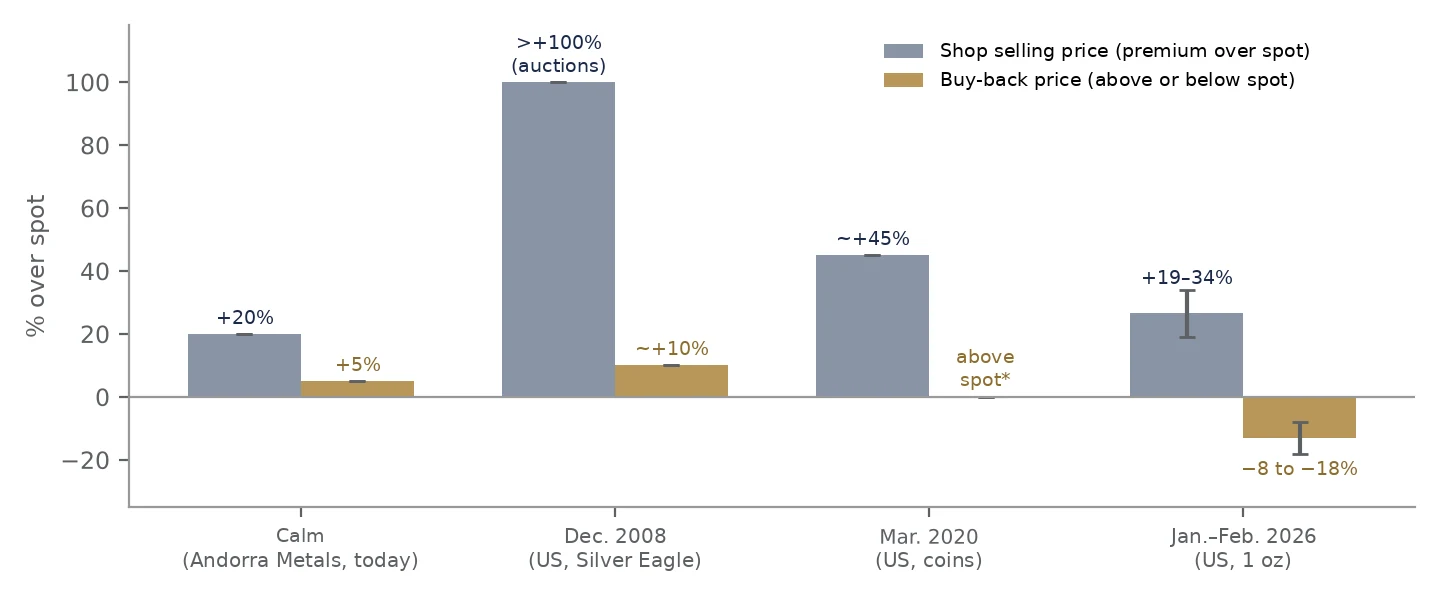
In high-mintage gold (Krugerrand, Maple, Philharmonic, Centenario), the buy-back stayed close to the metal even in the 2026 crashes. In silver, the buy-back gets worse precisely in the panics: in February there were saturated refiners that limited intake, and in Germany, in March, the resale spread on a silver coin reached close to 38%. That is why it is always worth asking the buy-back price before buying, at any store.
Buy-back at spot is not a property of gold. It is a commercial term of each store, ours included, which can change and depends on its liquidity and its solvency. A high selling price in a crisis does not prove that the owner can sell at that same premium: the dealer can widen the spread or limit purchases. The crisis data in this section are advertisements and accounts, not prices of transactions with a date and a volume.
Conclusion on crashes. In percentage terms, the coin falls as much as the metal and as much as the physical ETFs: there is no physical format that “holds up” better in a price fall. What does fall more are the products with no metal: futures, leveraged products and miners. The advantage of physical is behavioural (nobody liquidates your coin over a margin call) and it shows up above all in another type of crisis, when what fails is the system and not the price.
We cover this in more detail in Physical or paper: what happens to gold and silver when the market crashes.
8. Sprott: the premium and the discount
The Sprott trusts are, along with the MoraBanc fund, the closest thing to holding the metal: unencumbered gold and silver at the Royal Canadian Mint and the right to ask for the bars. But, unlike GLD or SLV, they have no banks creating and redeeming units every day, so they trade at a premium or a discount to the value of their metal depending on supply and demand.
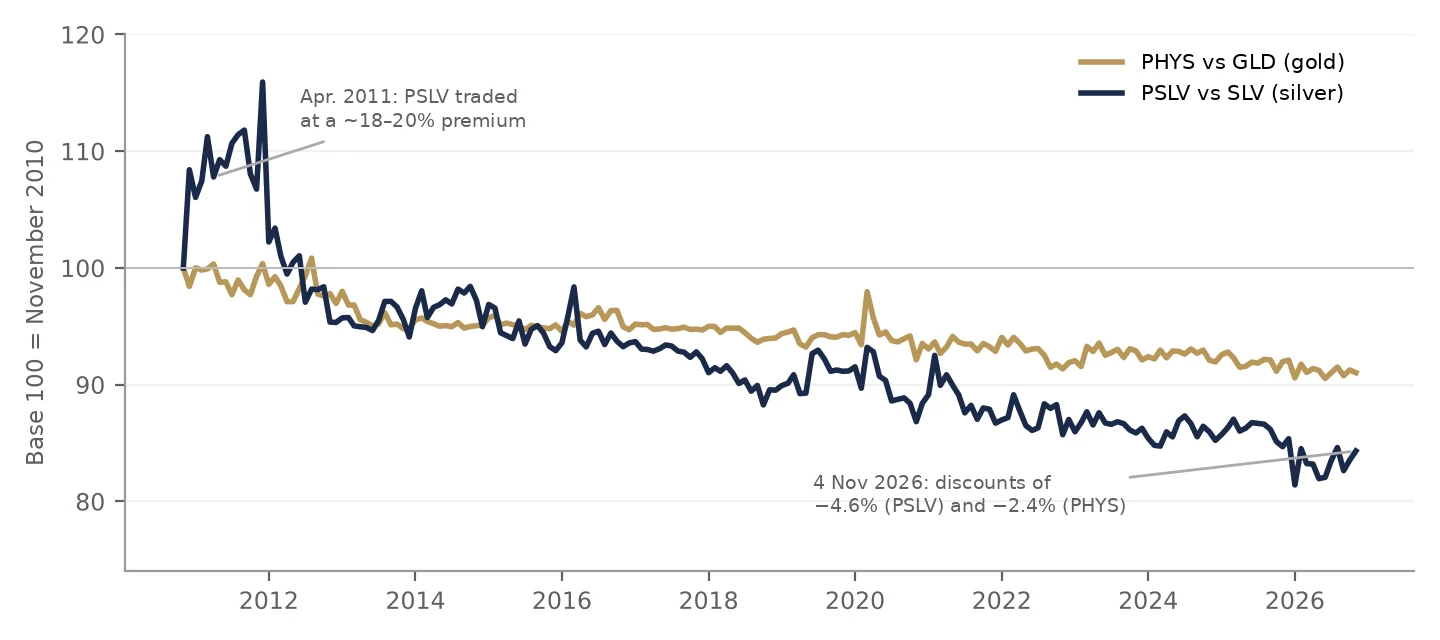
| 4 November 2026 | Price | Value of the metal (NAV) | Premium / discount | 52-week average | 52-week range | 5-year average |
|---|---|---|---|---|---|---|
| PSLV (silver) | USD 16.98 | USD 17.80 | −4.61% | −4.88% | −10.57 to −1.66% | −3.36% |
| PHYS (gold) | USD 30.67 | USD 31.42 | −2.39% | −2.34% | −4.35 to −1.07% | −1.78% |
Source: CEF Connect, PSLV and PHYS. In April 2011, PSLV traded at an 18–20% premium (ETF Trends); in March 2020, at more than a 10% discount during the panic.
What it means. Whoever bought PSLV in 2011 paid almost 20% more than the value of their silver and today gets 4.6% less: that difference explains why PSLV has returned 1.5 points a year less than silver since its launch. Over ten years, PSLV has ended up 10% behind SLV and PHYS 4% behind GLD. The current discount works in favour of whoever buys today, but it shows that the redemption right, with minimums of around 400 oz of gold or 10,000 oz of silver, is not enough to keep the price glued to the metal.
9. Correlation matrix
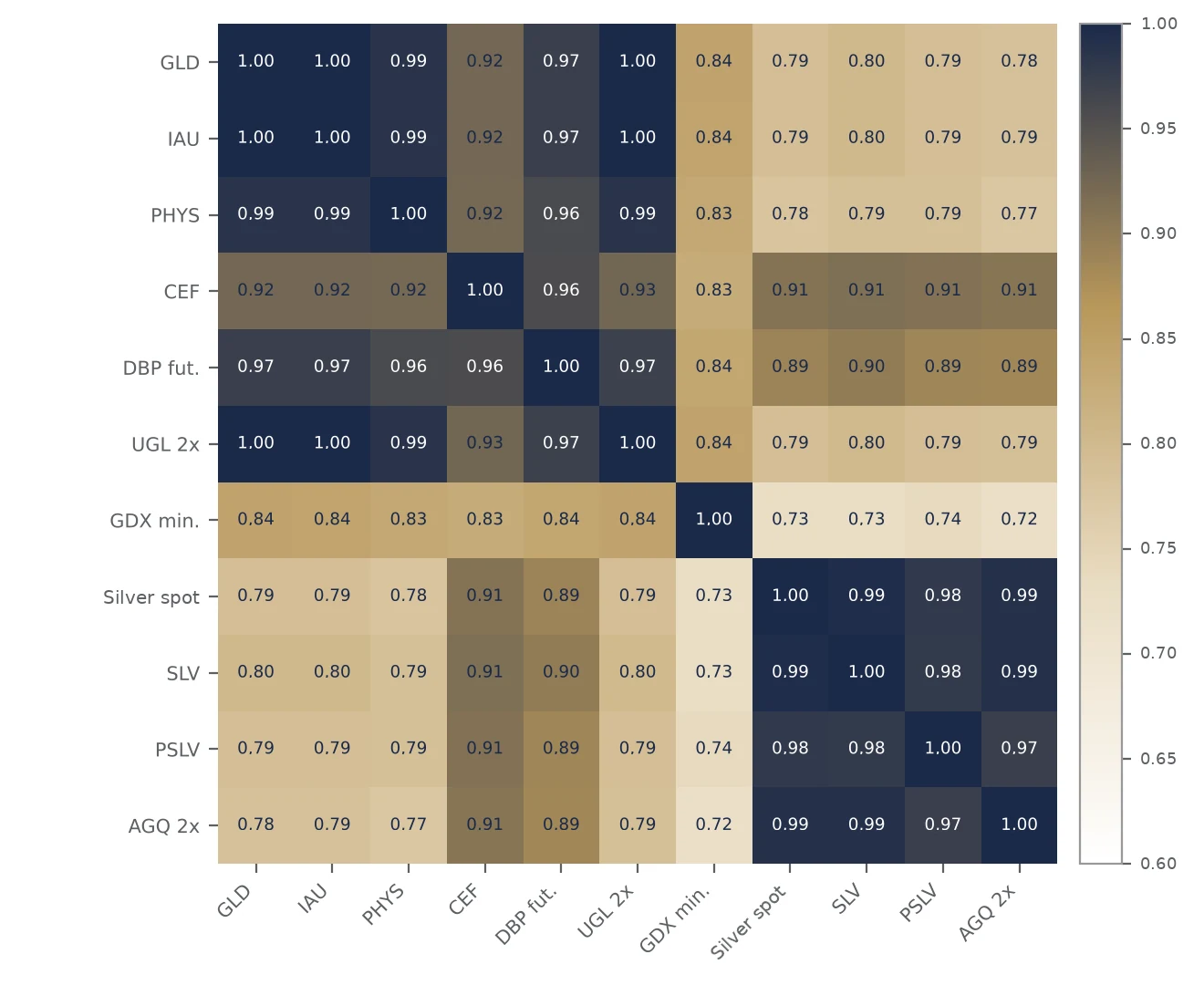
Three readings. First: everything that holds gold inside, or replicates it, moves the same way: GLD, IAU, PHYS and UGL have correlations of 0.99–1.00; leverage does not change the direction, it multiplies the size. Second: the miners (GDX) only have 0.84 with gold, because they are companies with their own costs, their own debt and their own stock market. Third: gold and silver have 0.79; combining them diversifies, and the gold/silver ratio serves to manage that weighting.
Correlation does not measure what matters. Day to day, a physical ETF, a Sprott trust and a coin move the same way. The difference shows up in what correlation does not see: what each one costs every year, how much you can lose with leverage and who holds the metal if something fails.
10. Coins with a collector premium: a better return?
The Mexican Libertad, the Chinese Panda and the Centenario have something the Maple or the Krugerrand do not: a collector market of their own. In silver, that has meant that their price has not fallen with the metal. But two things have to be kept apart: the price at which they are sold and the price at which they are bought back from you.
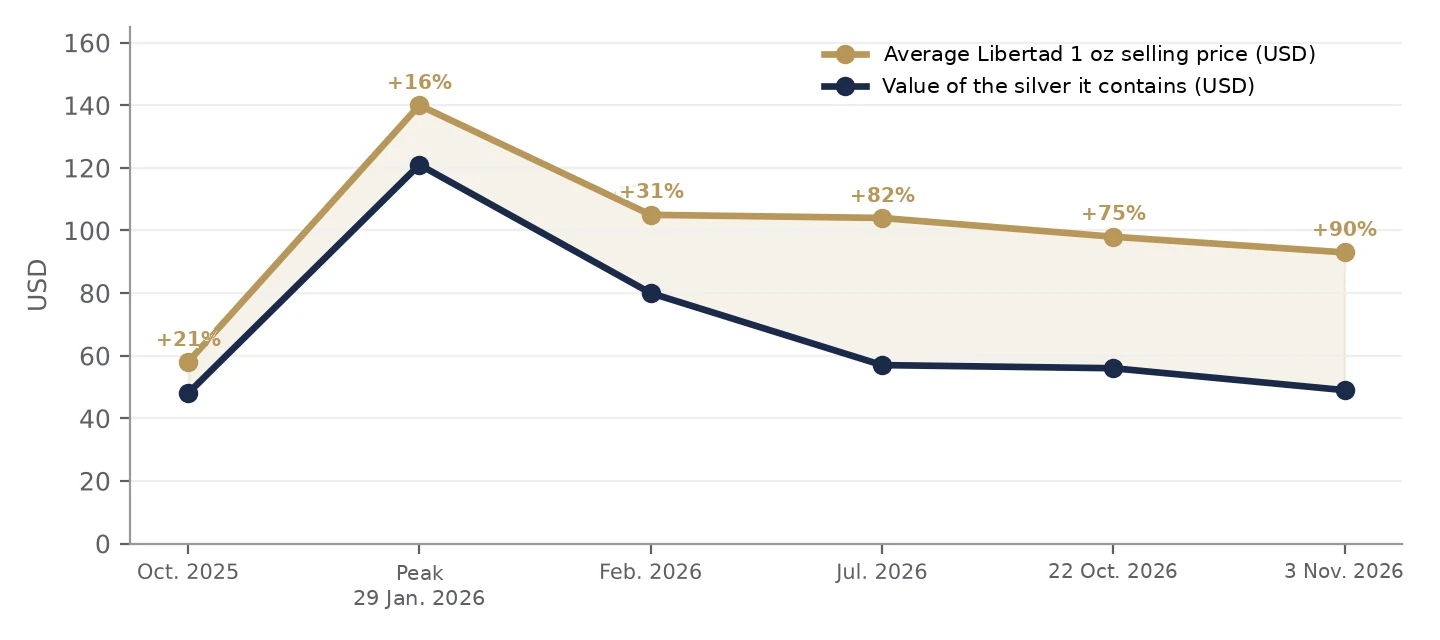
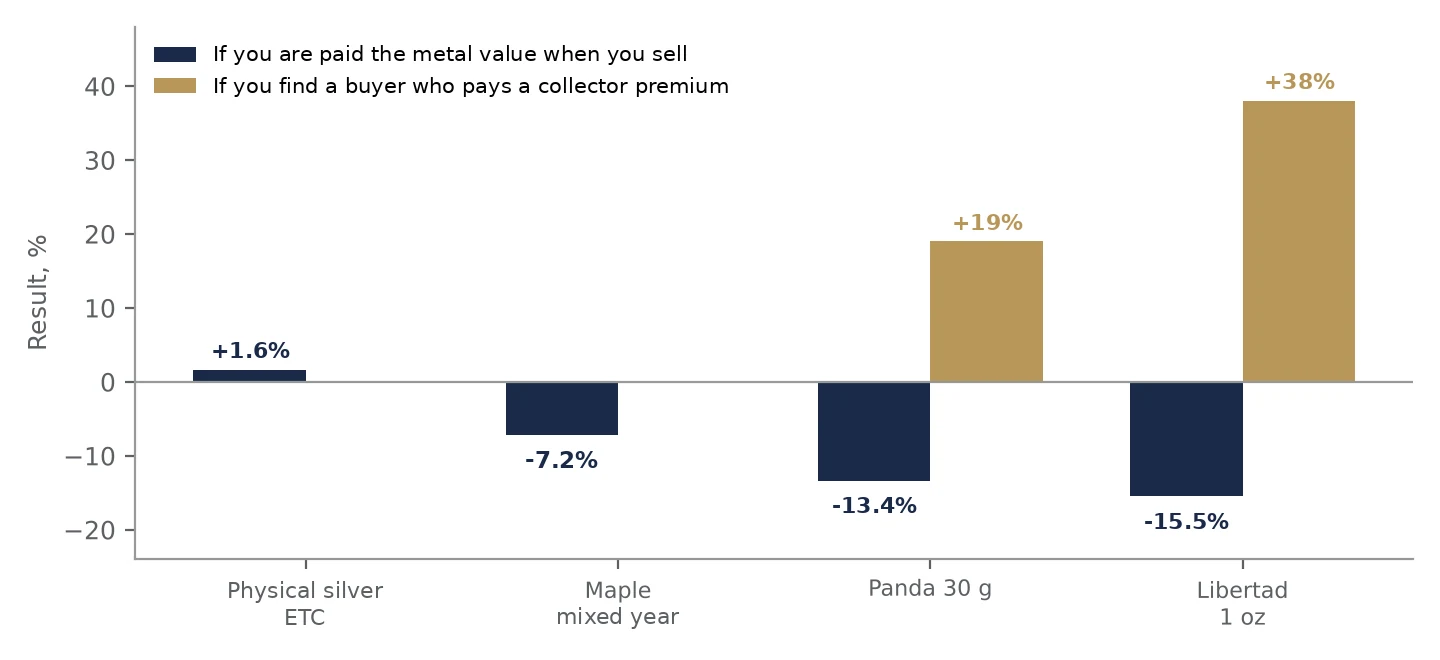
The Libertad went along with silver on the way up, with a premium of 14–21%, and since the crash it has refused to come down: its average price is still around USD 93 with silver at 49, a premium of close to 90%. The Panda repeats the pattern on a smaller scale, from ~18% to ~36% in a year. How much has whoever bought in October 2025 gained? It depends entirely on what price they are bought back at:
| Coin | Selling premium today | If they buy it back at metal | What moves it | Who it suits |
|---|---|---|---|---|
| 1 oz silver Libertad | ~88% (the cheapest US store, ~64%) | You lose almost all of the premium | Very small mintages and collectors in Mexico and the United States | A minority share, long horizon, specific years and grades |
| 30 g silver Panda | ~36% | You lose the premium | A new design every year; possible effect of Chinese export licences (not confirmed) | A collector; not for accumulating silver |
| 50-peso gold Centenario | Minimum premium 1.0–1.4% in calm conditions; 2.4% in November | Bought back as investment gold | 37.5 g of gold per piece; it behaves like bullion | Any gold investor: a lot of gold in a piece with history |
The Centenario is a different thing. It is not a semi-numismatic piece with a collector premium but an investment coin with a lot of gold (1.2057 oz) and more than a century of history, which at its minimum premium has cost the same as a Maple and in the February crash barely moved. Its return is that of gold, with the advantage of its liquidity and its history.
Conclusion on collector coins. The Libertad and the Panda have a double engine, the metal and collector demand, and in 2026 that second leg has held up their selling price. But the higher return only exists if, when you sell, you find someone who will pay the premium: a store that buys back at metal pays you the metal. As a way of accumulating silver they are the worst option of the year; as a numismatic piece, well chosen and with a long horizon, they can make sense for a minority share. At Andorra Metals we specialise in Mexican coinage and we help tell apart years, varieties and NGC and PCGS holders.
More premium data in Which gold coin to buy and Which silver coin to buy.
11. If somebody fails in a major crisis: you never see the ETF's metal
This is the difference that no return chart captures. In an ETF or an ETC the metal exists, but you never see it and they do not deliver it to you: when you sell you receive money. There are two types of crisis, and physical behaves in the opposite way in each one. In a price crisis there is metal to spare and buyers are missing. In a crisis of the system or of supply, factories, mints, platforms or banks fail: metal in hand is scarce, and whoever holds it can sell it above spot. According to accounts from the time, that happened in 2008 and in March 2020; in 2026, several leveraged and unregulated “virtual” gold platforms in Shenzhen froze withdrawals, a different case from a regulated ETF that illustrates the risk of depending on a platform. For those scenarios, this is what the prospectuses say:
| If this happens… | Physical ETF (GLD, IAU, SLV) | European ETC (IGLN, SGLD, PHAG) | Sprott (PHYS, PSLV) | Maple at home | Maple in custody |
|---|---|---|---|---|---|
| The custodian bank fails (JPMorgan, HSBC) | The bars belong to the fund, but a liquidator can freeze them; delays in redemptions | Depends on the prospectus, the security structure and the jurisdiction of each product | Canadian public custodian, not a bank | It does not affect you | Yours if it is allocated and segregated; access can be delayed |
| The issuer fails | Not applicable (trust) | The trustee sells the metal and pays you in money | The trust is wound up; you receive your share | Not applicable | Depends on the contract |
| Panic or emergency | The prospectuses allow redemptions to be suspended with no liability for it | Same; the issuer can close the product with 10–30 days' notice | It can trade at a heavy discount | You decide | A box at a bank can stay shut (Greece 2015: 3 weeks) |
| A shortage of physical metal | Creations jammed; the quoted price can break away | Same | It tends to trade at a premium | It can be sold above spot | Same as at home, if you can withdraw it |
| You want the metal | Not possible for a private investor | No (except for exceptions with a London account) | From ~400 oz of gold or ~10,000 oz of silver | You already have it | You withdraw it under the contract |
Sources: 10-K annual reports of GLD, IAU and SLV; base prospectuses of Invesco, iShares and WisdomTree; PSLV prospectus (linked in our analysis of prospectuses). These are tail scenarios, not the base case: JPMorgan and HSBC are among the most supervised banks in the world, and in the reports reviewed no suspension of redemptions is recorded.
If you choose professional custody, it is worth checking that the metal is allocated and segregated in your name, with a list of pieces; that it does not appear on the custodian's balance sheet and cannot be lent out; that there are physical audits; that the insurance covers market value, and that you can withdraw it within a defined period and at a defined cost.
If the reason for holding gold and silver is a major crisis, the format matters more than the return. A physical ETF gives you the price of the metal while the system works. A coin in your hands is still yours even if a bank, an issuer or an exchange fails, although turning it into money will depend on there being a buyer and at what price, and it has its own risks of theft and custody. That is why they do not compete: the ETF serves to track the price at low cost; the coin, to reduce dependence on intermediaries.
12. So which one is better?
It depends on what you are buying it for. Paper and physical do not compete: they serve different purposes. The table sums up which format usually fits each objective; it is not a personal recommendation, which requires analysing each investor's situation.
| Objective | Format that usually fits | Why |
|---|---|---|
| Tracking the price of gold at the lowest cost | A cheap physical ETC (IGLN, SGLD) | 0.12% a year; cheaper than the coin for around 30 years |
| Tracking the price of silver, or positions of a few months | A physical silver ETC | It avoids the 12.5% premium gap and, in Spain, the 21% VAT |
| Insurance against a crisis of the financial system | High-mintage physical gold at home or in a fixed-rent box | No issuer, no custodian, no exchange; in the ten-year simulation, level with GLD |
| The closest thing to the metal without keeping it at home | Sprott (PHYS, PSLV) or the MoraBanc fund | Unencumbered metal and the right to ask for it; with Sprott, watch the premium |
| Silver as insurance | A Maple or a 1 kg bar, long horizon | It is the one that breaks away most from paper in the real crises, but the premium is not recovered on cost |
| Gold with history, without paying a collector premium | A 50-peso Centenario | Investment-coin premium; it is bought back as gold |
| A numismatic interest with potential | A Libertad in specific years, only a share | A double engine, but the premium depends on finding a buyer |
| A higher return by taking more risk | Neither leveraged products nor miners as a substitute for metal | Drawdowns of 36% to 77% in 2026; AGQ has destroyed value since 2008 |
| Custody at 1% a year | Only if you cannot keep it yourself | It is the most expensive physical format over any period |
A common combination is a simple one: a core of your own physical gold for the extreme scenario, bought in calm conditions and not in the days that follow a crash, when premiums jump; and the tactical part in low-cost physical ETCs, to track the price and rebalance with the gold/silver ratio. The moment you buy weighs more than the format. The context in section 1 (energy, peak oil, El Niño and debt) may lead an investor to review the weight of metals in their portfolio and what share they want in physical. Whether metals fit and in what proportion depends on the objective, the horizon, the rest of the assets, the taxation and the residence of each investor, and it requires individual analysis.
If you want to see, at the day's prices, which combination makes sense in your case, book an appointment at Andorra Metals: Carrer Pau Casals, 8, Edifici Cornella II, Andorra la Vella.
Transparency and method
This article is published by Andorra Metals, which sells physical gold and silver and has an interest in that format. It is not independent research. The simulations are hypothetical, they use monthly data (which smooths out the extremes of a single day) and some figures come from approximate readings of charts or from commercial sources, as indicated in each case. We use our real buying and buy-back prices, we say what paper does better and we acknowledge that, on cost, the cheap ETF beats the coin for many years. Past returns do not guarantee future ones. Taxation depends on each investor's residence.
Method: adjusted monthly closes in dollars from November 2016 (or from the date indicated) to 5 November 2026. Silver spot: front-month COMEX future. Gold spot: price implied in GLD net of its 0.40% fee; before November 2004, World Bank monthly average. Maple simulation: purchase at spot × (1 + premium), sale at spot × (1 + buy-back), custody deducted monthly. ETFs: market price plus 0.3% round trip. Correlations on monthly log returns.
Sources
- Monthly closes (Yahoo Finance via digrin.com): GLD, IAU, SLV, PHYS, PSLV, CEF, DBP, UGL, AGQ, GDX, silver future (SI=F)
- World Bank, monthly gold price, via Datahub
- CEF Connect – PSLV and PHYS
- streetTRACKS Gold Trust (GLD) prospectus, SEC, 2007
- ETF Trends – PSLV trades at nearly a 20% premium (2011)
- WMO – El Niño/La Niña Update (August 2026)
- IRI, Columbia University – ENSO Quick Look (September 2026)
- Premiums and buy-backs: FindBullionPrices and goldsilver.ai (the United States), gold.de (Europe), Kettner Edelmetalle and Bitcoin.com News (buy-backs under stress), Market Oracle (2008), Money Metals and FXStreet (2020); Andorra Metals premium studies.
- Energy and macroeconomic context: our own compilation as of 6 November 2026 of data attributed to the IEA, EIA, Kpler, ANZ, WGC, IIF, CBO, the Silver Institute, Turiel (CSIC), Capellán (GEEDS), Laherrère and Coyne; it is worth checking them against each original publication before reusing them.
- Andorra Metals prices: premium ranking of 2 November 2026.
This article is for information only and does not constitute personalised investment advice. Version of 6 November 2026.
Work out the gold/silver ratio Our calculator tells you how many ounces of silver an ounce of gold costs today, with live prices, and whether the ratio is high or low against its historical average.
Open the calculator →Would you rather hold the metal in your hand? We see clients by appointment in Andorra la Vella to show gold and silver bars and coins, compare premiums piece by piece and answer your questions with no obligation.
Book an appointment →