Which silver coin to buy: what the 2025–2026 premiums teach us
If you are about to buy your first silver coin to hold for several years, the best choice on the 2025–2026 data is a high-mintage sovereign coin in random-year form (Maple Leaf, Britannia, Kangaroo or Philharmonic), bought in a calm phase. We explain it with 17 charts of US dealer premiums, the price list of a European shop and what is being argued in forums across five regions.
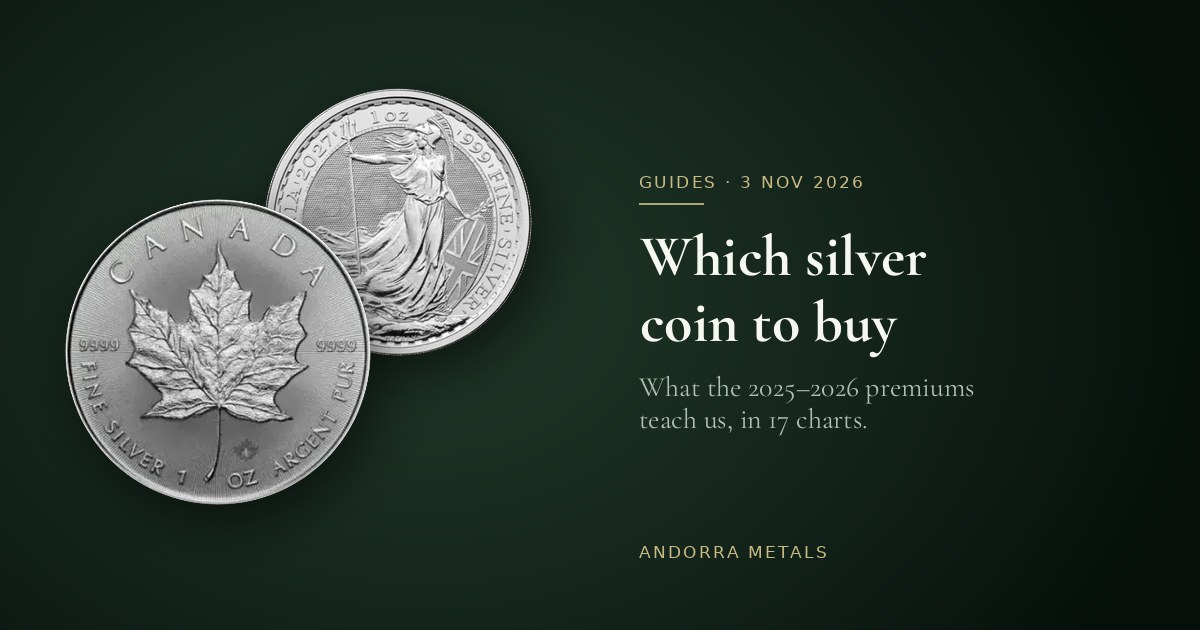
Our recommendation for your first silver coin
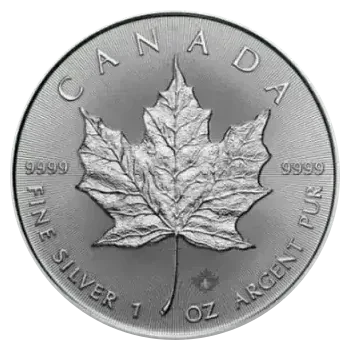
Pick a 1 oz random-year Canadian Maple Leaf. If none is available, a random-year Britannia, Kangaroo or Philharmonic does the same job. Buy it in a calm phase, not in the days that follow a sharp price move, and think of it as a several-year investment.
Why the random-year Maple
- It carries the lowest premium in calm markets. In the US its minimum premium runs at 5–8% and its average at 10–12%. In the price list of a European shop it is the cheapest 1 oz coin: 19.4% over metal (taxes included), against 22.9% for the Krugerrand, 24.4% for the Silver Eagle and 29.6% for the Libertad.
- It returns to its normal price quickly after a panic. After the January 2026 crash its premium was back to normal in about three months, because it is the coin that comes back to the market most through buy-backs.
- It sells anywhere. 9999 silver, recognised by any dealer in the world and the best seller in markets such as Singapore. When you sell, it is bought back at a small discount.
- Random year is the cheapest version of any coin. The current year costs 2–4 points more, and an old specific year can cost up to 24 points more, with no extra silver inside.
What to avoid on your first purchase
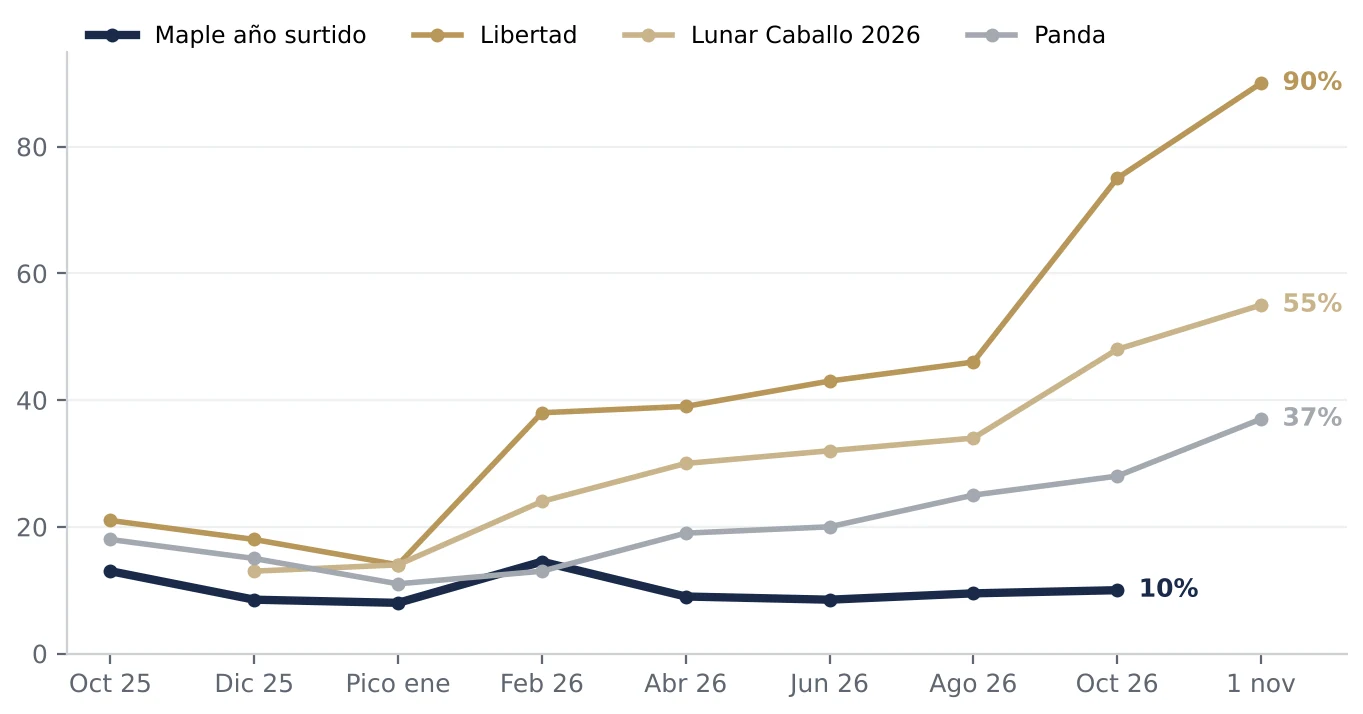
“Special” coins look attractive, but their premium does not come back: it builds up. In one year the Libertad went from ~21% to ~90%, the 2026 Lunar Horse from ~13% to ~55% and the Panda from ~18% to ~37%, while the Maple kept returning to its ~10%. That extra price is collector money: nobody guarantees that someone will pay it to you when you want to sell.
| Avoid | Why | Typical premium |
|---|---|---|
| Collector or semi-numismatic coins (Libertad, Lunar, Panda) | Their price does not fall with the metal; the premium builds up and the buy-back is uncertain | 37–90% today |
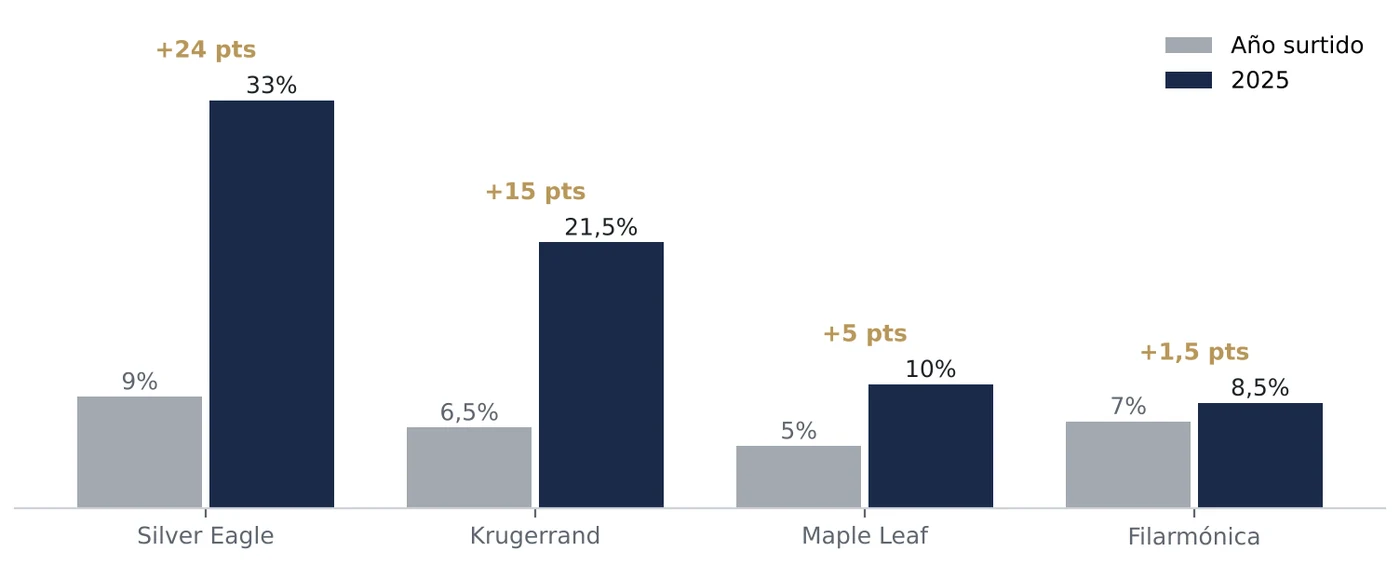
| Old specific years (Eagle 2025, Krugerrand 2025) | They are not refilled by buy-backs; the premium stays high | +5 to +24 points over random year |
| Small bars and fractions (1 oz, 50 g, ¼ oz) | In Europe they pay full VAT and have little buy-back | 30–37% in a European shop |
| Silver Eagle outside the US | Brand premium that you do not recover in Europe | +4–5 points over the Maple |
When to buy
- Never in the days that follow a crash. After the 30 January fall, premiums hit their yearly high between 2 and 20 February.
- The best moment is when the public sells. In May 2026, with the wave of buy-backs, the average premium fell to ~8 USD per coin, the lowest of the year.
- Today (3 November 2026) minimum premiums are in cheap territory and averages are at their normal level, with silver at ~49 USD. It is the best moment since May to start.
- Buy in several instalments. Spreading the purchase over several weeks or months averages out both the silver price and the premium.
Coin or bar first? And in what proportion
Coins first, always. The first purchase should be a 1 oz random-year sovereign coin, for four reasons that come out of the data:
- It is cheaper than the small bar. In a European shop the Maple costs 19.4% over metal and the 1 oz bar 36%; in the US the 1 oz bar is not cheaper than the coin either.
- It is sold in parts. With coins you can sell one or ten depending on what you need; a kilo bar is sold whole.
- It is bought back anywhere. Sovereign coins are recognised worldwide and come back quickly to their normal premium after a panic.
- The large bar only pays off if it is cheap. In the US there are buy-back kilos at 4–8% and new branded kilos at 30–35%. In Europe the kilo is barely one point below the Maple (18.6% against 19.4%) because it pays full VAT.
The bar comes later, when the position is large. A prudent rule is that no single piece should weigh more than 20–25% of what you hold in silver. A kilo is worth about €1,900–2,000 today, so the first bar makes sense from about €8,000 in silver.
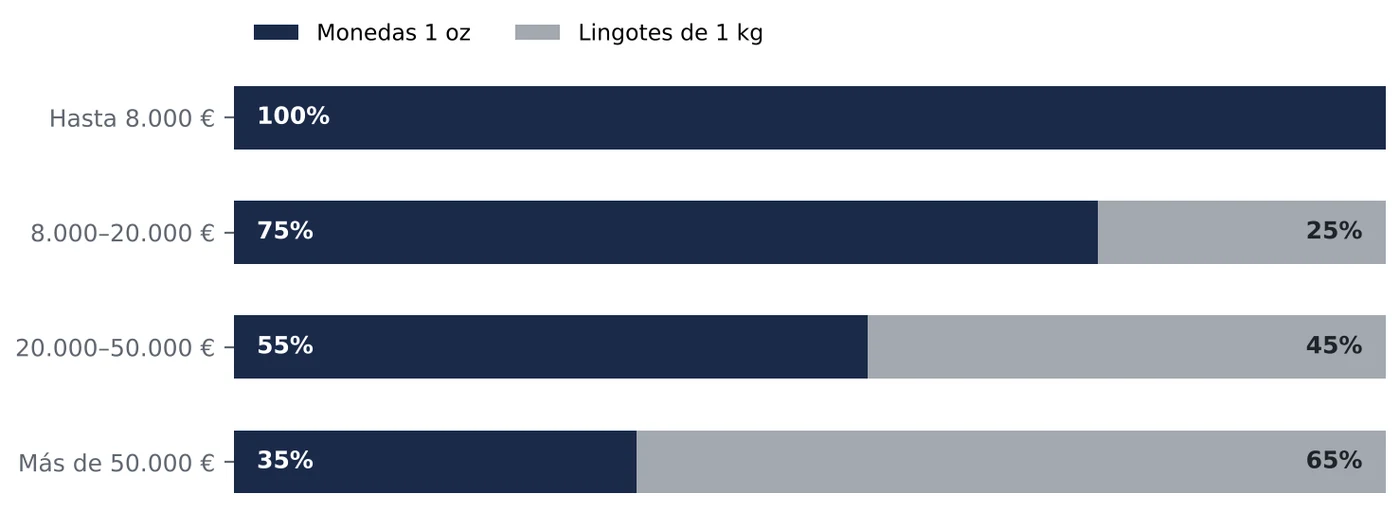
| Total silver | 1 oz coins | 1 kg bars | Why |
|---|---|---|---|
| Up to €8,000 | 100% | 0% | One kilo would be more than 25% of the position |
| €8,000–20,000 | 70–80% | 20–30% | One or two kilos to bring down the average cost |
| €20,000–50,000 | 50–60% | 40–50% | The kilo's premium saving starts to matter |
| Over €50,000 | 30–40% | 60–70% | Keep at least a third in coins so you can sell in parts |
Two caveats. In Europe the kilo's price advantage is small, so it makes sense to stay at the top of the coin range in each band. In the US, or wherever there are cheap buy-back kilos, you can go to the top of the bar range. In every case, avoid bars under 250 g and the 5 and 10 oz formats unless their premium is clearly below the coin's.
What to expect
The premium is a cost that silver has to recover before you make money. If you resold at metal price, silver would have to rise ~5–10% in the US or ~20% in Europe (because of taxes) just to break even. And silver is very volatile: in 2026 it went from 121 USD to under 50 in nine months. Only buy with money you can hold for several years.
This article is informational and does not constitute personalised investment advice.
November 2026 update
Silver has kept falling, from ~54.6 to ~49.1 USD in ten days (−10%), and on 3 November it was still at ~48.8 USD. Premiums have not spiked: almost all of them are at or below their historical average. The early signal of buying into the fall that we saw on 22 October has not been confirmed, at least not on goldsilver.ai.
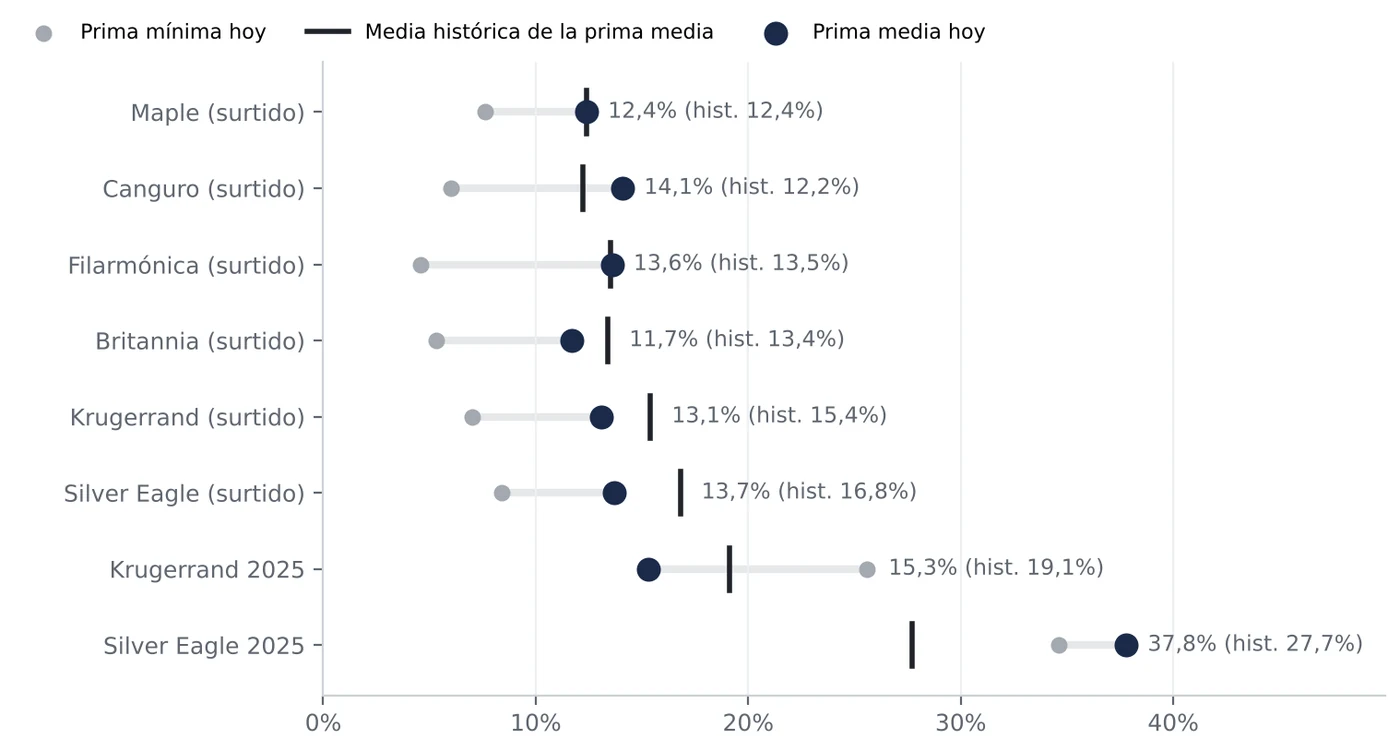
- Minimum premiums in cheap territory across all random-year coins: 4.6–8.4% on 3 November (Philharmonic 4.6%, Britannia 5.3%, Kangaroo 6.0%, Krugerrand 7.0%, Maple 7.6%, Silver Eagle 8.4%). The site itself classifies them all as “Cheap”.
- Average premiums at their normal level: 13.1–14.1% in the pages updated on 3 November. Since spot has fallen 10% and the percentage has barely risen, in dollars the average premium is still low: about 6–7 USD per coin. The only one above its historical average is the Kangaroo (14.1% against 12.2%), and only just.
- The random-year Krugerrand is the best relative opportunity: average premium of 13.1% against a historical average of 15.4%.
- On 1 November one dealer (MintBuilder) was selling Maples almost at spot (0.2%). It was a two-day offer: on 3 November the cheapest Maple is already at 7.6%. Bargains like this run out fast.
- The Silver Eagle 2025 is still the exception: average premium of 37.8% on 3 November (32.2% on the 1st), above its historical average (27.7%) and classified as “Elevated”. The Sprott Money offer at 17% is gone and the minimum is back to 34.6%: it keeps getting dearer.
- The Krugerrand 2025 is coming down in earnest: average premium of 15.3% on 3 November against ~21% in October, although the cheapest offer (5.3%) again looks like a misassigned random-year listing.
- The Libertad 2024 is out of stock at every dealer tracked.
- FindBullionPrices confirms it with a different dealer sample. The average premium of its silver coin basket has jumped from ~19.5% on 22 October to ~22.5% on 1 November (on 3 November it was still at ~22%), close to the yearly high in percentage terms. The lowest prices on 3 November, with silver at 48.99 USD, match goldsilver.ai: Philharmonic and Kangaroo from 51.25 USD (~4.6% premium) and Britannia from 51.51 USD (~5.1%). But in dollars it is still at ~11 USD per coin, the same as ten days ago: the jump is arithmetic, caused by the fall in spot, not by more demand.
- The random-year Philharmonic hits its yearly high in percentage terms on FindBullionPrices: average premium of ~14.3% on 1 November, against ~11.8% on 22 October and ~12.8% in February. In dollars, by contrast, it only goes from ~6.6 to ~7 USD per coin, far from February's ~10.5 USD. It is mostly arithmetic, with a small real rise worth watching.
- The Philharmonic 2026 stays at ~11.5% (~11% on 3 November), below the random-year coin (~14.3%). In dollars it even falls, from ~6.7 to ~5.6 USD per coin. This is the case the current-year rule describes: when the random-year premium rises, the mint's continuous supply leaves the new coin cheaper. Today, whoever wants Philharmonics in the US pays less for the 2026. The Kangaroo 2026 does the same: on 3 November its average premium is ~11% (~5.4 USD per coin), after a one-off rise to ~11.5% at the end of October, against ~14.1% for the random-year Kangaroo. It has been in a narrow 8.5–11.5% band since June.
- The Britannia 2026 does not repeat the Philharmonic case: it rises from ~13.5% to ~15.5% (in dollars, ~7.6 USD per coin on both dates) and stays about 4 points above the random-year Britannia (~11.3%). British buy-backs keep the random-year coin as the cheap option. On 3 November the 2026 falls to ~14.7% (~7.2 USD per coin), and the gap with the random-year coin (~11.2%) remains at about 3.5 points.
- The Krugerrand 2026 is coming down: after a one-day spike it ends at ~10.5% against ~12% on 22 October; in dollars, from ~6.7 to ~5.1 USD per coin. Along with the Philharmonic 2026, it is one of the cheapest things on the US market today, below even the random-year Krugerrand (average premium of 12.7% on goldsilver.ai). On 3 November it is still at ~10.5%, about 5.1 USD per coin.
- The random-year Britannia, pure arithmetic: average premium from ~10% to ~11.3% on FindBullionPrices, but in dollars it stays at ~5.5 USD per coin, the same as on 22 October. On 3 November it is still at ~11.2%: inside its range for the year (~6.5% in May, ~14.5% at the February peak) and far from any tension.
- The Maple (generic page), pure arithmetic: average premium from ~12.5% to ~14.3%; in dollars, ~7 USD per coin on both dates. On 3 November it is still at ~14%: above its calm band (~10–12.5%), but a long way from February's ~19.5%.
- The random-year Maple, almost the same: average premium from ~10% to ~12%; in dollars, from ~5.6 to ~5.9 USD per coin. On 3 November it marks a one-off rise to ~12.3% and comes back to ~11.7% (~5.7 USD). It is at the level of the July rise (~11.5–12%) and well below the February peak (~14.7%), and in dollars it barely moves.
- The random-year Kangaroo, the most stable: average premium from ~10.5% to ~11%; in dollars it falls from ~5.9 to ~5.4 USD per coin.
- The random-year Silver Eagle, almost the same: average premium from ~12.5% to ~15% on FindBullionPrices; in dollars, from ~7 to ~7.4 USD per coin. On 3 November it is still at ~15–16%. The monthly summary on its own page, which uses the cheapest dealer's premium, gives 7.7–7.9% so far in November, against an average of 5.3% in October: the minimum premium has also risen about 2.5 points, partly because of the fall in spot.
- The Silver Eagle (generic page) is still the most expensive bullion coin: average premium from ~17% to ~18.5%, with ~9 USD per coin on both dates, about 4–5 points above the Maple (generic page, ~14.3%). On 3 November, after touching ~18.8%, it ends at ~18% (~8.8 USD): at the level of its July rises, but far from February's ~22.5%.
- Summing up the FindBullionPrices bullion series: percentage premiums rise across the board because spot has fallen 10%, but in dollars they move between 0 and +0.4 USD per coin. It matches goldsilver.ai: there is no panic buying, and dollar premiums are still low.
- The Chinese Panda keeps its ratchet effect: average premium from ~28% to ~37% in ten days. Its average price is still anchored at ~65 USD while the coin's metal (30 g) falls to ~47 USD. In dollars the premium really does rise, from ~15 to ~18 USD per coin: it is the only series where this is not just arithmetic. On 3 November, after touching ~37.5%, it ends at ~36% (~17 USD per coin): double what it was a year ago (~18%) and at highs if you exclude October's artificial ~52% stretch.
- The random-year Libertad, the same: average premium from ~75% to ~90%, with the average price at ~93–95 USD and the metal at ~49. In dollars the premium holds at ~43–45 USD per coin: the price does not fall even when silver does. On 3 November it is still at ~88% on average (~92 USD), but the cheapest dealer has brought it down to ~80 USD (~64%): just as with the Lunar, there is more than 10 USD per coin between shops.
- The 2026 Lunar Horse, from ~48% to ~55%: its average price falls a little (from ~85 to ~77 USD), so in dollars the premium holds at ~27 USD per coin. On 3 November it brushes ~56% and ends at ~55%. Note the detail: the cheapest dealer sells it at ~52 USD, barely 6% over metal, while the average sits at ~76 USD. In these coins the spread between shops is enormous and comparing prices is worth more than in any other. The three collector coins (Libertad, Panda and Lunar) close the month with premiums of 37–90%, against ~12% for bullion coins.
And the bars? The FindBullionPrices silver bar basket disproves the idea that in the US the bar is always the cheap option. Its average premium was between 14% and 24% for most of the year, equal to or above the coins', and jumped to ~24% after the February crash. Only in the last week of October did it come in below (~16% against ~22.5%).
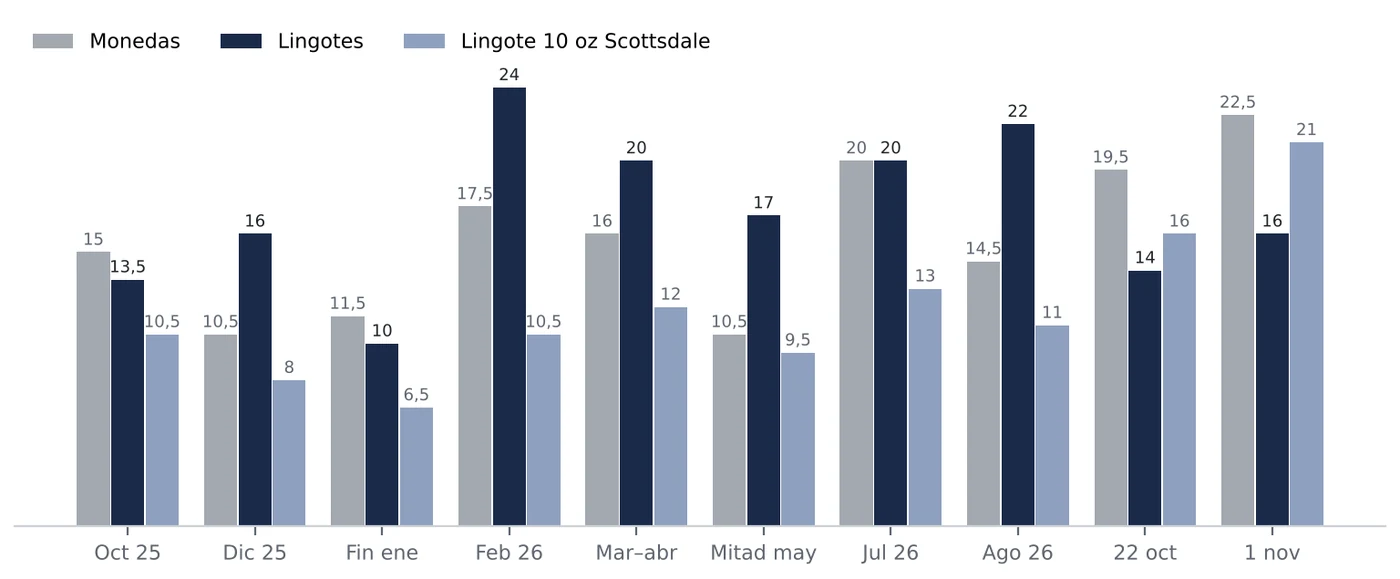
The bar series is very noisy: it jumps 8–10 points from one day to the next because the basket mixes 1 oz, 10 oz and 1 kg bars, and changes depending on which dealers have stock. It is useful for seeing the level, not for picking the day to buy. One specific product, the Scottsdale 10 oz bar, confirms it: in calm markets its average premium sits at 10–13%, like a 1 oz random-year coin and below the average of the coin basket, and it repeats the usual pattern (~6.5% at the peak, ~10.5% after the crash). Its final jump to ~21% should be treated with caution: since the end of September its maximum price has been frozen at ~730 USD, one dealer not updating prices and inflating the average while silver falls. The practical rule does not change: the bar only pays off in large format (1 kg or 100 oz), and in Europe also because of VAT.
The specific case of the PAMP Suisse 1 kg bar qualifies that rule. Before the peak its average premium was at 10–15%; after the crash it jumped to ~24% and, since data resumed in September, it has not gone below 30%. Today it is around ~35%, about 600 USD per kilo over metal value.
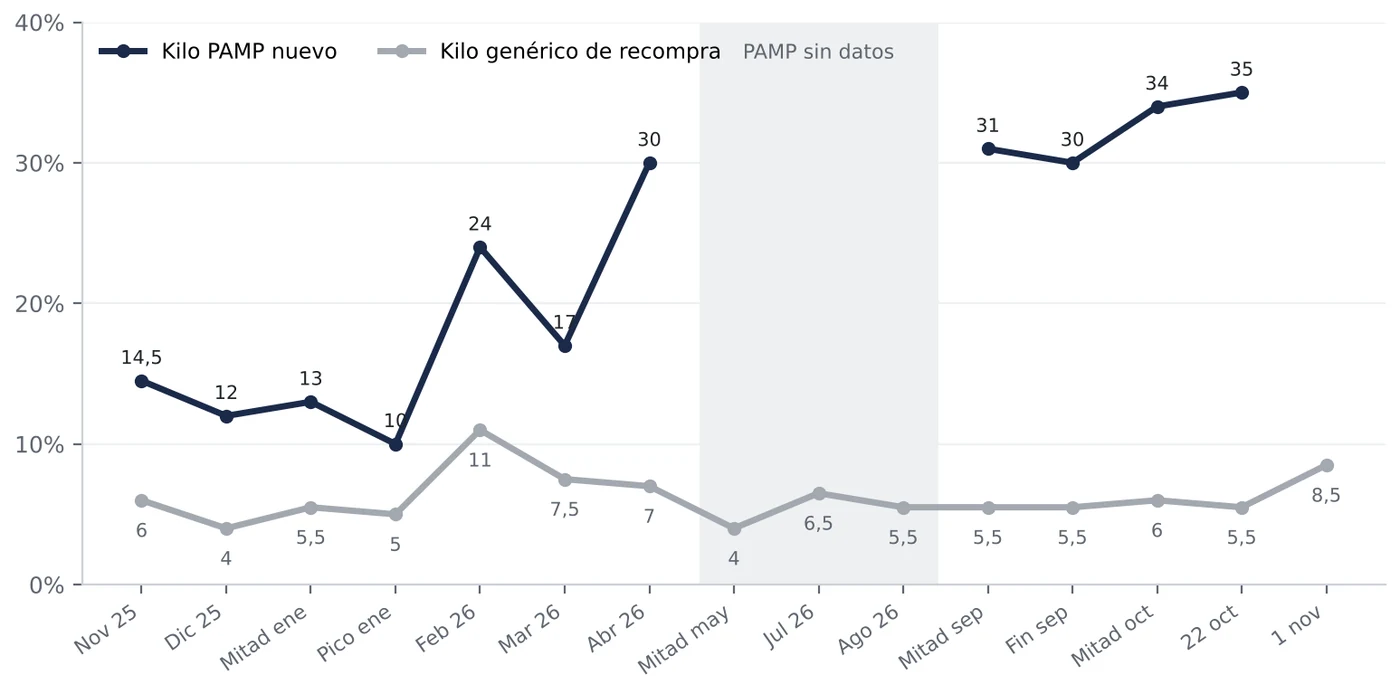
We have not found a confirmed cause. It may be that few dealers in the US carry this brand (the series has gaps) or the cost of importing Swiss bars, but it is not verified. The comparison with the generic secondary-market kilo (buy-back bars of any brand) clears it up: its average premium has been at 4–8% for most of the year, with a high of ~11% after the February crash, and on 1 November it is at ~8.5%. For the same silver, being new and branded multiplies the premium by four or five. The practical conclusion: the large format is only cheap if the brand and the market are cheap too. Before buying a kilo you have to compare its premium with that of 1 oz coins, which are at 11–15% today. In the price list of a European shop at the end of October the 1 kg bar was indeed the cheapest product (18.6%, taxes included).
What this means for the buyer: with silver 10% cheaper and premiums in cheap territory, it is the best combination of price and premium since the May wave of buy-backs. It is still valid to buy in several instalments: the spot trend is still down and nobody knows where the floor is.
What the data shows
We analysed the minimum and average dealer premiums in the US (goldsilver.ai) for six sovereign silver coins, in their random-year and specific-year versions, plus the Mexican Libertad, the Noah's Ark and a 1 oz bar.
- With the 29 January 2026 peak (121 USD) and the crash that followed, minimum premiums jumped to 19–34%; the jump was concentrated in the days of the fall. No coin escaped.
- The random-year coins came back to their normal band (5–9%) in two to five months. Kangaroo and Britannia in April, Eagle and Maple in April–May, Philharmonic in May, Krugerrand in July. Mass buy-backs refilled the channel.
- The specific-year coins did not normalise. Buy-backs come in as random year and do not refill a specific year. The scarcer that year is, the more premium it keeps.
- Semi-numismatics go their own way. The 2024 Libertad reached a premium of ~54% in April: its price anchors to the high and does not come down with spot.
- The 1 oz bar normalised a month later than the coins and, once normalised, it is no cheaper than they are.
- There is no tension today, but something is starting to move. At the end of October minimum premiums were still close to their normal band, although in the last few days the average premiums of the Philharmonic, Britannia, Maple and Kangaroo picked up. As of 1 November that signal has not been confirmed: with silver at ~49 USD, premiums are still at or below their normal level (see the update).
Two methodological warnings. The average premium jumps 8–10 points when a cheap dealer goes in or out of stock, with no change in the market. And some sites assign random-year offers to specific-year products: before trusting an anomalous minimum premium, you have to open that offer's link.
The US market in detail
The premium does not react to the level of spot but to how it moves: a gradual rise or fall compresses it, a vertical move in either direction sets it off. We see it in the daily data of eight to twelve US dealers (APMEX, SD Bullion, Money Metals, BullionStar, MintBuilder, Sprott, Silver Gold Bull, Hatton Garden) for twelve silver products.
| Product | Version | Type |
|---|---|---|
| Silver Eagle (US) | Random year and 2025 | Sovereign, with a bottleneck at the Mint |
| Maple Leaf (Canada) | Random year and 2025 | High-mintage sovereign |
| Krugerrand (South Africa) | Random year and 2025 | Sovereign, recent programme |
| Philharmonic (Austria) | Random year and 2025 | High-mintage sovereign |
| Kangaroo (Australia) | Random year and 2025 | High-mintage sovereign |
| Britannia (United Kingdom) | Random year | Sovereign, capital-gains exempt in the UK |
| Libertad (Mexico) | 2024 | Semi-numismatic |
| Noah's Ark (Armenia) | Random year | European, niche in the US |
| Perth Mint bar | 1 oz | Small bar |
When spot rises
- Gradual rise (October–December 2025, from ~48 to ~65 USD): the percentage premium falls in every coin. Krugerrand from 12% to 6–9%, Kangaroo from 6–14% to 4–10%, random-year Eagle from 16–20% to 6–8%, Libertad from 19% to 11%. The dollar premium holds and the price dilutes it.
- Vertical rise (January 2026, up to 121 USD): the goldsilver.ai charts show jumps to 19–34%, but their compressed axis does not separate the day of the peak from the collapse that followed. The daily FindBullionPrices series clarifies that during the rise the premium barely moved and that the big jump came with the fall (see the Philharmonic day by day). What rises most is what runs out first: the random year, which is second-hand stock (random-year Eagle at ~30%). The exception was the Eagle 2025, which was still arriving from the Mint at a fixed price and whose percentage premium even fell.
When spot falls
- Vertical fall (30 January, −33% in one day): the premium does not fall with spot, it rises. The Eagle 2025 went from ~13% to 25–27%; average premiums went to 30–34%. There were also un-updated prices with premiums of 0–3% for hours: bargains for anyone comparing.
- Gradual fall with buy-backs (April–June, from ~85 to ~65 USD): the public sells what it bought at 20–30 USD and the channel floods. The random year falls to 2–8%, there are bars at spot and the random-year Eagle even trades below spot. The specific year does not receive those buy-backs and stays high.
- Stability with spot drifting down (July–October, from ~70 to ~55 USD): minimum random-year premiums stay at 5–9%. The average percentage premium rises several points; most of it is arithmetic, although in October a real rise of ~1–1.5 USD per coin appears.
The full cycle
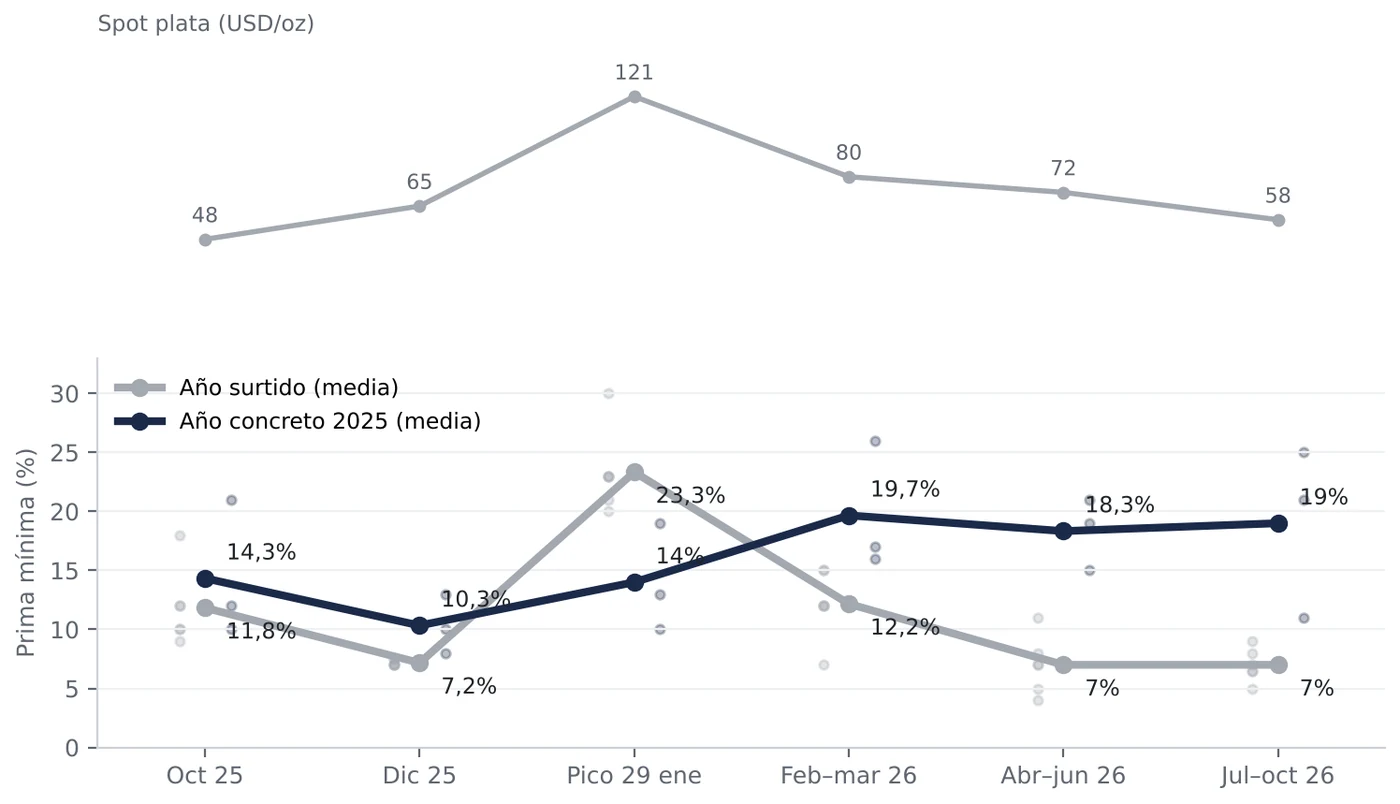
The chart sums up the two rules. In the random year, the premium follows volatility: it falls in the gradual rise, triples at the peak and goes back to its level as soon as buy-backs refill the channel. In the specific year, the premium follows the scarcity of that year: it barely reacts to the peak and then rises, because no new product arrives any more.
Four coins day by day: the jump comes with the fall
The daily FindBullionPrices series (average premium across its dealers, with exact dates) corrects an impression left by the goldsilver.ai charts (with their compressed axis): the premium does not spike on the way up, but in the collapse.
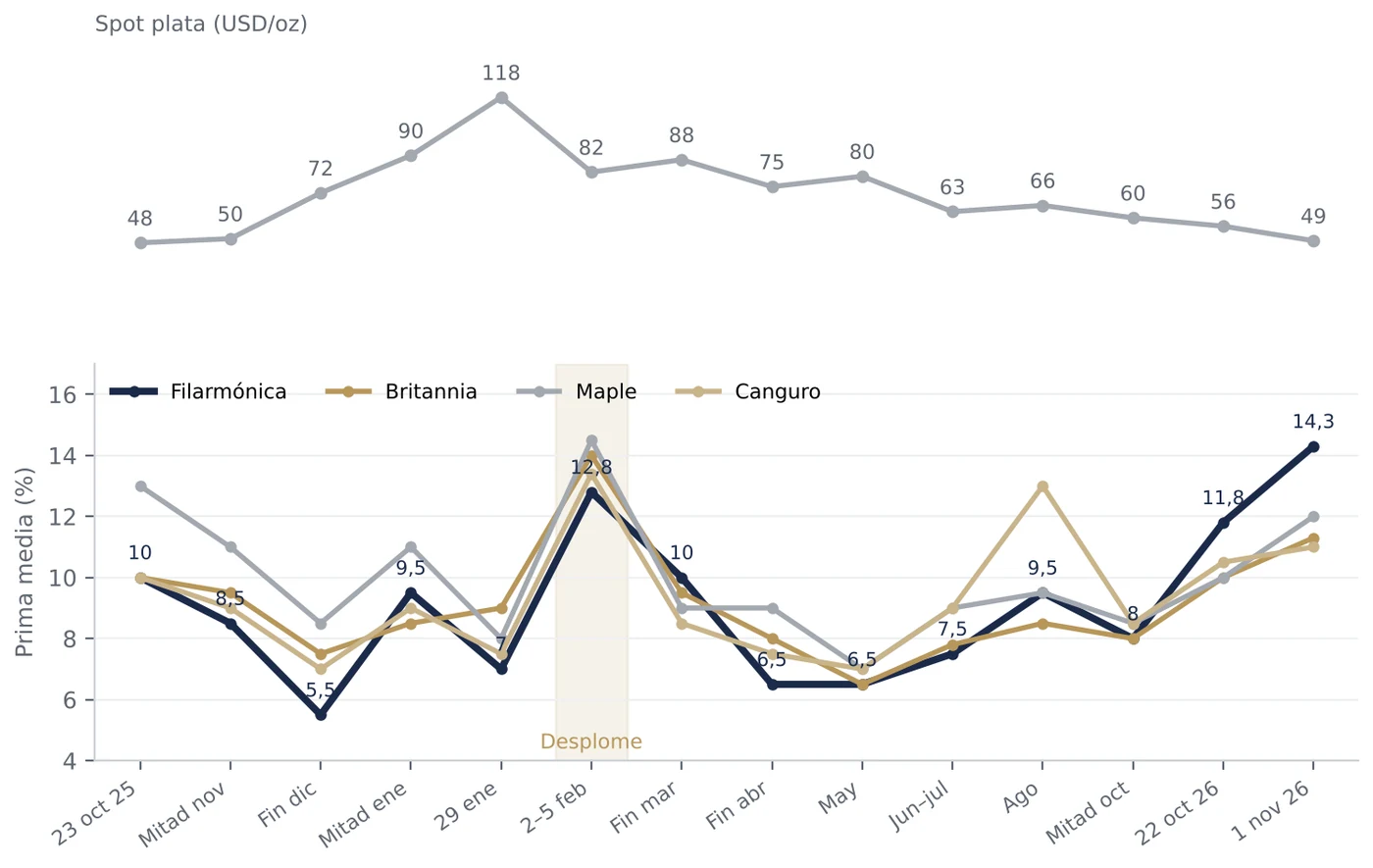
- In the middle of the rise the premium hit its low of the year: ~5.5% at the end of December, with spot at ~72 USD. On the day of the peak (29 January) it was at ~7%.
- The high came between 2 and 5 February, with spot already at ~82 USD: ~12.8%, about 10.5 USD per coin against ~8 USD on the day of the peak. It coincides with the Britannia (high on 2 February) and the random-year Silver Eagle (17 February) in the same source.
- The wave of buy-backs took it to 6.5% in April–May, and the August rebound lifted it to ~9.5%.
- Late rise: from ~8% in mid-October to ~11.8% on 22 October, with spot falling to ~56 USD. In dollars, from ~4.8 to ~6.6 USD per coin: that is a real rise, not just arithmetic.
- The Britannia repeats the pattern: ~7.5% at the end of December, ~14% in early February (and above 12% all that month), ~6% in mid-May and a rise from ~8% to ~10% in the last week of October. It took somewhat longer than the Philharmonic to come off the peak: it did not get back to ~10% until March.
- The Maple confirms it and adds the second jump: ~13% in October 2025, ~7% in the middle of December's rise, ~14.5% after the collapse. After hitting its low of the year (~6%) in mid-June, with spot at its own lows, the premium rose to ~12% at the end of July. It is the same post-fall jump that the FindBullionPrices dollar average shows. Today it is rising from ~8.5% to ~10%.
- The Kangaroo follows the same script and has the strongest second jump: ~6.3% in the middle of December's rise, ~13.4% on 3 February, ~6.8% in mid-May. After the June lows, its premium reached ~15% from mid-July to early August, with occasional falls to ~8.5% showing that the cheapest dealer was going in and out of stock. Today, ~10.5%.
- The sources differ on the level, not on the pattern. On goldsilver.ai the Kangaroo looked stable at 7–9% between April and September; FindBullionPrices, with more dealers, does pick up the summer jump. That is why it is always worth cross-checking two sources.
- The generic Maple page (no year specified, a mix of listings) sits between the random-year and current-year ones, and shows how long the blow lasts: ~19.5% on 3–6 February and above 18% for almost the whole month. The random-year one came down in days; the generic one took about three weeks and did not get back to ~8% until May. Then it repeats the script: ~11–12.5% in July after the June lows, ~10% in September and ~12.5% on 22 October.
- The random-year Silver Eagle marks the latest and longest peak: ~8–9% in the middle of December's rise, and a high of ~20% between 10 and 21 February, two weeks after the others. It falls to ~9–10% in May–June, jumps again to ~13–15% in July–August after the June lows and today sits at ~12–13%. It is the coin most tied to the US market and the one that suffers most from its mint's supply problems.
- The generic Silver Eagle page is the dearest and the slowest to normalise. ~12.5–15% in the middle of the rise, ~22.5% from 5 to 20 February and still ~17–18% in March and ~16.5% in April. It hit its low (~12.3%) in mid-May, went back to ~18% at the end of June and in July and today sits at ~17%. Against the generic Maple page (~10–12.5% in calm markets), the Eagle carries 4–5 points of brand premium in its own market.
- Watch out for outliers: the Eagle series shows a spike of ~104% around 10 September with a price of ~1,040 USD per coin. It is almost certainly a dealer error (a tube or lot listed as a single coin). We have excluded it.
- A note on the sources: on these FindBullionPrices pages the premium line is the average across dealers. The minimum premium the site itself publishes is 3–10 points lower; for instance, the Eagle's average minimum in July was 4.66%. The pattern over time is the same; the level is not.
The corrected rule: in this cycle, rises compressed the premium and sharp falls set it off. In episodes such as the 2021 silver squeeze the premium also spiked on the way up, but that was because stock ran out; in 2026 dealers had product during the rally and what overwhelmed them was buying into the fall.
The arithmetic effect: careful with the percentage
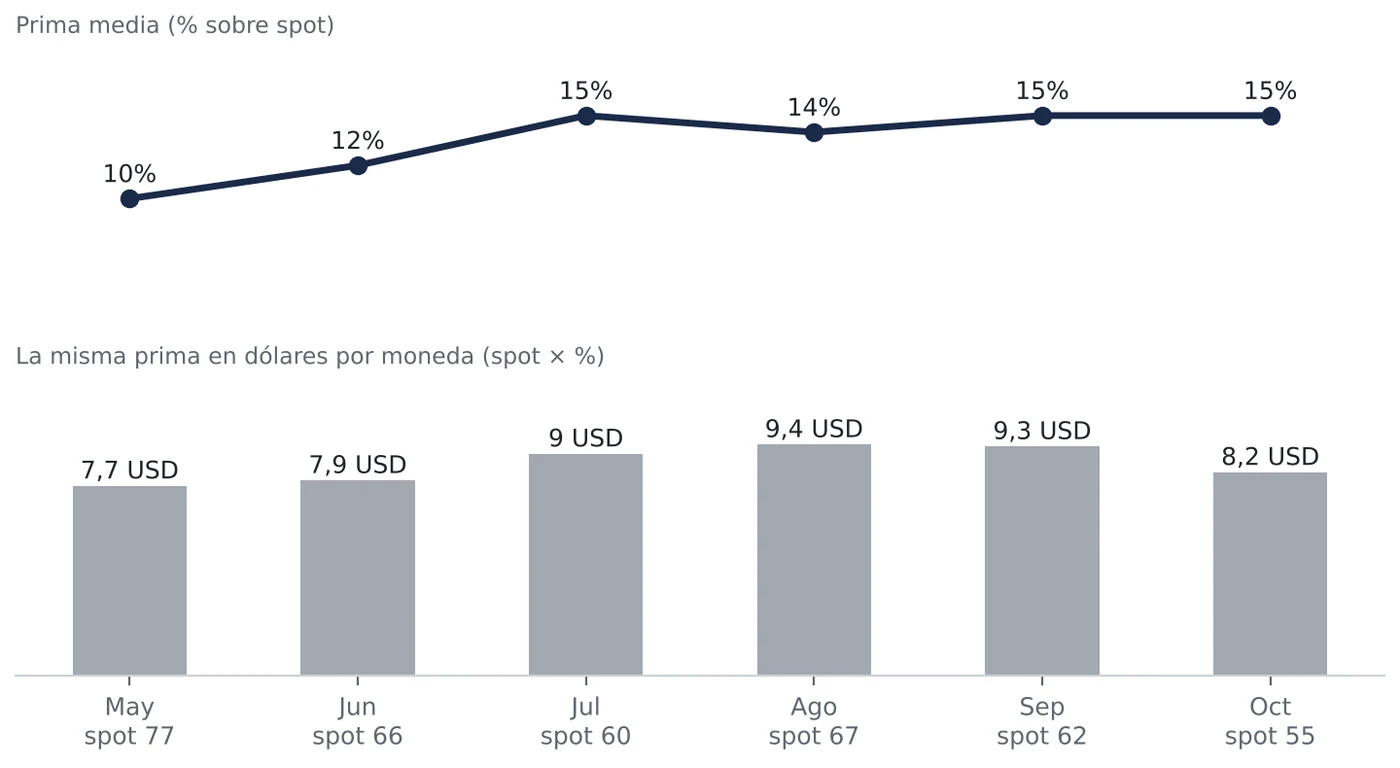
Between May and October spot fell from ~77 to ~55 USD and the Philharmonic's average premium went from 10% to 15%. It looks like more demand, but dealers kept charging about 8–9 USD per coin. The Krugerrand 2025 shows the same thing with its minimum premium: from 16% to 22% in percentage terms, and always ~12–14 USD per coin.
There is a useful nuance for reading the market. Mid-range dealers keep a fixed dollar premium; the most aggressive ones (those setting the minimum premium on the random year) quote a fixed percentage over spot. So when spot falls and the minimum premium rises in several coins at once, there is real demand; when only the average rises, it is almost always arithmetic.
A daily series covering a full year, from another source (FindBullionPrices, average of a group of silver coins), confirms the rule and qualifies it. In percentage terms, the average premium moves the opposite way to spot all year: every rise compresses it and every fall sets it off. But converted into dollars it is not constant: it goes from ~7 to ~14 USD per coin.
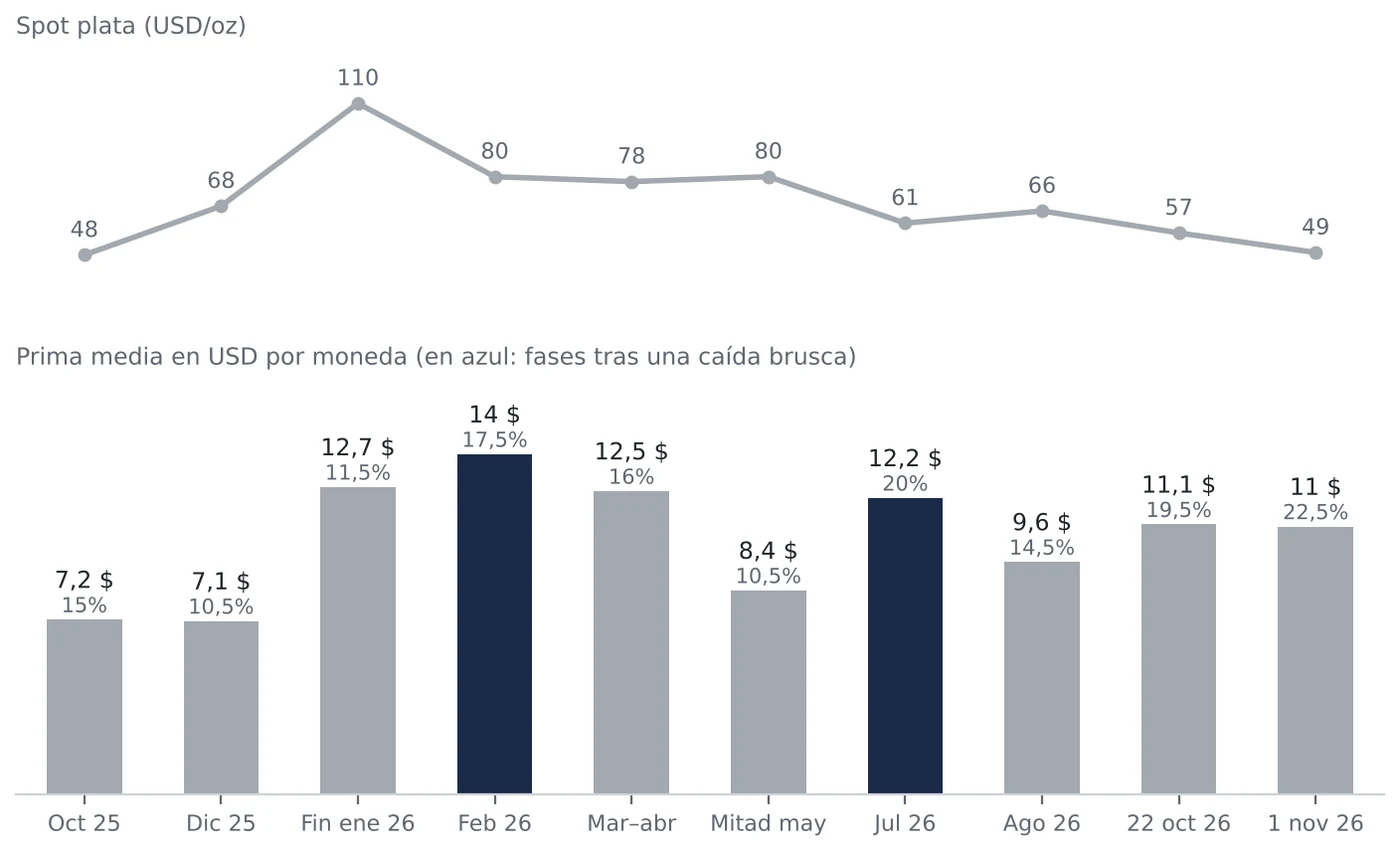
- The two real highs come after falls: ~14 USD after the January collapse and ~12 USD after the June lows. Sharp falls attract buyers and the dealer raises the premium with real money, not just arithmetic.
- On the way up the dealer also raises the dollar premium, but less than the price: from ~7 to ~13 USD between December and the end of January, while spot almost doubled. That is why the percentage fell.
- The best buying window of the year was mid-May (~8 USD, 10.5%), in the middle of the wave of buy-backs.
- On 22 October the average premium was at ~19.5% (on 1 November, ~22.5%), close to the highs of the year in percentage terms, but in dollars (~11 USD) it is in the middle of the range. The fall in spot from September to October explains most of it; a real rise of ~1–1.5 USD remains. It is a mild signal of buying into the fall, not tension: minimum premiums are still in their band.
The rule of the almost-fixed dollar premium holds for calm periods (May–June, August–September), not for the whole cycle.
How long the premium takes to come back
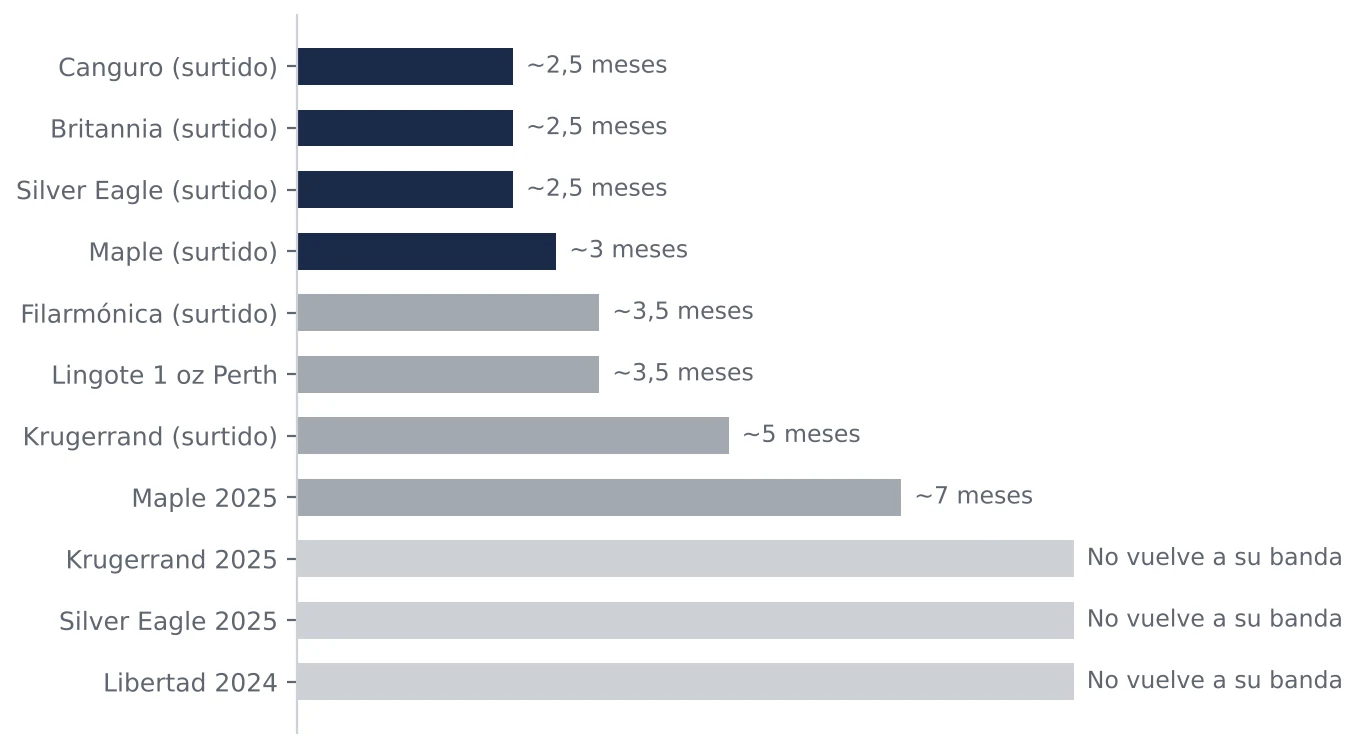
The speed depends on how many units come back through buy-backs. Random-year Kangaroo, Britannia, Maple and Eagle circulate in enormous quantities and refill in weeks; the Britannia also receives the flow of capital-gains-exempt British sellers. The silver Krugerrand, with a programme that has only existed since 2018, took five months. The specific years and the Libertad have not come back: in October 2026 the Eagle 2025 trades ~24 points above the random-year one and the Krugerrand 2025, ~15.
The current-year coin
The 2026 Philharmonic, Kangaroo and Britannia, which are still being minted, let us measure what it costs to buy the new coin against the random year in the same source.
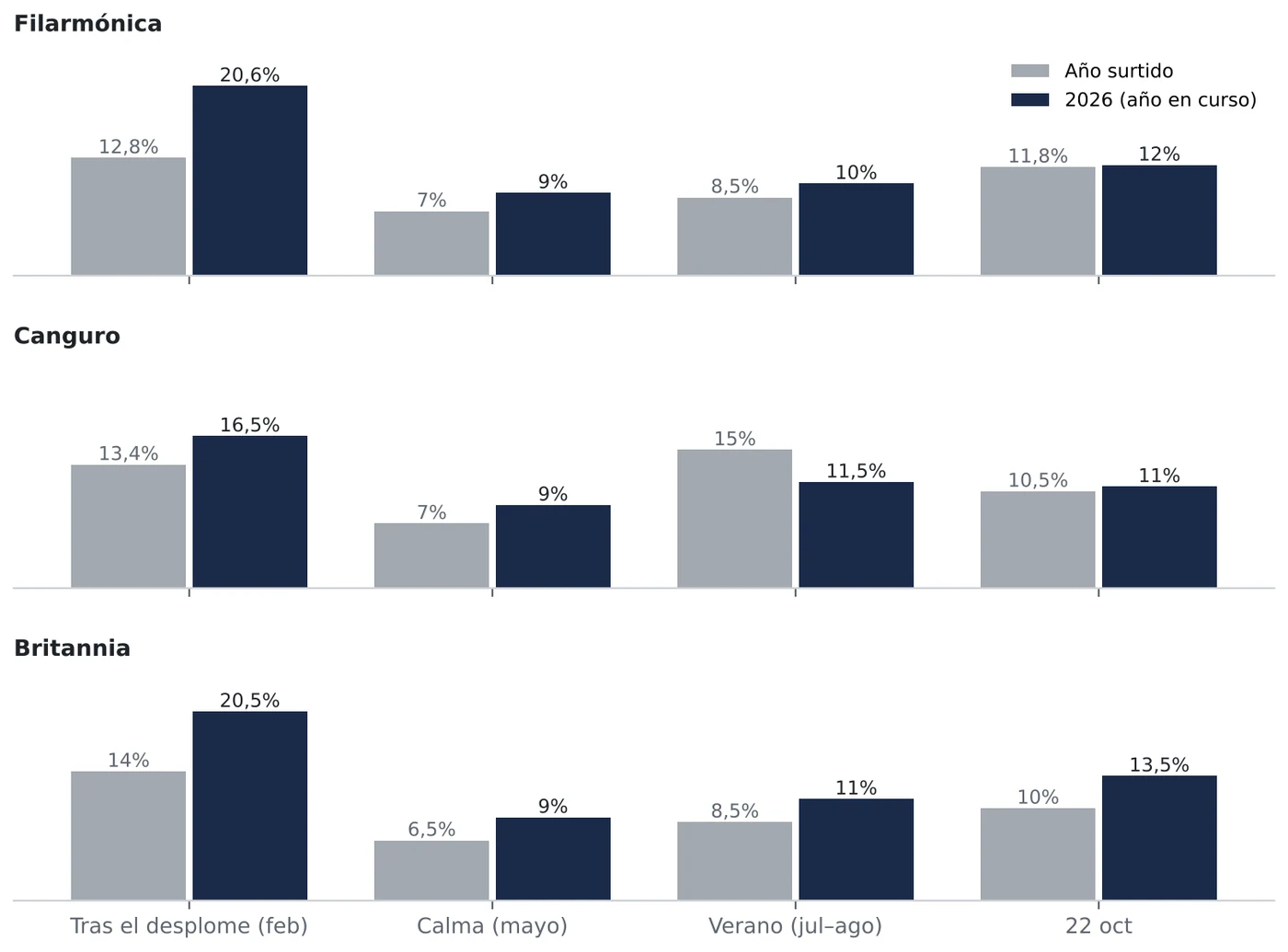
- In calm markets the new coin costs 2–3 points more (~9–10% against ~6.5–8%). The random-year one lives off buy-backs bought below spot; the new one leaves the mint with its wholesale premium.
- After the collapse, the new one jumped much more: ~20.6% on 5 February against ~12.8% for the random year. No buy-back can refill new product when demand spikes.
- Today the difference has almost disappeared (Philharmonic ~12% against ~11.8%; Kangaroo ~11% against ~10.5%), because the rise of the last few days has mostly lifted the random-year coin.
- The Kangaroo 2026 adds the key nuance: in July–August, when the random-year Kangaroo jumped to ~15% because the cheapest dealer kept running out of stock, the 2026 held at ~11%. Perth Mint's continuous supply cushions the later shocks. The new coin is dearer to start with, but more stable once the first blow has passed.
- The Britannia 2026 is the one that separates most from its random-year version: +2.5–3.5 points in calm markets and in summer, +6.5 after the collapse (~20.5% against ~14%) and +3.5 today (~13.5% against ~10%). Unlike the Kangaroo, it never came out cheaper than the random year. That fits with the capital-gains-exempt British buy-back flow, which keeps the random-year Britannia very cheap.
- Rule: the current-year coin costs 2–4 points more to start with and only comes out cheaper when the random year runs out of stock. For the investor, buying the new one only pays off at those moments.
- The Krugerrand 2026 confirms the full scale. Its average premium has moved in a narrow band, from ~14% in February to ~10–12% since June (with a one-off fall to ~7.5% in mid-May), with no summer jump: the mint's continuous supply stabilises it, just as with the Kangaroo 2026. And it costs less than the Krugerrand 2025, whose minimum premium is around 21% on goldsilver.ai. Last year's coin is already dearer than the current year's, even comparing the average of one with the minimum of the other. The ~31% spike on 18 July is another listing error and we exclude it.
- The scale comes out like this: random year (the cheapest) < current year (+2–4 points, stable) < old specific year (from a few points to more than 20, depending on how scarce it is).
In Europe the difference is smaller (in a European shop's price list, Maple 2026 at 19.9% against random-year Maple at 19.4%), probably because the VAT margin scheme already levels much of the price. The full scale comes out like this: random year, the cheapest; current year, a few points more; old specific year, from a few points to more than 20 depending on how scarce it is.
Semi-numismatics: the ratchet effect
The Mexican Libertad is the clearest example of a semi-numismatic coin: it follows spot when it rises and refuses to come down with it. Up to the January peak its average premium moved in the 14–21% range, like any other bullion. Since the collapse, its average price has stayed anchored around 95–110 USD while the metal fell from 80 to 57 USD.
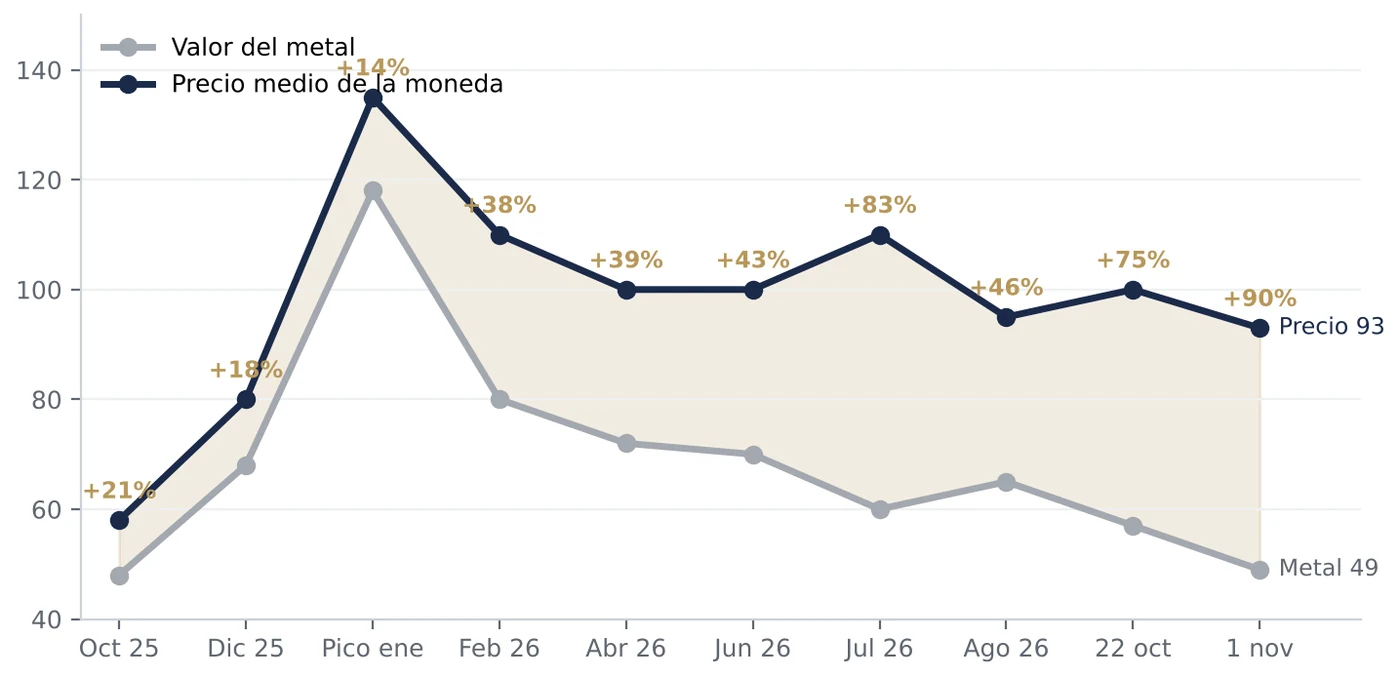
- The premium went from ~21% in October 2025 to ~75% on 22 October 2026 and ~90% on 1 November, with a peak of ~83% in July, when spot hit its lows.
- The spread between dealers is enormous: in August there were maximum prices of 165 USD with the metal at ~65. Those are asking prices from a few sellers, not transaction prices.
- The ratchet protects whoever already holds it only on paper. The dealer's selling price has not moved, but the buy-back price is another matter: collector forums recall that the secondary market does not usually pay premiums that are not backed by real scarcity.
- For anyone buying today it is the worst metal-to-price ratio in the study: with a premium of ~90%, silver would have to rise 90% to break even if it is resold at metal price.
- The Chinese Panda (30 g, random year) is a milder version of the same ratchet. Its average premium fell during the rise (~18% in October 2025, ~11% on the day of the peak) and, unlike bullion, did not jump after the collapse. From February it rose almost linearly (~13% in February, ~19% in April, ~21% in May, ~22–30% in summer) with an average price anchored at 80–90 USD while the metal fell. The ~52% stretch between the end of September and mid-October coincides with a maximum price of ~130 USD: that is one expensive seller arriving, not the market.
- One hypothesis for the Panda: since January 2026 China has required a licence to export silver. If that has limited the arrival of Pandas in the US, it would explain why its premium rises with spot falling, without the wave of buy-backs that made Western bullion cheaper. We have not been able to confirm it.
- The 2026 Perth Mint Lunar Horse (series III) takes the ratchet to the extreme in a new coin. Its average premium went from ~13% in December 2025 to ~25% after the collapse, ~40% in March and ~47–50% today, with an average price anchored at ~85–90 USD while the metal fell from ~118 to ~57 USD. The occasional falls to ~10% in May are one dealer clearing stock for a few days, not a change in the market.
The Libertad is a collector's piece with silver inside, not a vehicle for investing in silver.
Which coin holds up best against volatility in the medium and long term
For the medium- and long-term investor the premium is a cost that the metal has to recover before producing a profit. Buying in a panic or in a specific year can cost several years of appreciation.
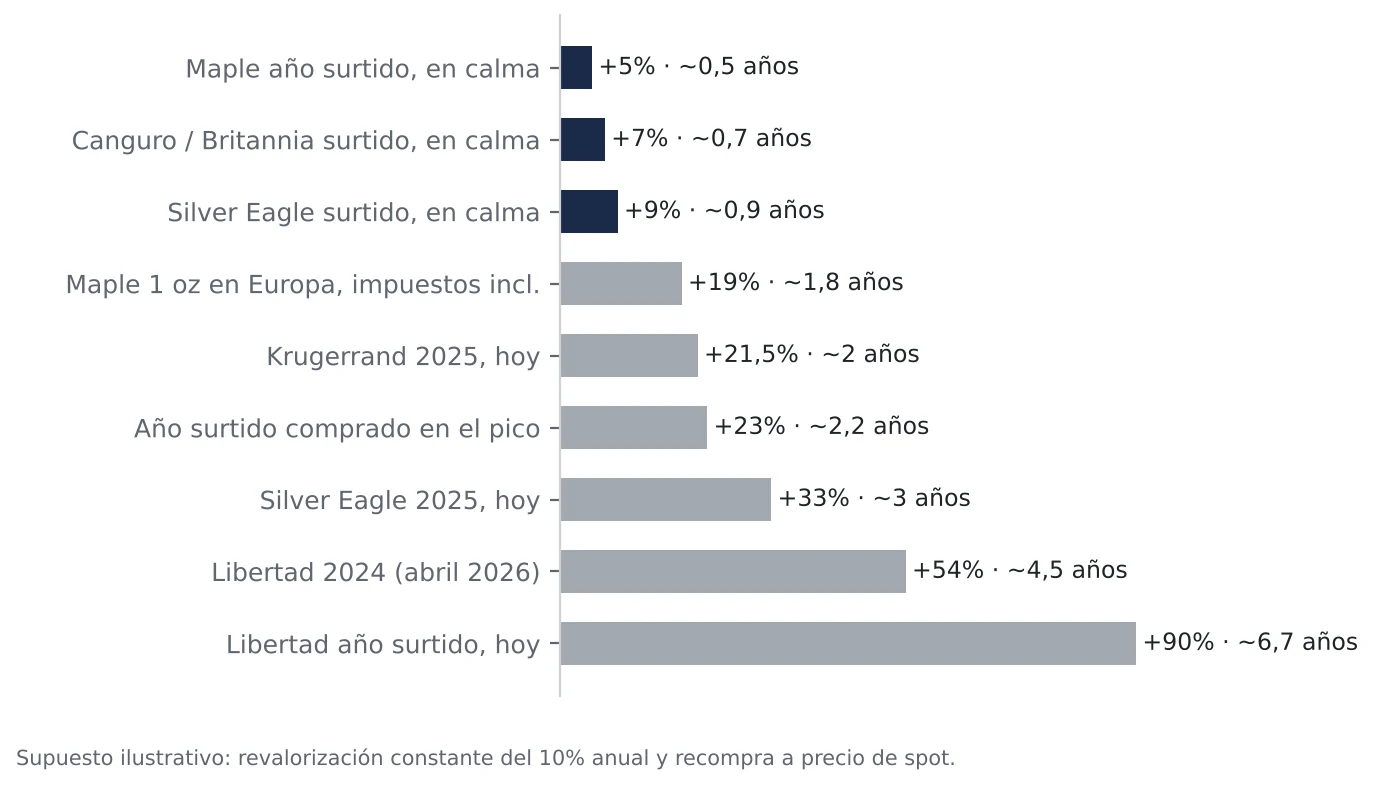
With the twelve charts, the ranking for a physical silver portfolio that has to withstand cycles like 2025–2026 comes out like this:
| # | Product | Premium in calm markets (US) | In the panic | Back to normal | Verdict |
|---|---|---|---|---|---|
| 1 | Maple, Kangaroo, Britannia, Philharmonic (random year) | 5–8% | Rises to 21–23% for days | 2–3.5 months | Core of the position |
| 2 | Large bar (1 kg, 100 oz) | Close to spot | Runs out before it gets dearer | Bars at spot in May–June | For large amounts; no chart of its own in this study |
| 3 | Krugerrand (random year) | 6–7% | ~20% | 5 months | Complement |
| 4 | Silver Eagle (random year) | 8–10% | ~30%, the widest swing | 2.5 months | Only if you are going to resell in the US |
| 5 | 1 oz bar | 6–8% | ~31% | 3.5 months | No advantage over the coin and a worse buy-back |
| 6 | Old specific year (2025) | 10–33% | Little reaction; rises afterwards | Does not come back | Collection only; bought back as random year |
| 7 | Semi-numismatic (Libertad, Panda, Lunar) | ~20% | ~54% (2024) and ~90% (random year, 1 Nov) after the fall; price anchored at ~95 USD | Does not come back | Collection only |
The practical conclusion in the face of volatility: buy high-mintage random-year sovereign coins, and do it in calm phases or when buy-backs flood the market (as in April–June 2026), never in a vertical move. The coin is the same; what changes the return is when you buy.
The United States: is physical decoupled from paper?
The dominant argument in the stacker communities (Reddit's r/WallStreetSilver, r/Silverbugs and Silver Twitter) is that high premiums prove that the paper price (COMEX, London) does not reflect the real scarcity of physical metal. The data backs that thesis for a few weeks and takes it away afterwards.
What is confirmed:
- In January–February 2026 physical did separate from paper: premiums of 19–34% in the US, dealers out of stock and a Shanghai premium of almost 17 USD/oz over London at the end of January.
- The forum veterans' intuition that premiums “always end up falling” came true. So did their view that dealers take months to give them back: in 2020 the Silver Eagle premium stayed at 9–12 USD months after spot had recovered.
- The usual recommendation to buy random year is correct: it is the first thing to come back to metal price.
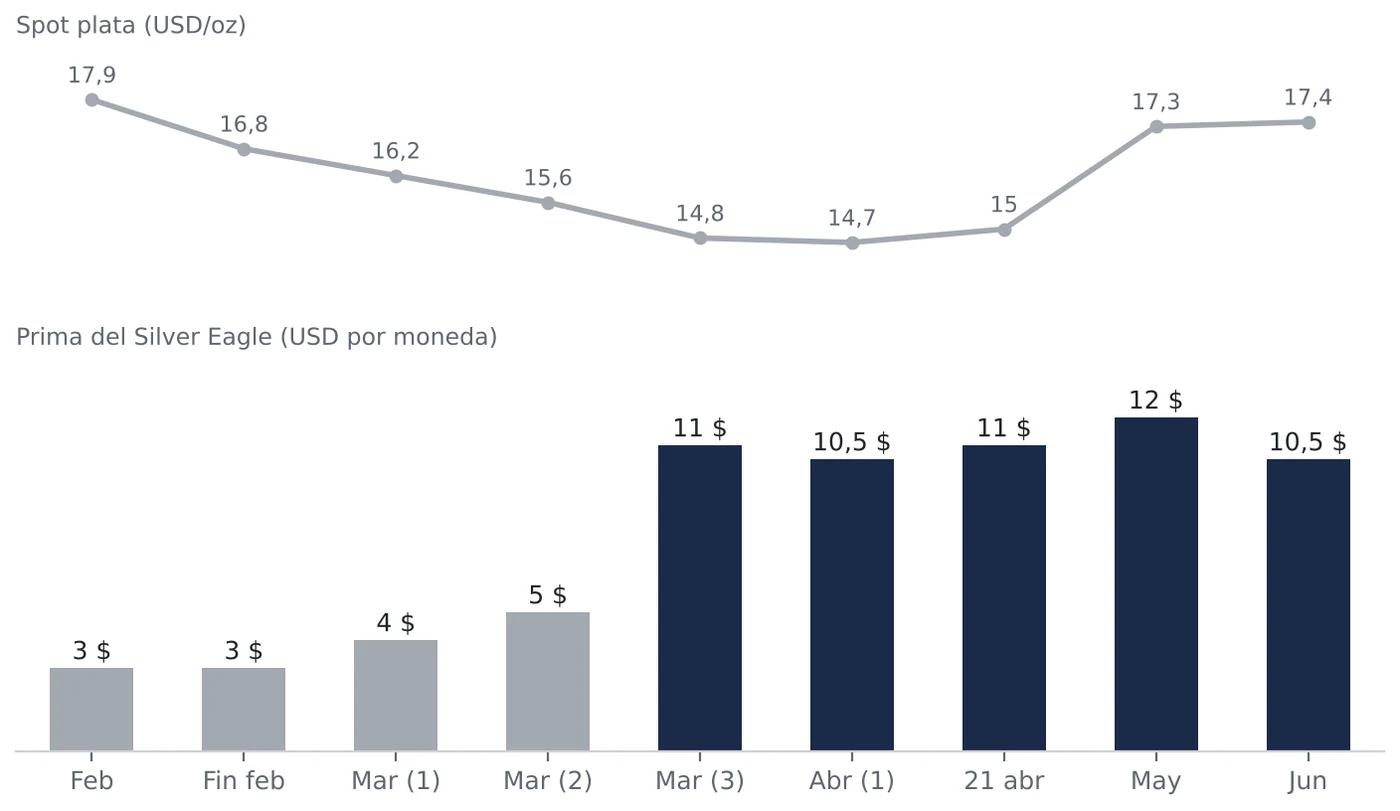
The 2020 precedent shows the same as 2026: the premium spikes with the fall and takes months to come down, even when spot has already recovered.
What is not confirmed:
- The decoupling was not permanent. In May–June 2026 there were dealers selling 10 and 100 oz bars at spot, Kangaroos at less than 1 USD over spot, and the random-year Silver Eagle even traded below spot on 11 June. The US Mint sold zero Silver Eagles in May: the public that had bought at 20–30 USD sold above 100 USD and the channel flooded.
- Part of the “high premium” cited in the forums is arithmetic. With spot falling, a fixed dollar premium rises in percentage terms without there being any more demand. Some forum members were already pointing this out in 2021; most threads ignore it.
- On the selling side, physical suffers too. In the fast rises, refiners and dealers restricted their buying of scrap silver and old coins, widening the buy-back spread. Physical liquidity is asymmetric: easy to buy in calm markets, hard to sell in euphoria.
Collector forums add one data point that closes the circle: the limited-mintage 2025 Silver Eagle proofs already resell below their issue price. The secondary market does not recognise premiums that are not backed by real scarcity.
Europe: VAT sets the premium
In Europe the forum conversation (German, Dutch, British and the European Reddit threads) does not revolve around paper against physical, but around how to pay less VAT. It is the variable that weighs most on the European premium, above any market tension.
- Investment gold is VAT-exempt in the EU; silver is not. A German buyer pays 19% on silver and nothing on gold. The forums repeat it as the explanation for why Europeans prefer gold.
- The margin scheme (Differenzbesteuerung) is the valve. Silver coins imported from outside the EU, or bought back from private individuals, can be sold paying VAT only on the dealer's margin. Bars cannot use it: they pay full VAT. That explains why in Europe the coin is always cheaper than the small bar: 10–15 points of difference according to Austrian dealers.
- A signal to watch: some German dealers indicate that in 2026 the margin scheme is applied mostly to used silver and numismatic coins, not to new imports. If that is confirmed, European premiums on new coins would tend to rise.
- The Philharmonic, being from the EU, often cannot be sold under the margin scheme, and some German wholesalers do not offer it that way. It is one of the reasons why non-EU coins (Maple, Kangaroo, Noah's Ark minted for Armenia) dominate the German market.
- In the United Kingdom, the Britannia is exempt from capital gains tax. The British sell Britannias at no tax cost and periodically flood US dealers, which keeps its premium among the lowest there.
The result in prices: in Europe 1 oz silver coins move in premiums of 20–25% in calm markets, against 5–9% in the US. A European shop's table at the end of October confirms it: Maple at 19.4%, Krugerrand at 22.9%, Libertad at 29.6% and 1 oz bar at 36%. The product ladder is the same as in the US; what changes is the tax floor.
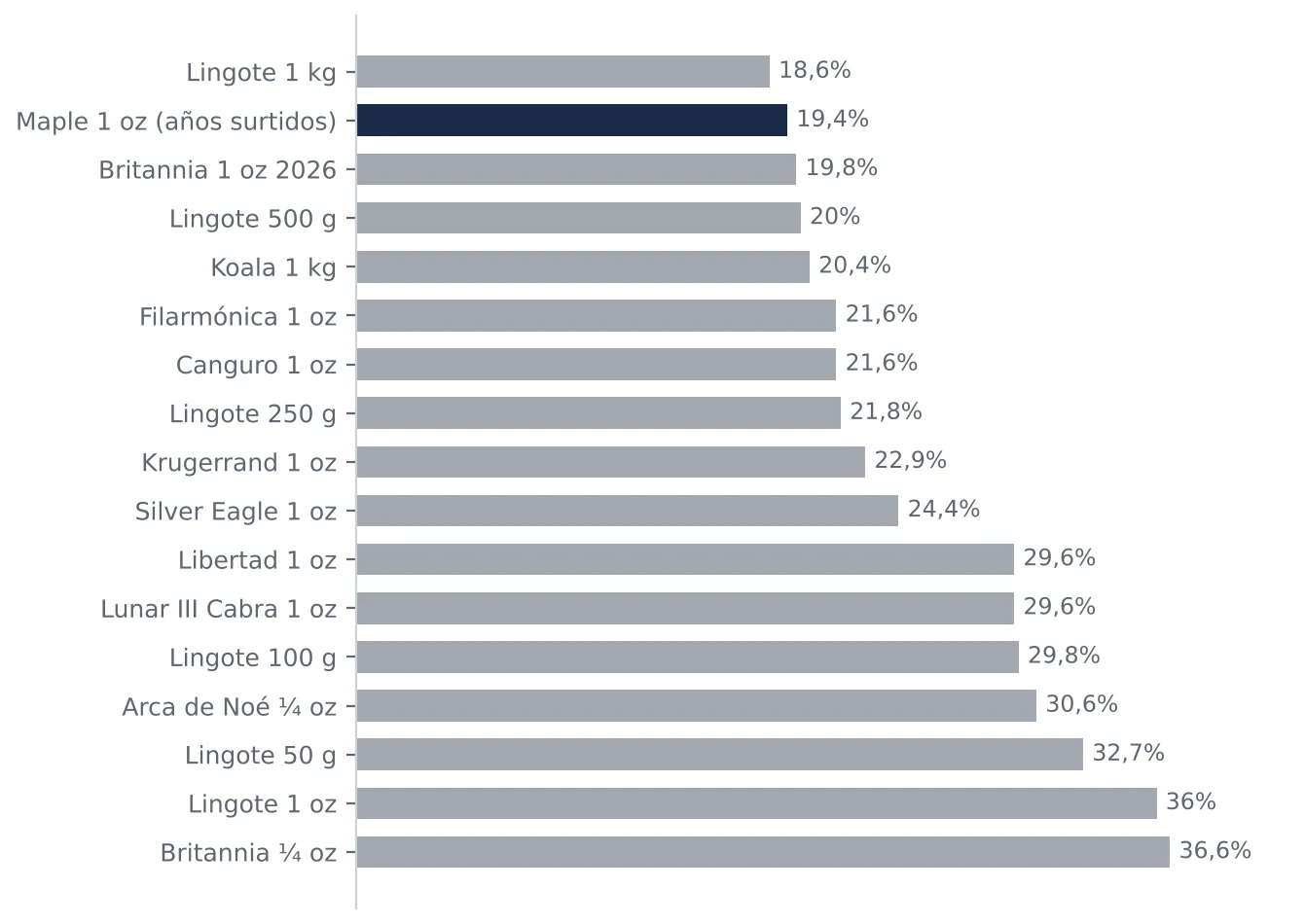
Below 250 g, any 1 oz coin comes out cheaper than a bar; the difference reaches 17 points between the Maple and the 1 oz bar.
Asia: political premiums, not just demand
In Asia the highest premiums of the year are not explained by retail demand but by government decisions: export controls, tariffs and taxes. Western forums tend to read them as proof of global scarcity; Asian analysts are more cautious.
China. Since 1 January 2026 only licensed exporters can take silver out of the country. At the end of January the Chinese quote reached almost 17 USD/oz over London, and in Hong Kong large bars were trading with premiums of up to 8 USD when the norm is a discount. But the Chinese price has 13% VAT built in, so part of that “premium” is a tax artefact that grows the more the retail buyer buys. In September the premium was still at ~8 USD and, even so, metal was leaving China for the West: it was not a scarcity signal attracting silver.
India. The world's largest silver consumer raised the import tariff from 6% to 15% on 13 May and four days later moved bars to the licence regime. In July domestic premiums were above 10% despite weaker-than-usual demand. Figures of 50–70% Indian premiums after the January collapse circulated on Silver Twitter; we have found no sources to confirm them and treat them as exaggeration. What is documented are premiums of ~10% in the 2025 festive season.
Singapore. It is the opposite case: silver bars and a list of sovereign coins (Maple, Britannia, Kangaroo…) have been GST-exempt since 2012, and there is no capital gains tax. With neutral taxation, premiums look like those in the US, and local dealers kept stock during the peak with premiums of ~12% on 1 oz coins, against the American 19–34%.
The Asian lesson: a high regional premium usually indicates a barrier (tariff, licence or tax), not necessarily a worldwide shortage.
The Middle East and Russia
The Middle East. The debate about silver premiums is scarce: the investment culture in the Gulf revolves around gold and souk jewellery. What matters is fiscal and, once again, ambiguous.
- In the Emirates, the VAT rules classify gold, silver and platinum of at least 99% purity in tradeable form as zero-rated investment metal. But several price sources indicate that private individuals are charged 5% on silver, and others limit the zero rate to transactions between registered businesses. In practice, the treatment depends on the seller.
- In Saudi Arabia, 999 investment silver is listed as exempt, against the general 15%.
- The clearest market signal is that the banks are entering the business: Emirates NBD already sells silver bars from 100 g to 1 kg, as it did with gold before.
Russia. It is the case most similar to Europe, with the asymmetry taken to the extreme.
- Gold in bars has been VAT-exempt since March 2022; silver in bars pays 20%, and the Finance Ministry has confirmed that this is correct.
- Investment coins are exempt. The reference is the 3-rouble Georgy Pobedonosets (1 oz, 999 silver), with mintages of up to a million units a year.
- The problem is the buy-back: banks buy back between 5% and 25% below the selling price, and in Moscow Sberbank only buys back at nine branches. There are numismatic shops advertising that they pay 30% more than the banks.
- On Russian financial forums the most repeated conclusion is that the silver coin does not pay off because of the spread, and that a non-physical metal account (OMS) is better. VTB reported a 36% increase in silver accounts in 2025, with purchases from 1 gram and no VAT.
The Russian lesson: when the bar pays tax and the coin does not, physical concentrates in coins; and when buy-backs are in the hands of a few players, the spread eats the return and the investor migrates to paper accounts.
The silver tax map
Where bars and coins are taxed the same, the large format is the cheapest; where the bar pays tax and the coin does not, the coin wins hands down.
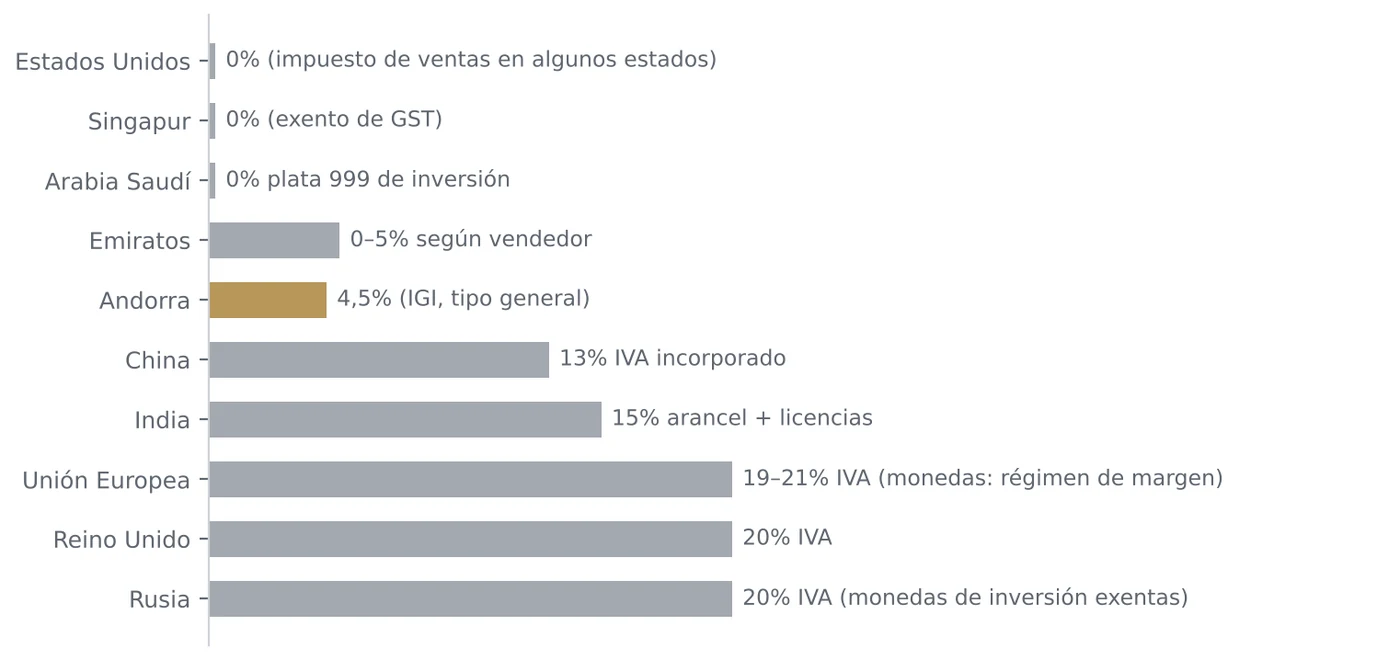
| Region | Silver bar | Silver coin | Effect on premiums |
|---|---|---|---|
| United States | No VAT (sales tax in some states) | Same as the bar | 1 oz coin at 5–9% in calm markets; large bars close to spot |
| European Union | Full VAT (19–21%) | Margin scheme if from outside the EU or from buy-back | 1 oz coin at 20–25%; small bar above 30% |
| United Kingdom | 20% VAT | Britannia exempt from capital gains | Constant flow of buy-backs that keeps the Britannia cheap |
| Andorra | IGI, general rate of 4.5% | IGI, general rate of 4.5% | Tax floor far below the EU's |
| China | 13% VAT built in; export licences | — | Shanghai premium of 8–17 USD/oz in 2026 |
| India | 15% tariff and import licences | — | Domestic premium above 10% since July |
| Singapore | GST-exempt | Coins on the official list exempt | Premiums similar to those in the US |
| Emirates | 0% in the rules; 5% in retail practice according to sources | Same | Barely relevant: the market looks at gold |
| Saudi Arabia | 999 investment silver exempt | Same | 15% for the rest |
| Russia | 20% VAT | Investment coins exempt | Bank buy-back spread of 5–25% |
The Libertad and the Panda: why they cost more and whether they are worth it today
These are the two coins whose premium has grown most this year. In US dealer data, the random-year Mexican Libertad has gone from an average premium of ~21% to ~88%, and the Chinese Panda from ~18% to ~36%. It is not an error or a passing bubble: both have something the Maple and the Britannia do not, a collector market of their own.
The Mexican Libertad
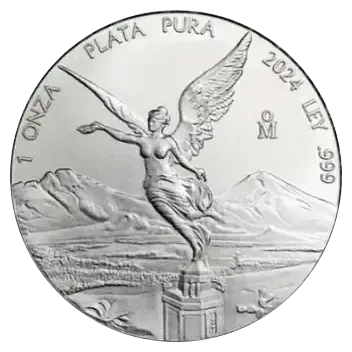
- It is the oldest silver investment coin still minted every year. The Bank of Mexico has issued it since 1982, four years before the Silver Eagle. Its design, the winged Victory with the volcanoes, comes from the 1921 gold Centenario and has not changed since.
- It has very short mintages. In recent years a few hundred thousand 1 oz Libertads have been minted each year, against the tens of millions of Silver Eagles. In 2025 the Bank of Mexico, with unsold 2024 stock, issued only around 300 uncirculated 1 oz units (a figure that is not yet final). Each year thus becomes a sought-after piece.
- It has collector demand on both sides of the border, in Mexico and in the US, with an active market in NGC- and PCGS-encapsulated pieces and in minting varieties and errors.
- That is why its price does not fall with the metal. For months the random-year Libertad has held at ~90–95 USD even though silver has kept falling to ~49 USD. On 3 November the average premium is ~88%, and the cheapest US shop sells it at ~64%.
The Chinese Panda
- It changes design every year since 1983 (only 2001 and 2002 repeated). That makes it collectable by year, especially among Asian buyers.
- It weighs 30 g, not an ounce. Since 2016 it has weighed 30 grams of .999 silver (0.96 oz), which makes it harder to compare with 1 oz coins.
- Far more of them are minted than Libertads, about 10 million pieces a year in total, so its collector premium is more moderate.
- This year its premium has risen for real, in dollars too, from ~15 to ~17–18 USD per coin in recent weeks. One possible explanation is the silver export licence China has required since January 2026, although we have not been able to confirm it.
Are they a good investment at today's premiums?
It depends what you are buying them for.
- As a cheap way to accumulate silver, no. With a premium of 36–88%, if you were only paid for the metal when selling, silver would have to rise in the same proportion to recover what you paid. To accumulate ounces, the random-year Maple or Britannia are still far more efficient.
- As a piece with a double engine, yes, it can make sense. Its value depends on the metal and on collector demand. This year that second leg has protected whoever bought: the Libertad has held its price while silver fell. But that protection is not guaranteed. If the Bank of Mexico releases the stock it is holding or collector demand cools, the premium can fall.
- Where the value is. In specific short-mintage years, in good condition or encapsulated, bought at a good price and from someone who knows how to tell them apart. Between shops there is more than 10 USD of difference per coin, and between years and varieties far more.
- Who for. For anyone who already has the base of their silver in bullion and wants to devote a minority part to pieces with numismatic value, with a long horizon. Not for a first purchase or for money you might need soon.
Andorra Metals and the Mexican coin
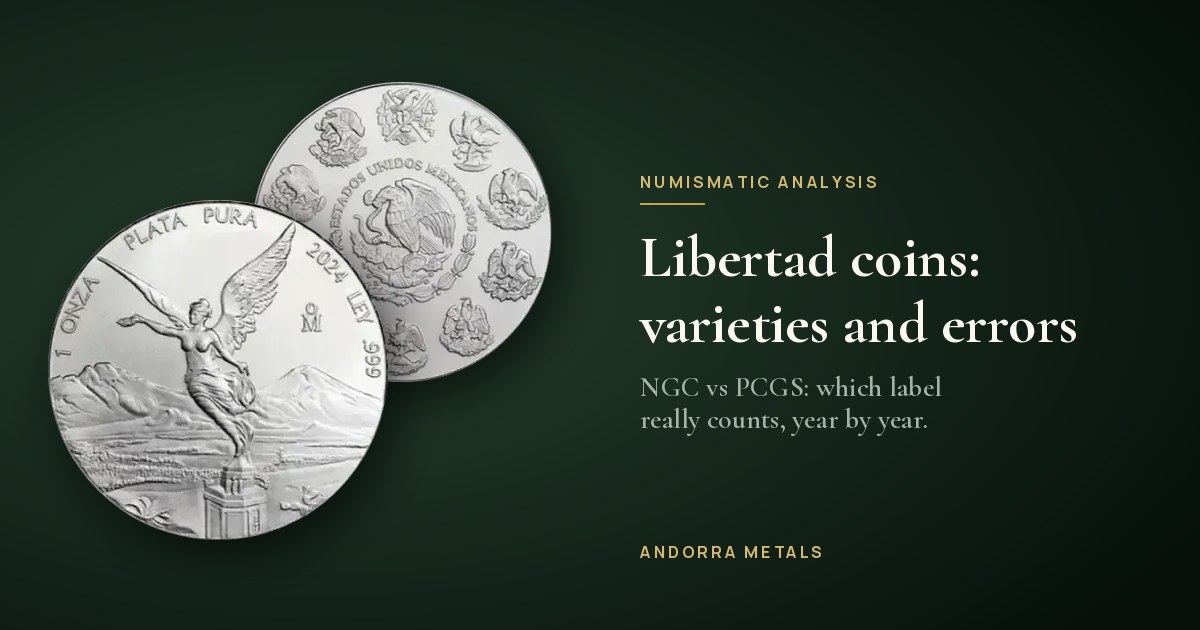
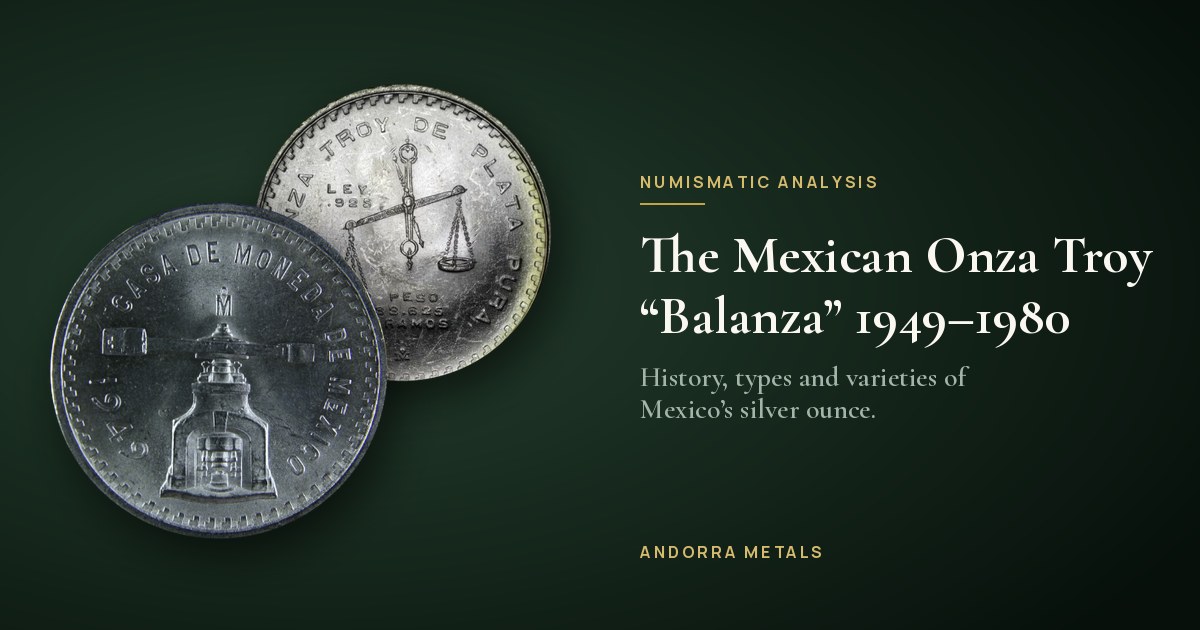
At Andorra Metals we specialise in Mexican coins: the Libertad in all its years and sizes, the Onza Troy Balanza, the gold Centenario and the new Angel ounce. We help you choose the year and version that make sense for your budget, tell varieties and NGC and PCGS encapsulations apart, and buy at a fair price. To find out more, read our guide to Libertad varieties and errors or book an appointment and we will go through it in the shop.
Conclusions
Cross-checking data and forums from five regions, the premium on physical silver is explained by three layers that are worth separating before drawing conclusions.
- The tax floor sets the level. The US and Singapore start at zero; the EU starts at 19–21%; Russia penalises the bar with 20%. Comparing premiums between countries without stripping out taxes leads to false conclusions.
- The product sets the elasticity. High-mintage random-year bullion comes back to its band quickly; the specific year, the semi-numismatic and the small bar take longer or never come back. The difference is explained by buy-backs: what the public resells refills the channel.
- Market tension moves the premium in the short term, and it is the only layer that interests the speculator. You recognise it because the minimum premium rises (not just the average) and in several products at once.
On the forums' great debate, physical is not permanently decoupled from paper. It separated at the January peak and converged again within four months, to the point that in June there was physical silver at or below spot price. The persistent regional premiums (China, India) respond mostly to taxes and trade barriers, not to a global shortage.
What the forums get right is the behaviour: premiums rise in panics (both up and down), take months to come down, and the random year is the cheapest way to buy.
What to buy, in practice
Translated into a concrete purchase, with the November 2026 data:
- To start, a 1 oz high-mintage sovereign coin. The 1 oz silver Maple Leaf is our first choice: 9999 silver, recognised anywhere and the first to come back to its normal premium after a panic. Ask in the shop for random-year units: they are the cheapest version of the same coin.
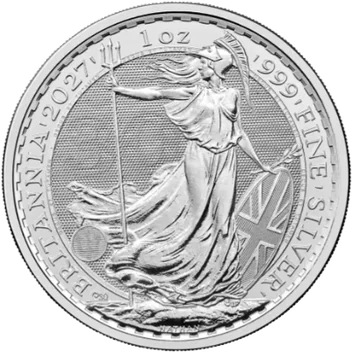
- As an alternative, the 1 oz silver Britannia. Just as liquid as the Maple. The 2027 edition marks 30 years of the coin; if what you want is silver at the lowest cost, ask about the random-year Britannia as well.
- Collector coins, only if you like them as pieces. The 1 oz silver Libertad is a beautiful coin with a market of its own, but today its premium is above 60% over metal: buy it out of numismatic interest, not as a cheap way to accumulate silver.
- Bars, when the position grows. From about €8,000 it makes sense to add a 1 kg bar according to this article's allocation table. Ask us for the price of the day before deciding.
- Combine it with gold. If you already have gold, our gold/silver ratio calculator helps you decide how much silver to add and when. And if what you are missing is the gold, here is which gold coin to buy.
If you have doubts about which coin or which format suits you, book an appointment at Andorra Metals and we will look at it with the prices of the day.
Sources
Premium data
- goldsilver.ai — US bullion premium comparator
- FindBullionPrices — Random-year Silver Eagle, premium history
- FindBullionPrices — Silver Eagle sales hit zero in May 2026
- FindBullionPrices — Scrap silver buying restrictions
- SD Bullion — The January 2026 peak and crash
- goldsilver.ai — 1 oz silver coins
- FindBullionPrices — Random-year Philharmonic, premium history
- FindBullionPrices — Silver coins, daily history
The United States: forums and debate
- Collectors Universe — Thread on extreme premiums
- Collectors Universe — 2025 Silver Eagle proof below issue price
- CoinTalk — How long high premiums lasted after 2020
- Greysheet — Silver Eagle premiums in 2020
- StartupFortune — The WallStreetSilver debate on premiums
- IG — Silver's two markets: paper and physical
Europe
- Trisor — VAT and the margin scheme on silver (Germany)
- Gold & Co — What differential taxation is
- Edelmetalle direkt — Margin scheme and the Philharmonic
- Collectors Universe — Why Europeans prefer gold
Asia
- Kitco — Why silver costs 8 USD more in Shanghai
- SMM / Goldinvest — Asia pays record premiums
- Kitco / Reuters — Import restrictions in India
- BullionStar — GST exemption in Singapore
- BullionStar — Silver premiums at the start of 2026
The Middle East
- StashAway — Investing in silver in the Emirates
- MetalCharts — Silver in dirhams and VAT
- KSA Expats — Silver VAT in Saudi Arabia
Russia
- PPT.ru — The Finance Ministry's position on silver VAT
- Kommersant — Buy-back spreads on investment coins
- T—Zh — Investors on precious metal coins
- EAN — VTB and the boom in silver accounts
Libertad and Panda