Which gold coin to buy: what the 2025–2026 premiums teach us
If you are going to buy your first gold coin and hold it for several years, the best choice on the 2025–2026 data is a 1 oz random-year government bullion coin (Krugerrand or Maple Leaf; in Europe the Philharmonic works just as well), bought in a calm phase. In gold the premium is small, so what decides the cost is the format and the timing, not the brand. We explain it with more than thirty premium series from US dealers, the prices from the European comparison sites and what the specialist press in six regions reports.
Our recommendation for your first gold coin
Choose a 1 oz random-year Krugerrand or Maple Leaf. In Europe, a 1 oz Philharmonic does the same job. Buy it in a calm phase, not in the days that follow a sharp move in the price, and in whole ounces whenever the budget allows.
Why a random-year Krugerrand or Maple
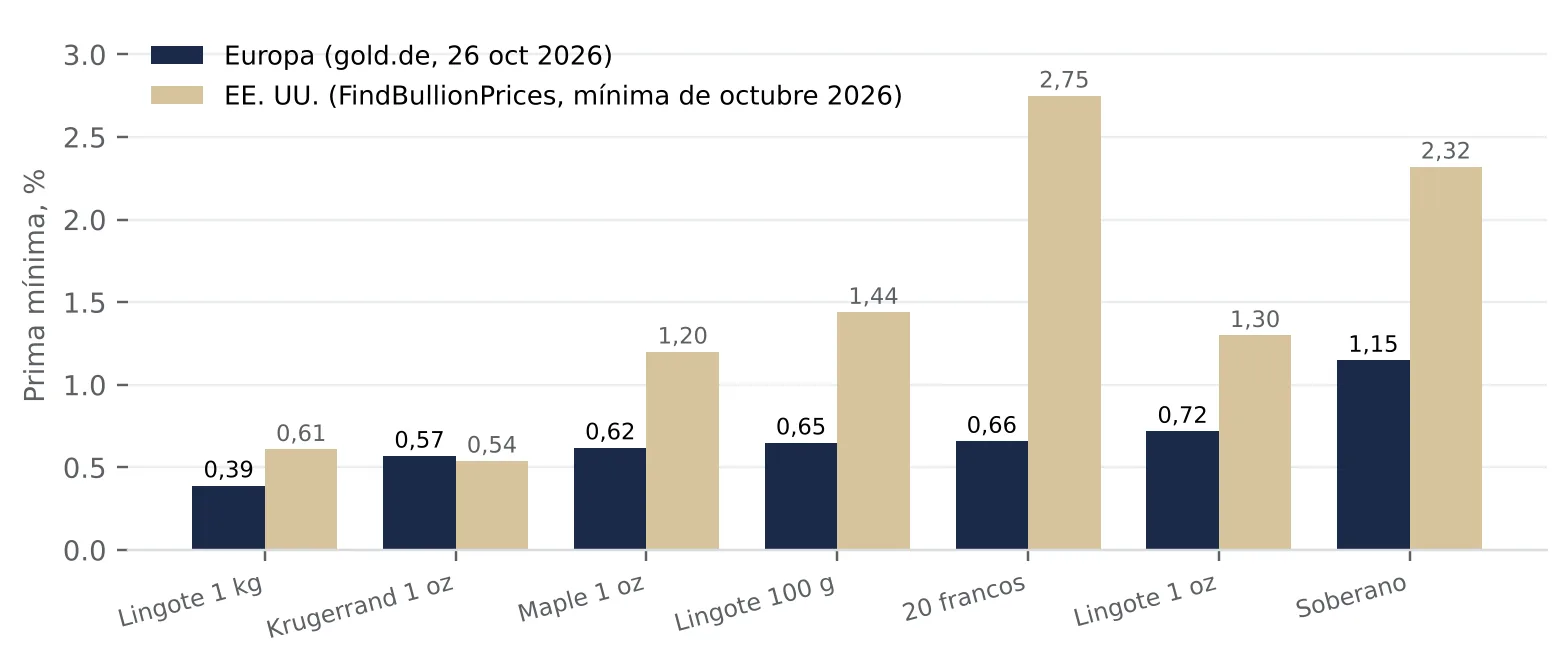
- They are the cheapest coins there are. In the US their lowest premium in calm conditions was 0.3–0.6% (Krugerrand) and 0.7–1.3% (Maple) during 2026. On the European comparison sites, on 26 October, the Krugerrand cost 0.57% over the metal and the Maple 0.62%: less than a 100 g or a 1 oz bar.
- They go back to their normal price sooner after a panic. After the crash of 30 January, the Maple's premium fell from 2.14% to 1.40% in one month. They are the coins that come back to the market through buybacks the most.
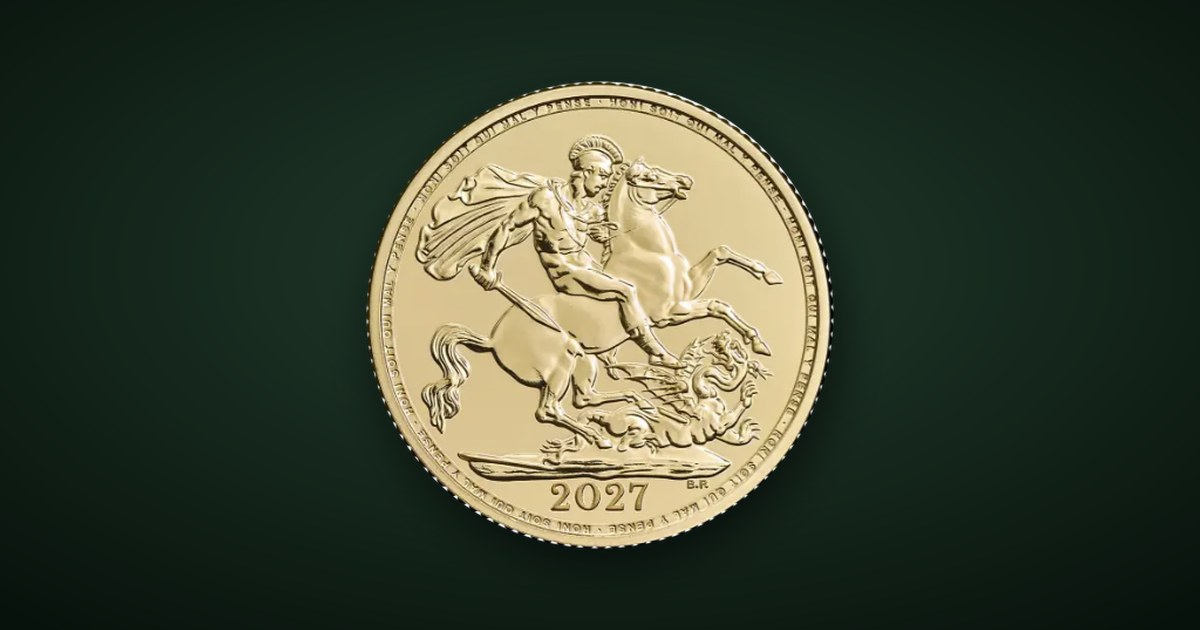
- They sell anywhere. The Krugerrand is the most traded gold coin in the world, and the Maple is 9999 gold recognised by any dealer. Both are exempt from VAT in the EU as investment gold.
- Random year is the cheapest version. The same coin from the current year costs between 1.2 and 3.5 points more, and an older specific year 1–2 points more in ounces and up to 10 points in fractions, with no more gold inside.
The key difference with silver. In silver, the premium on a 1 oz coin was around 10% in the US and 19–25% in Europe because of VAT. In gold, the 1 oz premium moves between 0.3% and 3%. That is why, in gold, the real cost is decided by three things the buyer does control: the size of the piece (a tenth-ounce costs ten times more per gram), the timing (the same coin can cost three times the premium in a panic) and the shop (for the same Maple there is up to 3.5 points of difference between dealers on the same day).
What to avoid on your first purchase
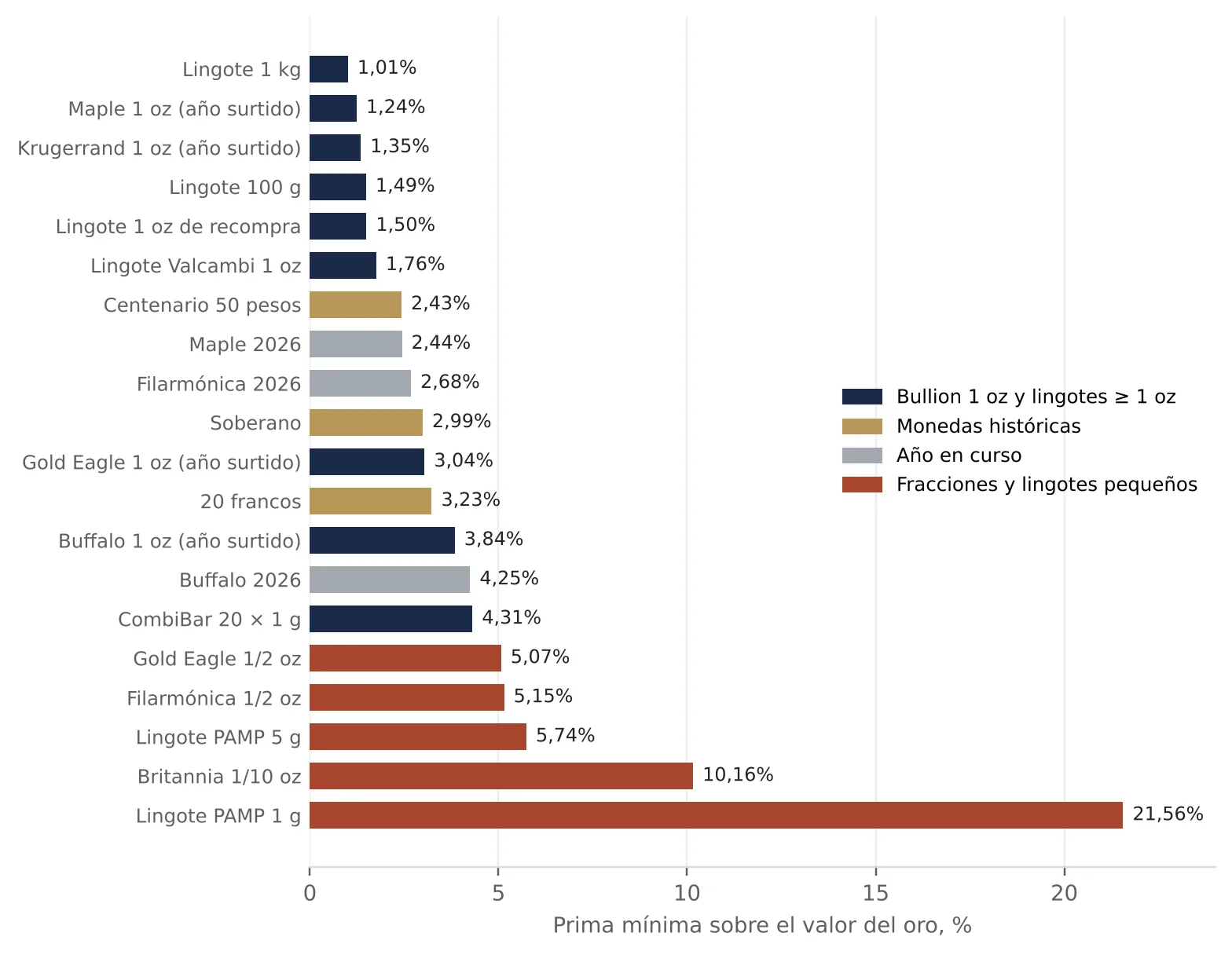
The ladder is clear. Bars of 1 oz or more and 1 oz random-year government bullion coins cost 1–1.8%. Current-year and historic coins, 2.4–3.2%. Fractions and small bars jump to 5–22%. The tenth-ounce and the gram cost between 8 and 18 times more premium per gram than a Maple.
| Avoid | Why | Typical lowest premium |
|---|---|---|
| 1/10 oz fractions and 1–5 g bars | The cost of making and selling a piece is almost the same as for an ounce | Tenth-ounce: 9–11% · 5 g: 5–10% · 1 g: 15–32% |
| Older specific years (Buffalo 2025, 1/4 oz Krugerrand 2025) | They are not replenished by buybacks; a single seller sets the price | +1 to +5 points in ounces; +9 to +10 in fractions |
| Current-year coins (Krugerrand 2026, Buffalo 2026) | The mint charges a fixed surcharge and it almost never gets cheaper | Krugerrand 2026: ~4% · Buffalo 2026: ~4.2% |
| Gold Eagle and Buffalo outside the US | An American brand premium that is not recovered in Europe when you sell | +1.5 to +2.5 points over the Maple |
| Half-ounces in a panic | They amplify the cycle: under stress their premium triples | 1.4% in calm conditions · 5.5% in a panic |
When to buy
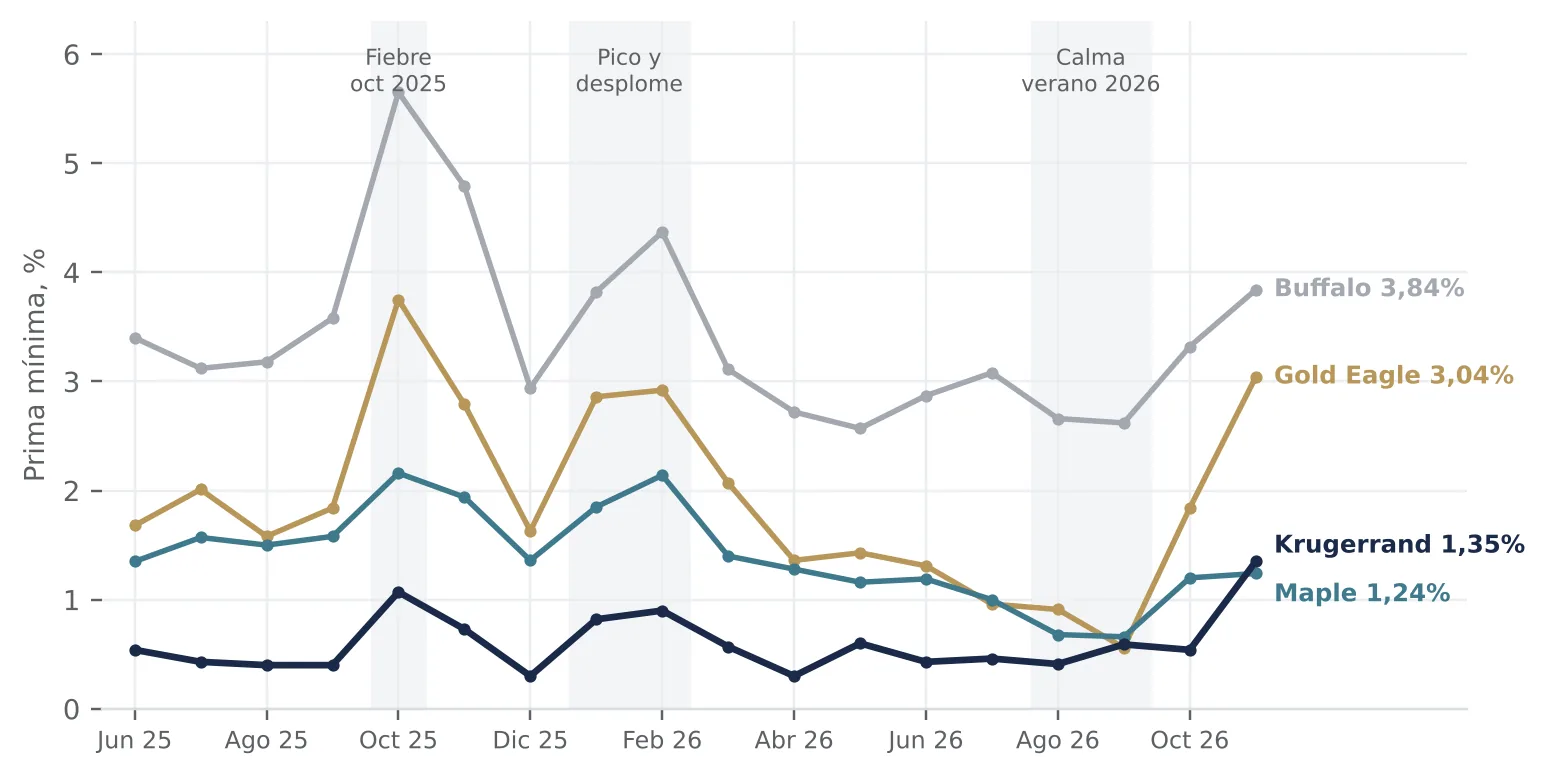
- Never in the days that follow a sharp move. In the buying frenzy of October 2025 and after the crash of 30 January 2026, the Gold Eagle's lowest premium rose to 3.75% and 2.92%, and the Buffalo's to 5.65%.
- The best moment is prolonged calm. In August and September 2026, with gold stable, the Maple fell to 0.66%, the Gold Eagle to 0.56% and the Krugerrand moved in the 0.4–0.6% range. It was the best buying window of the year, three months later than in silver.
- Today (4 November 2026) there is a buy signal on the way down. With gold at ~4,040 USD (~€3,590), after the biggest fall in an October since 2008, the lowest premium has risen across all random-year coins. On the Gold Eagle it is already above its February level. Krugerrand and Maple are still cheap (~1.2–1.4%).
- Buy in several instalments. Spreading the purchase over several weeks or months averages out both the gold price and the premium.
Coin, fraction or bar? And in what proportion
First, 1 oz coins. In gold, unlike silver, the 1 oz government bullion coin is not dearer than the bar: in the US the random-year Krugerrand was cheaper than any 1 oz bar in almost every month, and in Europe the Krugerrand (0.57%) and the Maple (0.62%) cost less than the 100 g bar (0.65%) or the 1 oz bar (0.72%). They can also be sold in parts and are bought back by any shop.
- The large bar only saves money from 250 g upwards. In Europe, the 250 g bar cost 0.32% and the kilo 0.39%; in the US, the kilo moved between 0.6% and 1.0% all year. The saving against a Krugerrand is 0.2–0.4 points: storage convenience rather than a saving.
- Mid-size bars add nothing. The 100 g bar cost twice the premium of the Krugerrand in calm conditions in the US (~1.45% against ~0.5%), and the 1 oz bar between 0.4 and 1.5 points more.
- Fractions, only if the budget does not reach an ounce. If it does not, a Sovereign or a 20 francs is better than a modern half- or quarter-ounce: they cost half the premium per gram.
The bar comes in when the position is large. A prudent rule is that no single piece should weigh more than 20–25% of what you hold in gold. With gold at ~€3,590 an ounce, a 250 g bar is worth about €29,000 and a 1 kg bar about €115,000. That is why the first large bar makes sense from around €120,000, and the kilo from around €500,000.
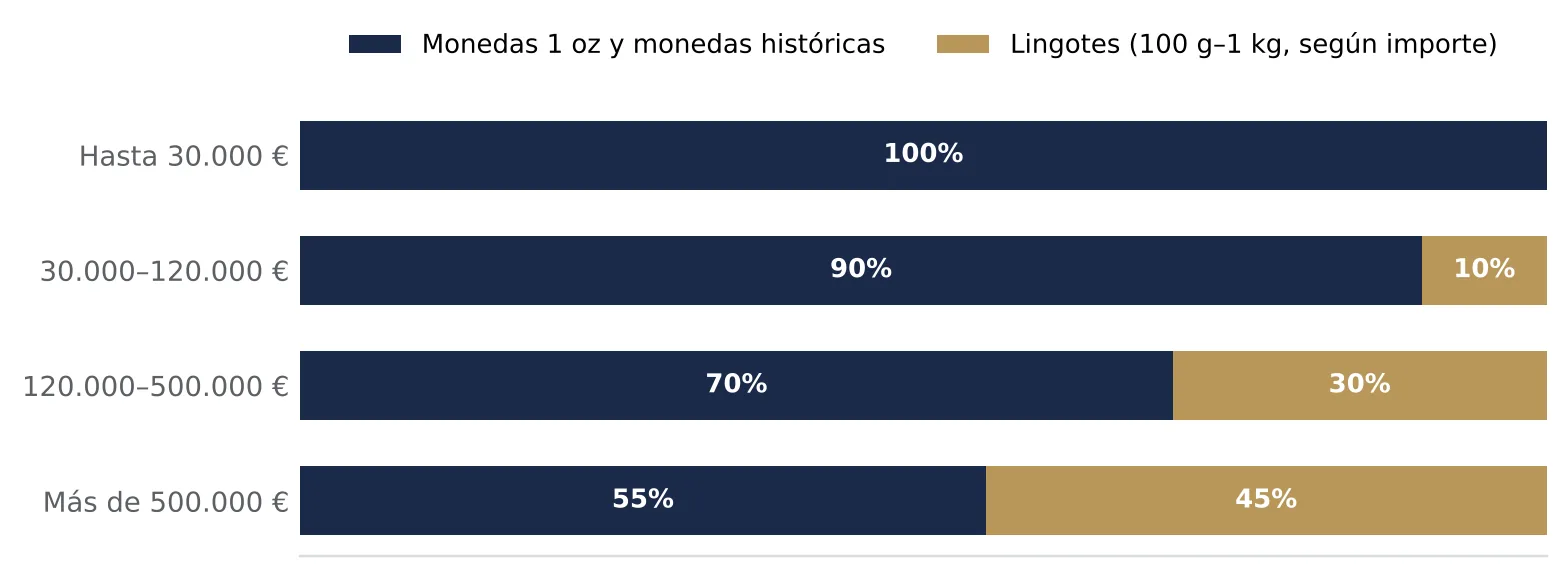
| Total gold | 1 oz coins | Bars | Why |
|---|---|---|---|
| Up to €30,000 | 100% | 0% | Any worthwhile bar would weigh too much; the coin is just as cheap |
| €30,000–120,000 | 90–100% | 0–10% | A 100 g bar only if its premium is clearly below the Krugerrand's |
| €120,000–500,000 | 70% | 30% | 250 g or 500 g bars, the cheapest on the European market |
| More than €500,000 | 50–60% | 40–50% | Kilos for convenience; keep at least half in coins so you can sell in parts |
What to expect
The premium is a cost that gold has to recover before you make money. With a well-bought 1 oz coin, a rise of ~1% is enough to break even if you resell at the metal price. With a tenth-ounce you need ~10%, and with a gram ~20%. On top of that comes the shop's buyback discount, which in gold is usually larger than the premium itself. And gold is volatile too: in 2026 it went from 5,595 USD to less than 4,000 in five months (−27%). Buy only with money you can leave untouched for several years.
This article is for information only and does not constitute personalised investment advice.
November 2026 update
Gold closed October down 6.7%, the biggest fall in an October since 2008, and hit its lowest level in twelve months. As of 4 November it trades at ~4,040 USD (~€3,590). The fall has triggered buying by the public: in Germany, 95% of the enquiries at the country's largest comparison site were to buy and only 5% to sell, against 87/13 a year ago.
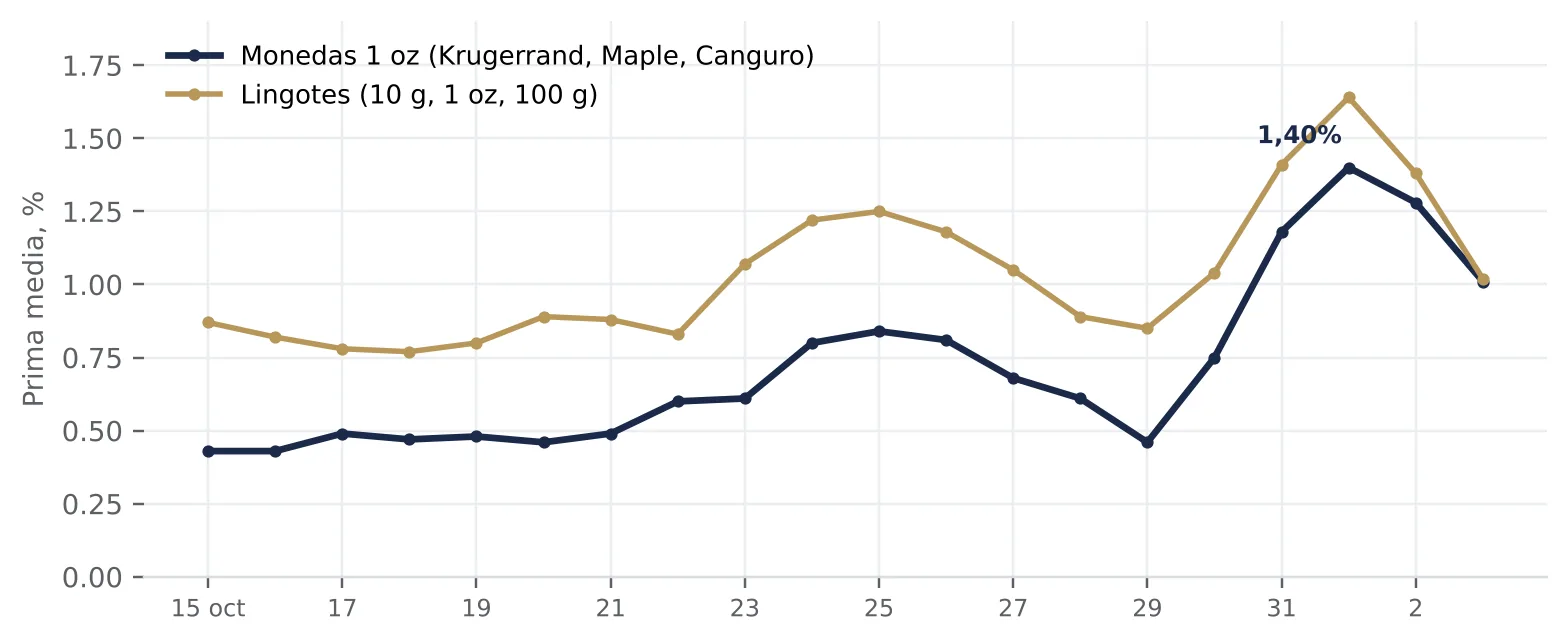
- In Europe, the coin premium went from 0.43% to 1.40% between 15 October and 1 November, and fell back to 1.01% on the 3rd. It is a sharp rise in percentage terms, but we are talking about some €35 per ounce.
- In the US, the rise is concentrated in the American coins. The lowest premium on the random-year Gold Eagle went from 0.56% in September to 3.04% in November (from ~24 to ~119 USD per ounce). The Maple's and the Krugerrand's went only from ~0.6% to ~1.3%.
- The historic coins are rising at the same time too: the Sovereign, from 1.54% to 2.99%; the Centenario, from 1.30% to 2.43%; the 20 francs, from 2.44% to 3.23%. It coincides with the Diwali season, the great gold-buying period in India and the Middle East, where the Sovereign is the benchmark coin.
- This is not stress like January's. No 1 oz random-year government bullion coin, apart from the Gold Eagle, has exceeded its highs of October 2025 or February 2026.
- Small bars are tightening too. The Valcambi 5 g bar has a lowest premium of 7.9% today, above its historic average (6.3%), and goldsilver.ai flags it as elevated. Its average premium is 12.8%. There is a wide gap between shops: 14.9–15.7% at the dearest. The PAMP 5 g is still at ~5.7%: in small pieces, the brand and the shop move the price more than the market does.
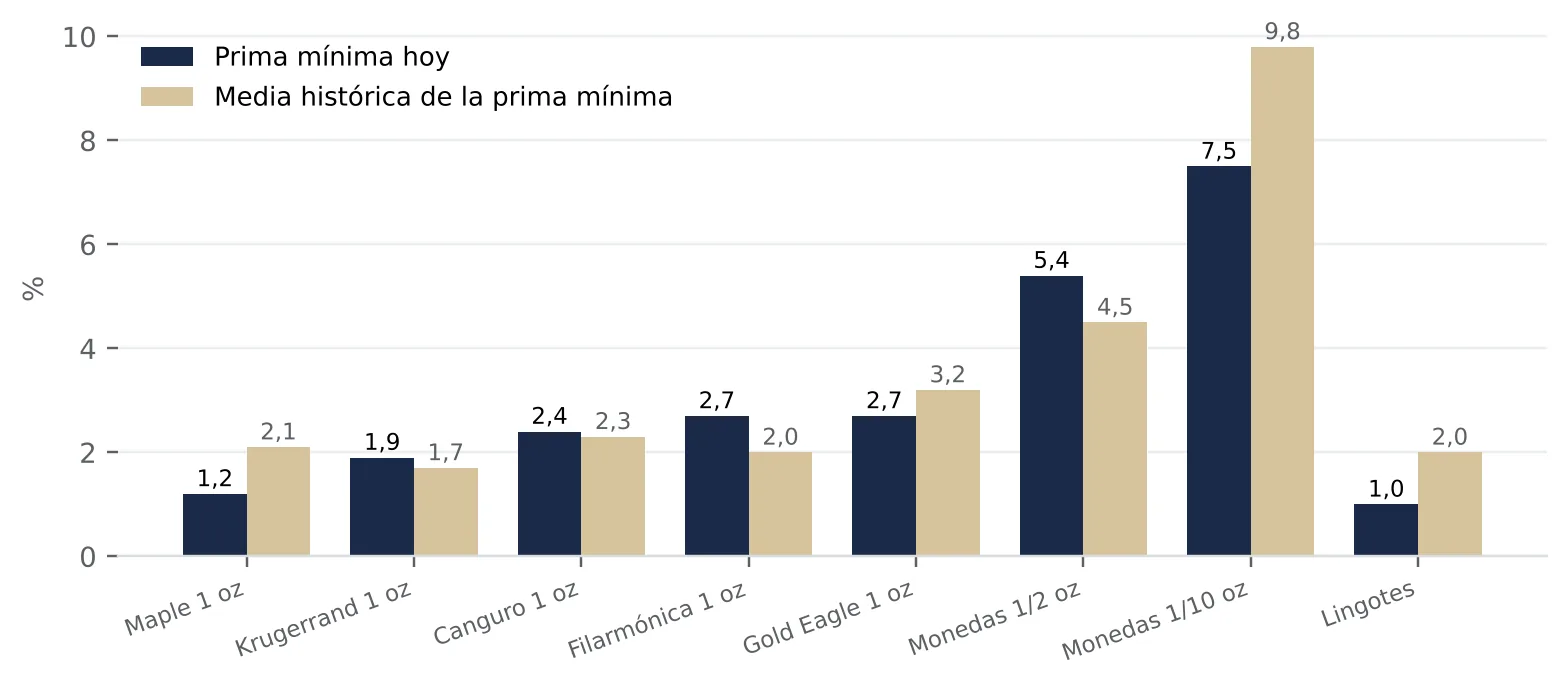
The practical reading: today is a good moment for Krugerrand, Maple or large bars, which are at or below their average. It is a bad moment for half-ounces and for the American coins, which are above. The Philharmonic looks dear in the US because it is a niche coin there; in Europe it is one of the cheapest.
In large bars, the rise has reached the average premium but not the lowest one. On the Argor-Heraeus kilo, the average premium has gone from ~1.2% in the summer to 2.0% (historic average, 1.6%), and the site itself flags it as elevated. The lowest is still at 1.4%, its normal level. In other words: the kilo is still a good buy, but only at the cheapest dealer. Between the best and the worst offer for the same bar there is more than a point today, some 1,300 USD per kilo. On top of that, the branded kilo costs ~0.4 points more than the generic one (1.0% in November).
What the data shows
We have analysed the daily and monthly premiums of more than thirty gold products on two US comparison sites (FindBullionPrices and goldsilver.ai) between June 2025 and November 2026, and cross-checked them against the European comparison sites (gold.de) and the press in each region. Four distinct behaviours come out:
How to read the figures in this study. The lowest premium is the cheapest offer published on the comparison site that day or that month: it may not include shipping, insurance or payment fees, and it may require a bank transfer, a minimum quantity or a specific year. The average premium is the average of the shops that publish a price on the comparison site. What you pay at a particular shop, especially outside Germany or in a bricks-and-mortar shop, is usually between the two or above. We use the lowest premium to compare products with each other and over time, not as the price any buyer will pay. To decide, what counts is the final price and what you would be paid on resale.
| Product type | Lowest premium in calm conditions | In a panic | Examples |
|---|---|---|---|
| 1 oz random-year bullion | 0.3–1.3% | Rises 1–3 points and comes back in 1–3 months | Krugerrand, Maple, Gold Eagle |
| Fractions and small bars | 1.4–17% | Shoots up (half-ounce ×3, 5 g bar ×2) or does not move (tenth-ounce) | Half-ounces, 1/10 oz, 1–5 g bars |
| Historic coins | 1–2% | They do not react: they hit their lows in the panic | Sovereign, 20 francs, Centenario |
| Bars from 250 g to 1 kg | 0.3–0.8% | They barely move | Kilo, 500 g, 250 g |
- There are two episodes of stress, not one. The buying frenzy of October 2025, with queues at the shops, gold at ~4,380 USD and the biggest daily fall since 2013 on the 21st, stretched premiums as much as the crash of January 2026.
- Each format has its buyer and its moment. Grams get dearer in euphoria and at Christmas. The 1 oz coins, after the crashes. The historic ones, in the traditional buying seasons (Diwali).
- Comparing shops saves more than choosing the moment. On the same day, for a 1 oz Maple, there were 3.5 points of difference between the cheapest and the dearest dealer in the US, more than the premium moves in a panic.
The full cycle
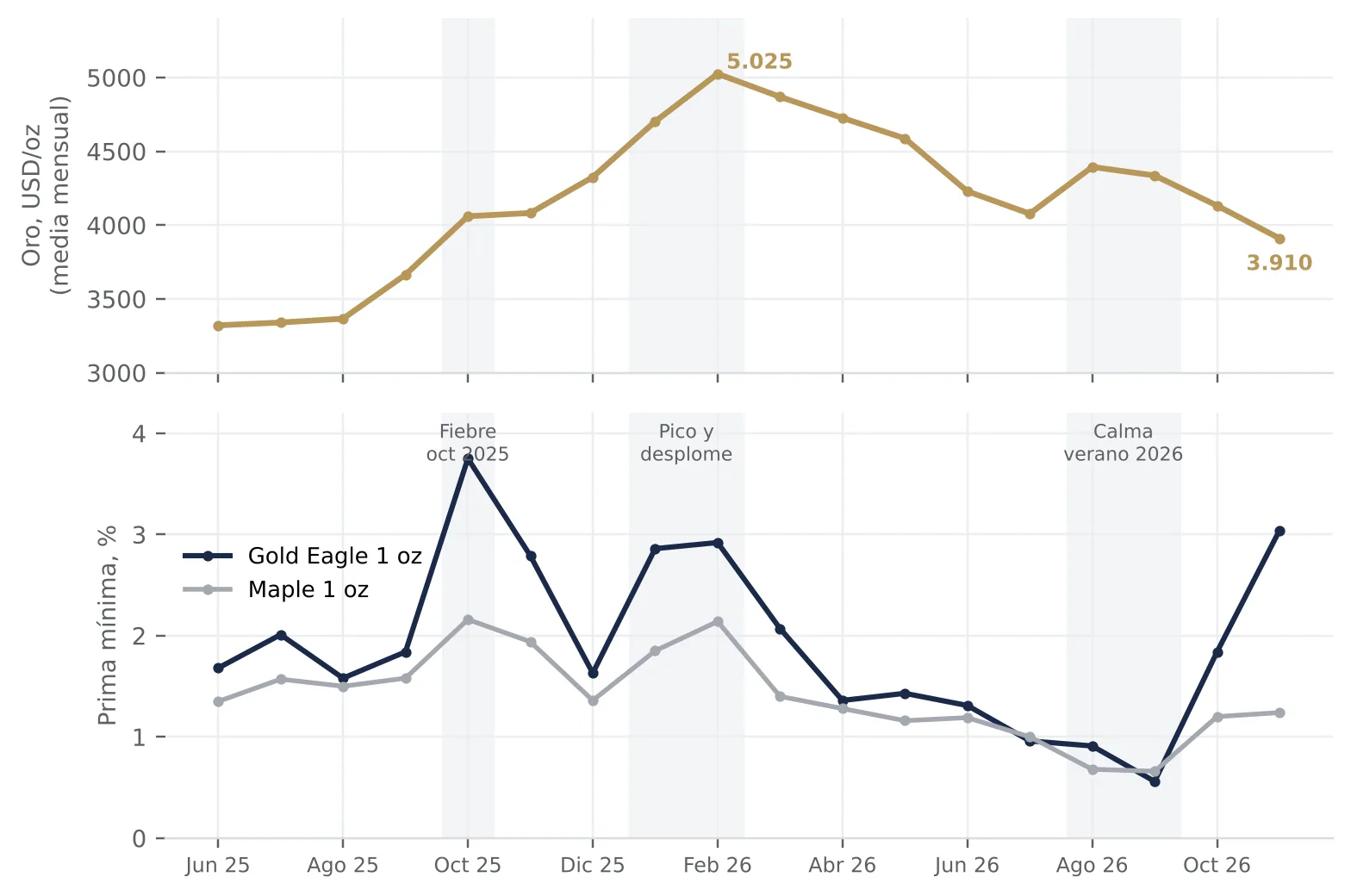
October 2025: the first frenzy
Gold hit ~4,380 USD on 20 October, with queues at shops across much of the world and the Diwali season under way. On the 21st it fell by up to 6.3%, its biggest daily fall since 2013. The Gold Eagle's lowest premium rose to 3.75%, the Buffalo's to 5.65% and the Maple's to 2.16%: the highs of the whole series.
January and February 2026: the peak and the crash
Gold rose without pause to a record 5,595 USD on 29 January. On the 30th it fell 9.5%, the biggest daily fall since 1983, after the nomination of the new chair of the Federal Reserve. On the way up, ounce premiums compressed (Krugerrand to 0.30% in December). After the crash they jumped: Maple to 2.14% and Gold Eagle to 2.92% in February. On that 30 January there were dealers who sold Philharmonics and Centenarios below the value of their gold, with prices that had not been updated.
March to September: the long normalisation
Gold corrected to ~3,995 USD at the end of June (−27% from the high) and then stabilised. Buybacks from the public refilled the market and premiums fell month by month to their lows in August and September.
How long the premium takes to come back
| Product | Peak (Feb 2026) | One month later | Back to its normal range |
|---|---|---|---|
| Krugerrand 1 oz | 0.90% | 0.57% | 1 month |
| Maple 1 oz | 2.14% | 1.40% | 2–3 months (and it kept falling until September) |
| Gold Eagle 1 oz | 2.92% | 2.07% | 2 months |
| Gold Eagle 1/2 oz | 5.48% | 4.02% | 4 months |
| PAMP 5 g bar | 10.34% | 8.08% | 2 months |
| Valcambi 1 oz bar | 1.80% | 1.80% | 6 months: the bar normalises later than the coin |
The arithmetic effect: beware the percentage
Not all premiums behave the same way when gold moves. Some are a fixed amount per piece: the 20 francs cost ~18–20 USD in lowest premium for almost the whole year, so in percentage terms it rose only because gold was falling. Others are a fixed percentage: the 1/10 oz Britannia stayed at 9–11% all year, and the Buffalo 2026 at ~4.2% from May onwards. To know whether a rise in the premium is real demand, look at whether it also rises in dollars or euros, not just in percentage terms.
The current-year coin and the specific year
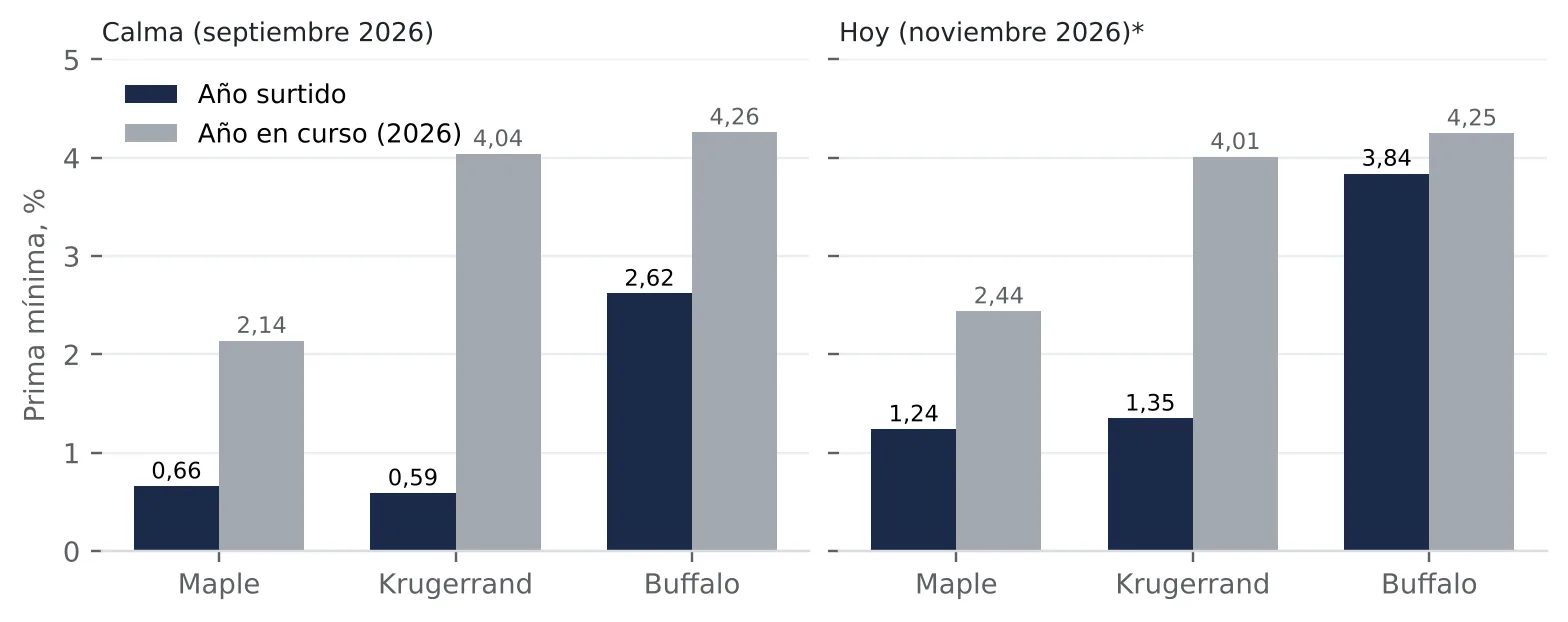
- The Maple 2026 is the cheapest new coin (~2–2.4%): the Canadian mint supplies without interruption. The Krugerrand 2026 and the Buffalo 2026 cost ~4%.
- The Krugerrand changes places depending on the version. The random-year one is the cheapest coin in the US; the 2026 one is among the dearest, with few dealers and a premium that rose from 2.6% to 4% over the year.
- In calm conditions the new coin costs 1.5–3.5 points more; under stress, much less. In February the Maple 2026 cost only 0.25 points more than the random-year one; in September, 1.5 points more. It is the same rule as in silver: the new one only comes out almost level when random year run out.
The older specific year
| Coin | Generic or random year | Specific year 2025 | Extra cost |
|---|---|---|---|
| Maple 1 oz (average of the lowest premium) | 2.1% | 3.3% | +1.2 points |
| Kangaroo 1 oz (average of the lowest premium) | 2.3% | 4.3% | +2.0 points |
| Buffalo 1 oz (usual lowest premium) | 2.6–3.1% | 7.9% | +5 points (~200 USD per ounce) |
| Krugerrand 1/4 oz (lowest premium today) | 5.8% | 14.5% | +8.7 points |
| Gold Eagle 1/4 oz (lowest premium today) | 7.9% | 18.3% | +10.4 points |
Watch out for one-off offers. Today there is a Maple 2025 at 1.2% and a Buffalo 2025 at 3.7%, from a single dealer that appears to be clearing stock. They are exceptions worth taking if they appear, but they are not the normal price for a specific year.
Fractions: what it costs to buy small
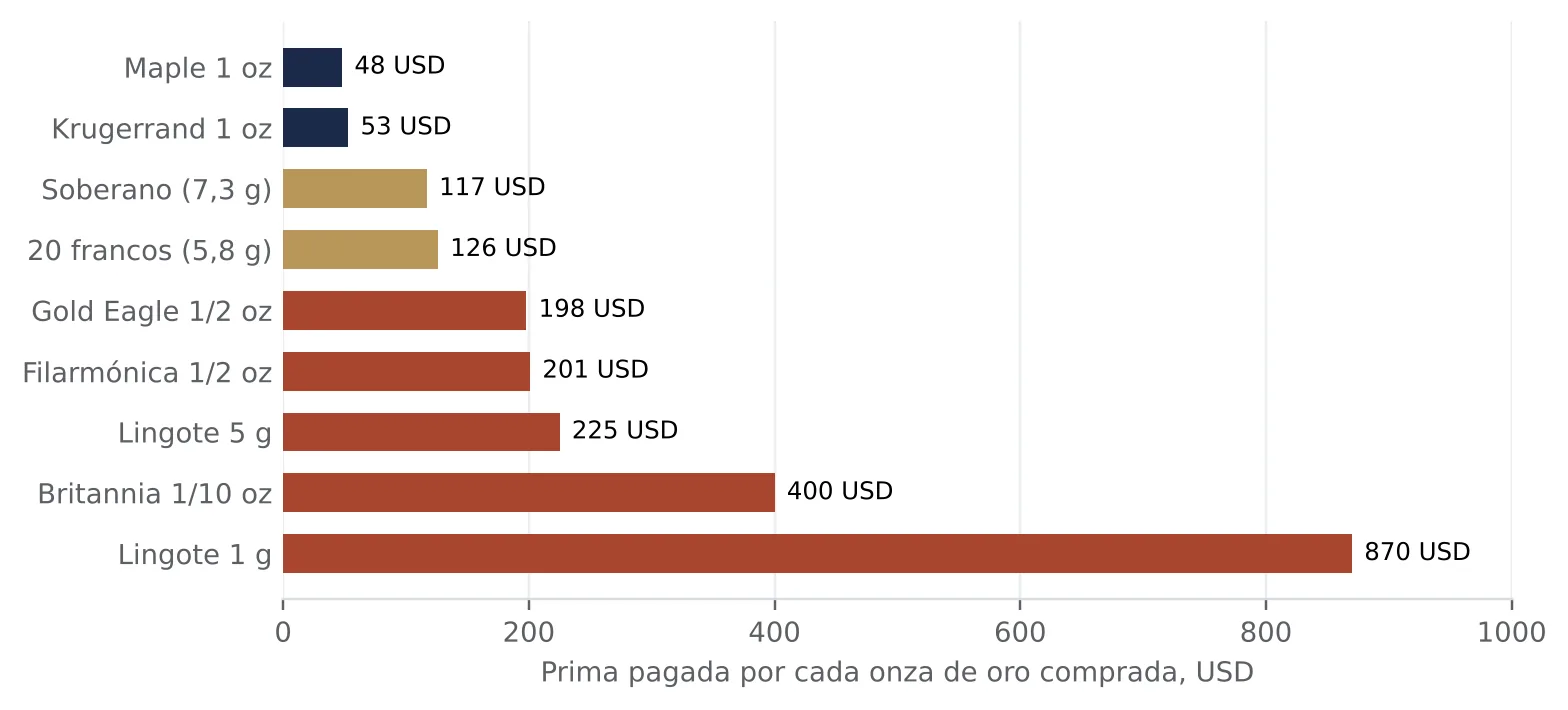
The reason is the cost per piece. Making, packaging and selling a 3 g coin costs almost the same as a 31 g one: a 1 g bar carries ~28 USD of premium, a tenth-ounce ~40 USD and a 1 oz Maple ~48 USD. Spread over the grams, the small piece works out extremely dear.
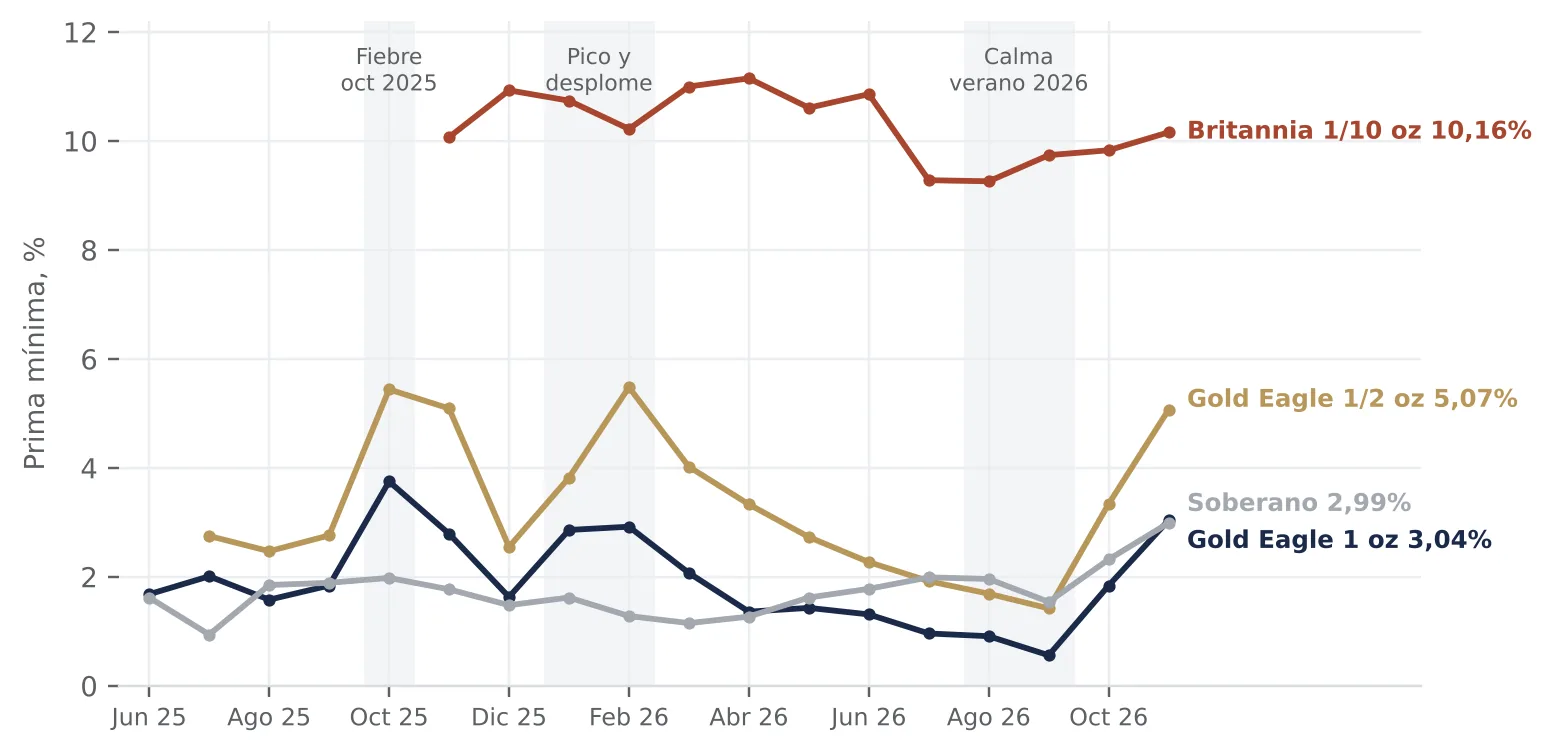
- The half-ounce depends on the moment. In September 2026, the Gold Eagle half-ounce cost 1.42%, less than a point above the whole ounce. In February, 5.48%. Bought in calm conditions it is reasonable; in a panic it is the worst possible purchase.
- The tenth-ounce has no good moment. It stayed at 9–11% all year, reacting to neither panic nor calm. It is for giving as a present, not for investing.
- The gram gets dearer in euphoria. The 1 g bar hit its high (31.7%, ~49 USD per piece) in January, with gold at a record and in the middle of the gift season, not after the crash. In calm conditions it costs ~16–18%.
- If you want grams, buy a CombiBar. The divisible 20 × 1 g bar costs ~3.4–4.3% (about 5 USD per gram), against ~16–22% for the loose gram (23–28 USD). Same product, a fifth of the premium.
Bars: the kilo is cheap; the mid-sizes are not
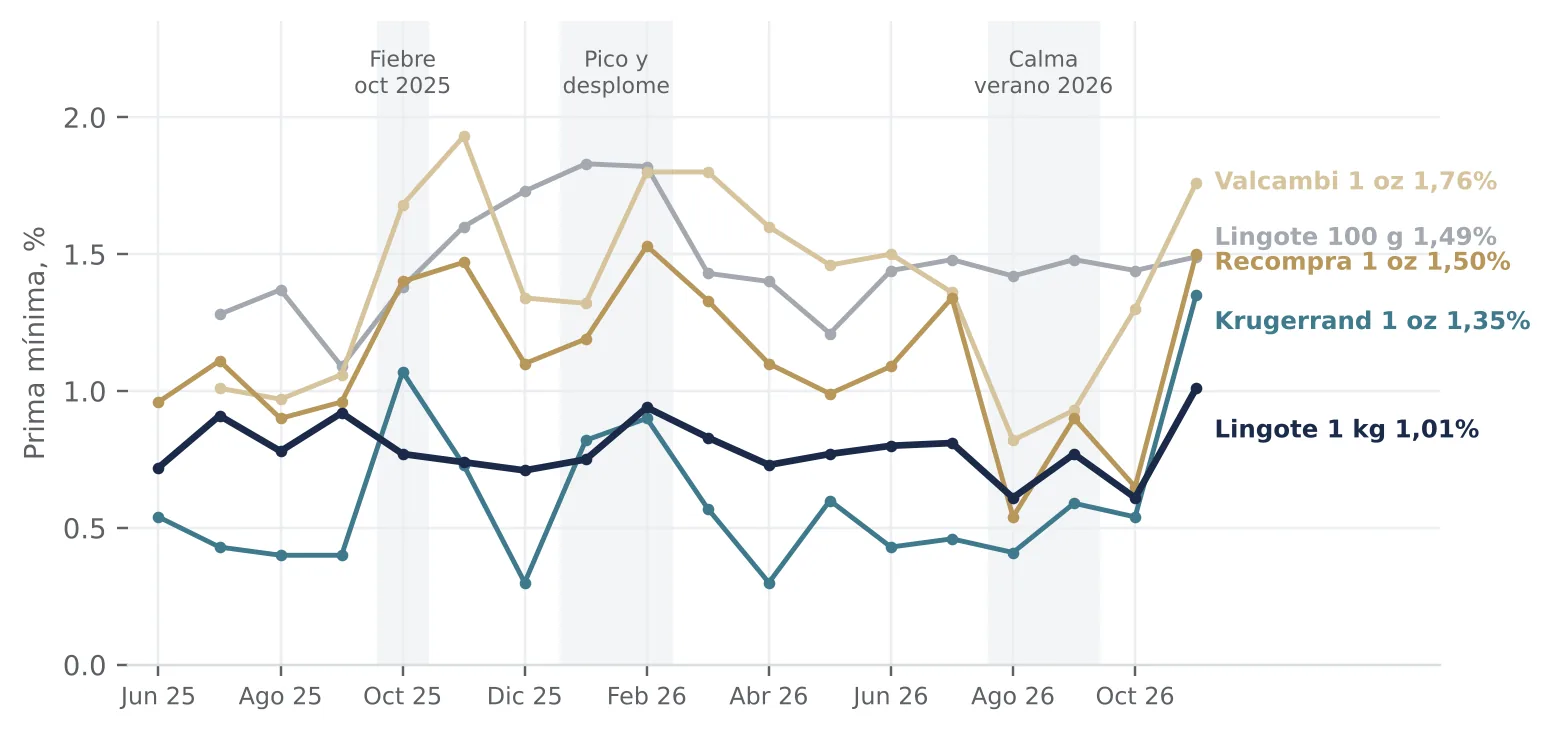
- The kilo moved between 0.61% and 1.01% over 17 months (30–45 USD per ounce). It beat or matched the Maple every month and only lost to the Krugerrand in calm conditions (~0.3 points).
- The 100 g was dear in calm conditions (~1.45%, twice the kilo) and barely reacted to anything. The 1 oz bar, new or buyback, cost the same or more than the Krugerrand almost always.
- In standard bars the brand hardly counts; in special-presentation ones it does. Between a new Valcambi bar and a buyback one there is ~0.25 points. But the 1 oz Argor-Heraeus Kinebar, with hologram and case, has a lowest premium of 3.4% today and an average of 4.5%, at its normal level. That is double a Valcambi (1.76%) or a Krugerrand (1.35%), and since August it reached 4.5–5%. You are paying for the packaging, not the gold: some 80 USD more per ounce.
- After a panic, the buyback bar gets cheaper sooner, because it is what the public resells: in March–June 2026 it came out ~0.4–0.5 points cheaper than the new branded one.
| Bar | Lowest premium in calm conditions (Aug–Sep 2026) | Comment |
|---|---|---|
| 1 g | ~17% | For giving as a present; in Europe, from ~4% second-hand |
| 5 g | ~5–6% (PAMP and Valcambi) | Doubles in a panic; Valcambi at 7.9% today |
| CombiBar 20 × 1 g | ~3.4% | The cheap way to hold grams |
| 100 g | ~1.45% | No advantage over the 1 oz coin |
| 1 oz (new or buyback) | ~0.7–0.9% | Similar to the Maple; worse than the Krugerrand |
| 1 oz Kinebar (hologram) | ~2–3% | Premium presentation: double a standard bar |
| 1 kg | ~0.6–0.8% | The most stable; only for very large positions |
Historic and Mexican coins: Centenario, Sovereign, 20 francs
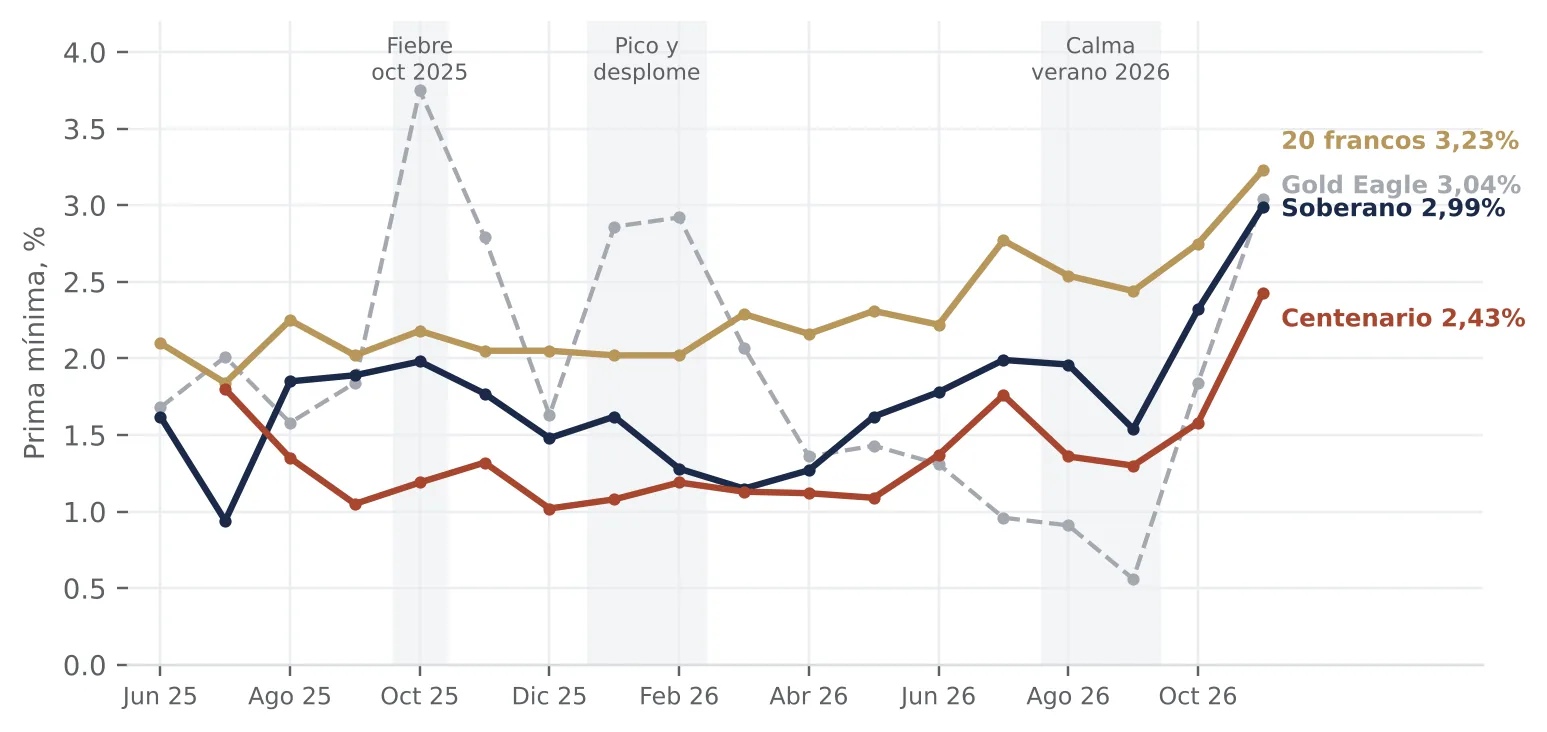
The historic coins are bought almost as bullion and behave differently. Their lowest premium was stable and immune to the panics: in the February crash, the Sovereign hit its low (1.15% in March) and the Centenario barely moved (1.19%). Their buyer is not the one who reacts to the falls, but the collector and the traditional saver.
The 50 pesos Centenario
It is a coin with a lot of gold per piece (37.5 g, 1.2057 oz) and history going back to 1921, and in lowest premium it is as cheap as a Maple: 1.0–1.4% for almost the whole year. Between October 2025 and February 2026 it was even cheaper than the Maple. In November it rises to 2.43% (~115 USD per coin). Its average premium, on the other hand, reached ~4% in October: there is a wide gap between shops, so comparing them is essential.
The British Sovereign
It is the exception among small pieces. With 7.32 g of gold (a quarter-ounce in practice) it cost 1.2–2% in calm conditions, almost the same as an ounce and much less than a modern quarter-ounce. It has been struck since 1817, there are tens of millions in circulation and in the United Kingdom it is exempt from capital gains tax. It is the benchmark gold coin in India and the Gulf.
The 20 francs
It is the coin most immune to the panics in the study: its lowest premium moved between 1.8% and 2.3% from June 2025 to June 2026. In the US it is a niche coin and costs somewhat more than the Sovereign. In Europe it is a local coin: on 26 October it cost 0.66% over the metal, the same as a Maple.
The Chinese Panda: a semi-numismatic gold coin
The 30 g random-year Panda can be bought at ~3% from the cheapest dealer, but its average premium jumped from ~4–5% to ~8.5–9% in recent weeks, and between shops there is more than 300 USD of difference for the same coin. It is the same pattern as the silver Panda and Libertad, on a smaller scale: a collector's piece, not a cheap way to accumulate gold.
Which format copes better with volatility
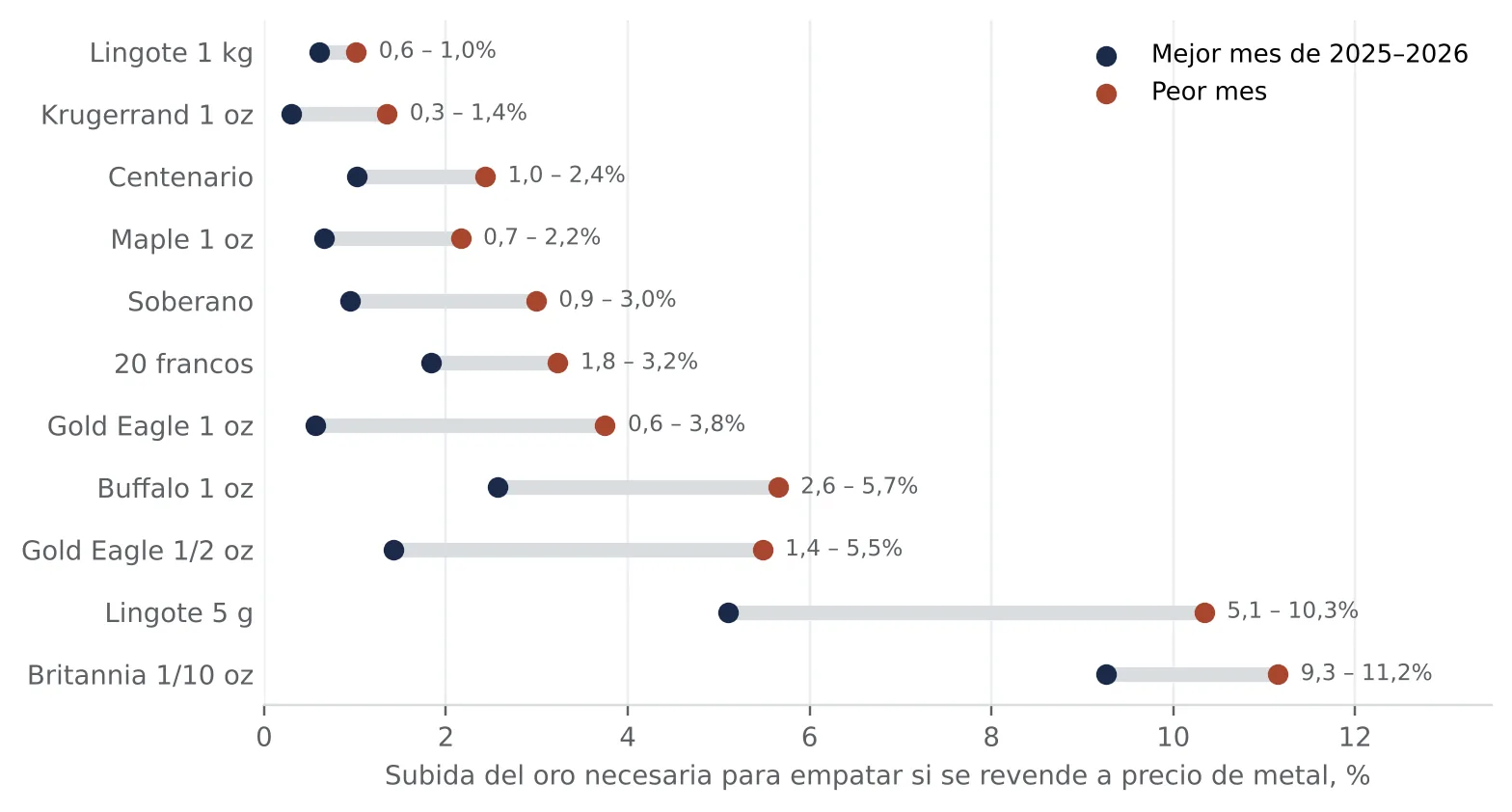
The range between the best and the worst month tells you how much is at stake when you choose the moment. It is 0.4 points on the kilo and a point on the Krugerrand; on the Gold Eagle and the half-ounce, 3–4 points; on the Buffalo, 3. The tenth-ounce has little range, but it starts from a floor of 9%.
Regions: where and why the premium changes
United States: the brand premium
In the US, the coins from its own mint, the Gold Eagle and the Buffalo, carry a mark-up under stress that does not exist in Europe. The random-year Buffalo never fell below ~2.6%, and the Gold Eagle goes from 0.6% to 3–4% as soon as the American public buys the dip, which is what is happening now. Worldwide, demand for bars and coins fell 19% in the third quarter of 2026 (268 t), while central banks bought 42% more (321 t) and exchange-traded funds added 211 t.
Europe: the cheapest gold in the world for the small buyer
- Investment gold pays no VAT in the EU (coins of 900 fineness or higher struck after 1800 and sold for less than 180% of the value of their gold, and bars of 995 fineness or higher). That is why, unlike silver, the European premium is pure commercial margin.
- Dealers have cut their margin. The average gold premium on the German comparison site fell from 1.21% in October 2025 to 0.78% in October 2026, even though the price rose.
- Historic coins are local. The 20 francs, the Sovereign and the Austrian coronas cost the same in Europe as a Maple (0.7–1.2%), whereas in the US they pay 2–3 points.
- Germany is not all of Europe. The German comparison site brings together the most competitive online dealers on the continent. In other countries, and in bricks-and-mortar shops, the usual premium is higher, and the order between coins can change: in some markets the Maple is cheaper than the Krugerrand. Always compare the final price, with shipping.
- Gold Eagle and Buffalo are not worth it here. They have the same liquidity as a Krugerrand or a Maple, but their American brand premium is not recovered when selling in Europe.
Asia: policy premiums
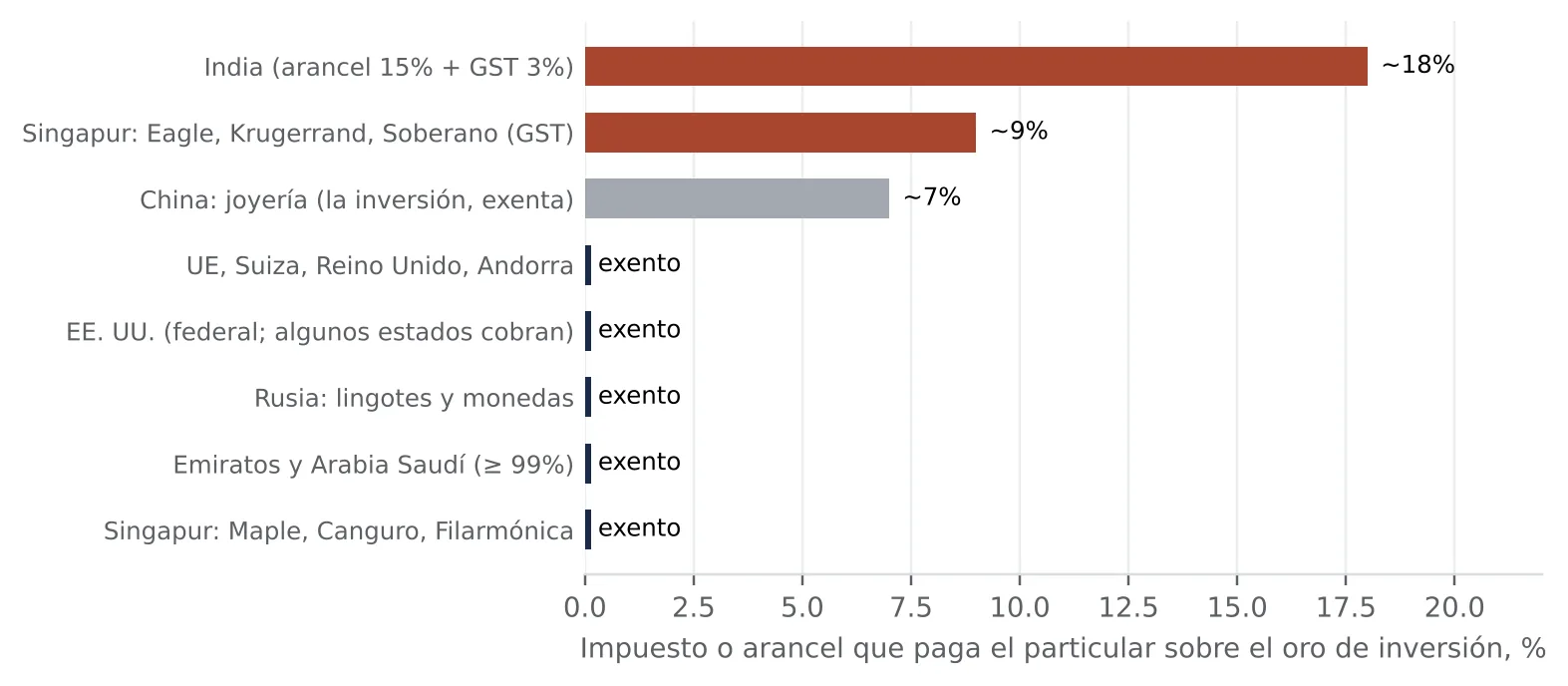
- India raised the gold import duty from 6% to 15% in May 2026 (plus 3% GST). Before that, in January, the local premium reached 112 USD per ounce, the highest since 2014, on fears of that increase; afterwards, the market moved to a record discount of up to 207 USD against the official price, because demand stalled.
- China cut the VAT credit on gold not destined for investment from 1 November 2025. Jewellery became ~7% dearer, while bars and coins bought from members of the Shanghai Gold Exchange kept their tax treatment. The effect was to divert buying towards bars and funds.
- Singapore exempts investment gold from GST, but only coins of 995 fineness or higher included on its list. The Gold Eagle, the Krugerrand and the Sovereign, at 22 carat, pay 9%. There the Maple and the Kangaroo are the efficient coins.
The Middle East and Turkey
In the Gulf, investment gold of 99% fineness or higher is free of VAT, and the Sovereign is the traditional coin. In Turkey, gold is the benchmark form of saving against the lira. The Turkish Mint produced more than 5.1 million coins in the first quarter of 2026, a record, and local premiums widen in episodes of currency stress.
Russia
Russia removed the 20% VAT on bars for private individuals in March 2022 (coins were already exempt) and exempts the gain on their sale from tax. Buying soared, above all in kilos, and the government has proposed limiting gold leaving the country to 100 g per person.
The gold tax map
| Jurisdiction | Purchase | Particularity |
|---|---|---|
| European Union | Exempt | Coins of fineness ≥ 900 and bars ≥ 995; annual list of coins in the Official Journal of the EU |
| United Kingdom | Exempt | Sovereign (from 1837) and Britannia are also exempt from capital gains tax |
| Switzerland | Exempt | Investment gold outside VAT |
| Andorra | Super-reduced IGI rate (0%) | No wealth tax and no inheritance tax |
| US | No federal VAT | Some states apply sales tax |
| Singapore | Exempt only for fineness ≥ 995 | Eagle, Krugerrand and Sovereign pay 9% GST |
| India | 15% duty + 3% GST | Since May 2026; before that, 6% + 3% |
| China | Investment exempt | Since November 2025, jewellery loses part of the VAT credit (~7% dearer) |
| Russia | Exempt | Bars exempt since 2022; gain on sale exempt |
The conclusion for the European buyer is simple: in gold, tax does not determine the format, as it did in silver. What decides is the cost per piece, the timing and the buyback discount. The tax rules on gains depend on each buyer's country of residence; check with your adviser.
What matters is your residence and where the metal goes, not just where you buy. Andorra is not part of the EU. If you enter Spain or France with €10,000 or more in cash, gold coins of 900 fineness or higher or bars of 995 fineness or higher, you must declare it at customs (Regulation EU 2018/1672). Declaring is an obligation, not a tax, and the subsequent taxation, for example when you sell at a gain, is that of your country of residence.
The buyback spread: the cost you do not see
In gold, with buying premiums of 0.5–1.5% on 1 oz coins, the discount at which the shop buys the coin back from you usually weighs more than the premium itself. The real cost of a transaction is the sum of the two: what you pay over the metal when you buy and what is deducted when you sell.
- The differences between buyers are large. In a test by the German consumer organisation Stiftung Warentest (March 2026), the same Krugerrand received offers with €238 of difference between the best and the worst, more than 5% of the value of the coin.
- The format also decides the buyback. High-mintage government bullion coins and bars from recognised brands are bought back close to the metal price. Fractions, specific years and collector coins are bought back at a larger discount, or only at the metal price.
- The round-trip sum. If the gold in a coin is worth €3,000, the shop sells it for €3,090 (3% premium) and buys it back for €2,940 (2% below the metal), you would lose €150 instantly, 4.85% of what you paid. To get back to the €3,090 gold would have to rise 5.1%, not 3%: the rise needed is (1 + premium) / (1 − buyback discount) − 1. With a Krugerrand at a 1% premium and a buyback 1% below the metal, ~2% is enough.
- Ask for the buyback price before you buy. A shop that publishes its selling price and its buyback price at the same time lets you know exactly what the complete transaction costs.
The context: who is buying gold and who is selling
Premiums are easier to understand if you know what is happening in the market. Gold set its record at 5,595 USD on 29 January 2026 and hit a one-year low (~3,880 USD) on 30 October, after the worst October since 2008. Selling to cover margins because of the fall in technology stocks, and a Federal Reserve leaning towards raising rates, pushed investors towards Treasury bonds, not towards gold. On 4 November, after the Democratic victory in both chambers of Congress, the dollar fell to a one-month low and gold rose 3%, back above 4,000 USD.
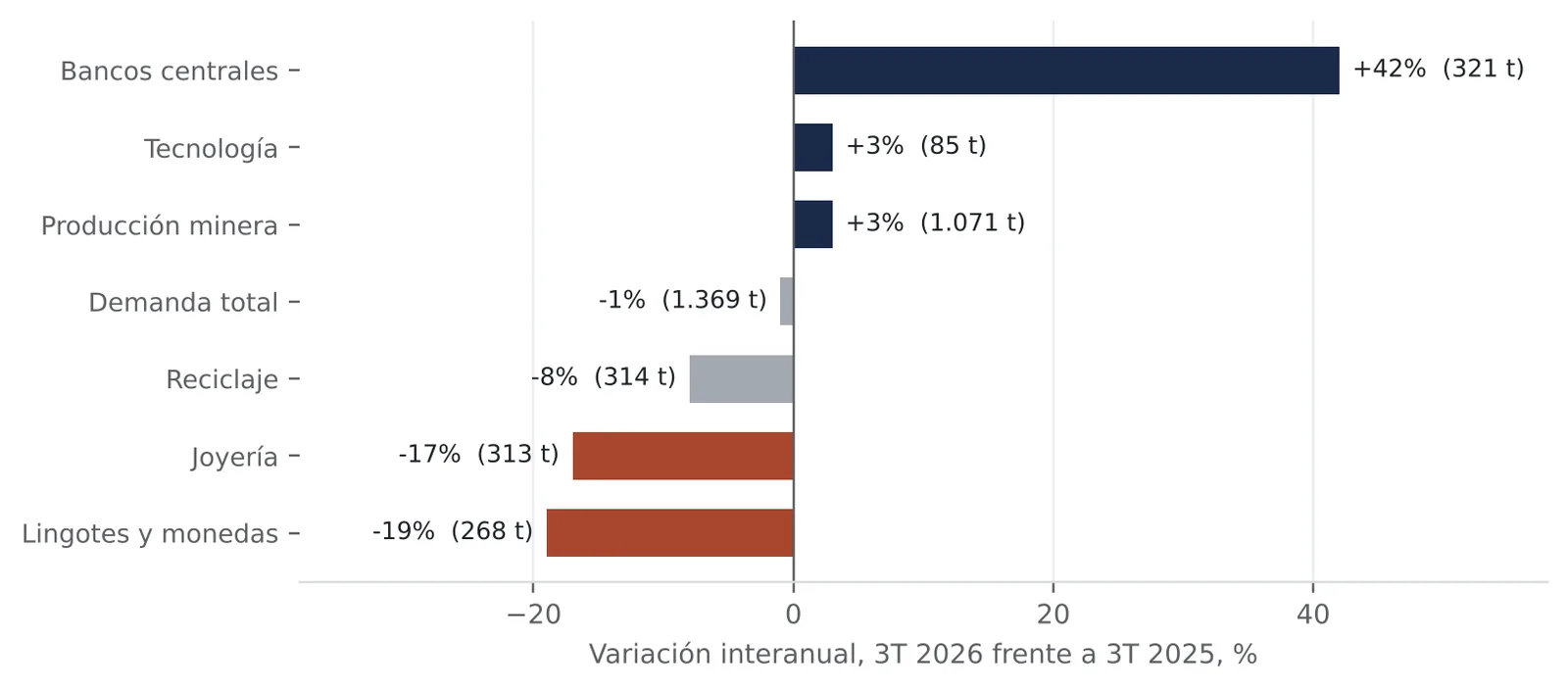
- Central banks bought 321 t in the third quarter (+42%), their best quarter since the end of 2024, and 675 t so far this year. Only some 120 t have been officially declared: almost two thirds are purchases that the World Gold Council estimates but nobody announces.
- China has been buying for 23 months in a row. In September it added some 23 t, its biggest monthly purchase in three years, and its official reserves reach 77.5 million ounces (~2,410 t). The country also imported more than 1,000 t between January and August, more than in the whole of 2025.
- Poland is the biggest buyer of the year (98 t to August, close to its 700 t target). Uzbekistan, Kazakhstan and the Czech Republic are also buying. Turkey and Russia have sold to support their currency or their budget, and Kazakhstan wants to cut gold's weight in its reserves from 78% to ~75%.
- ETFs are buying again: 211 t in the quarter, a record in dollars, with record holdings of 4,256 t. Institutional investors are buying the dip.
- Private individuals, by contrast, are buying less. Bars and coins, −19% (a four-year low); jewellery, −17% (the worst third quarter since 2000). China is up 7% in bars and coins; India is down 40%, although it expects a Dhanteras (6 November) with sales 10–12% higher than last year.
What to watch in the coming weeks. The market puts a ~83% probability on a Federal Reserve rate rise in December (meeting on the 8th–9th), the main headwind for gold. In its favour are the central bank purchases and geopolitics: the war premium from Iran and Hormuz has deflated with the fall in oil, but a new attack before the new Congress is sworn in on 3 January would be a bullish catalyst.
Where the physical gold is: vaults, delivery and Asia
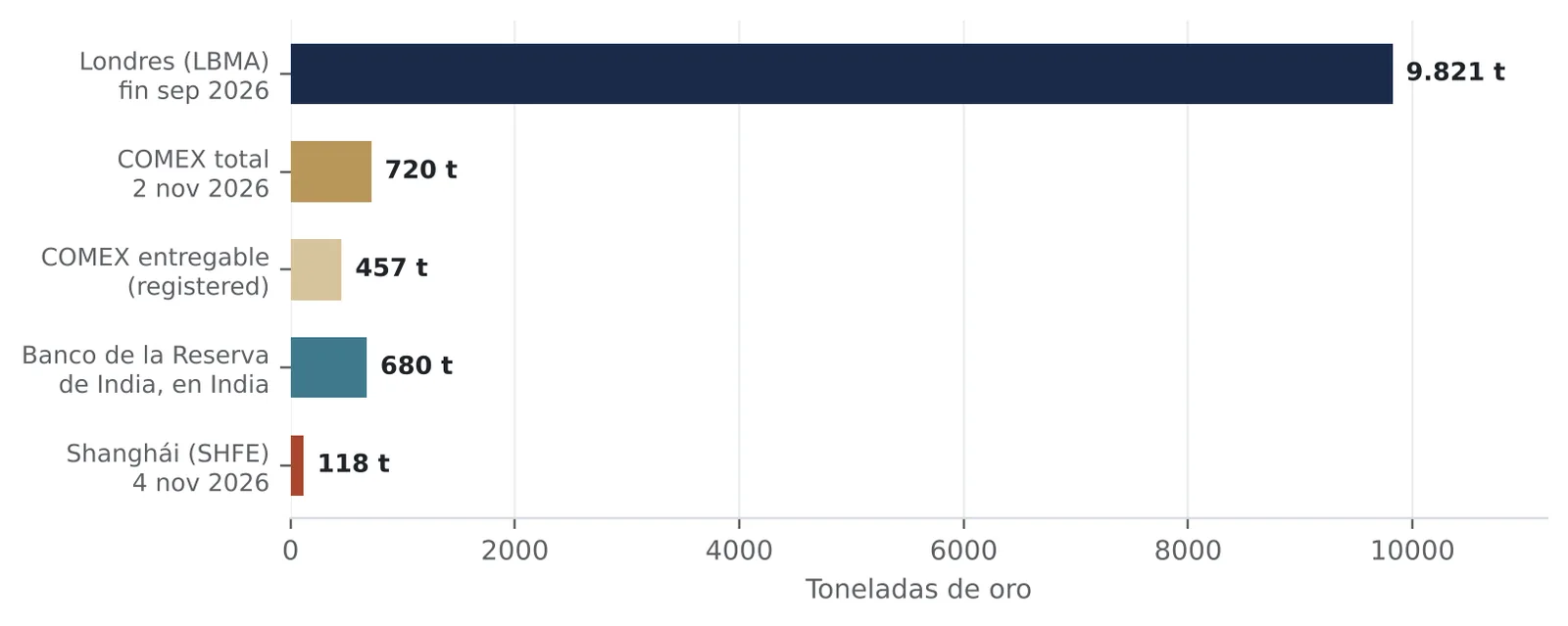
- London's vaults are full. 9,821 t at the end of September (~1.3 trillion USD), some 1,300 t more than in April 2025, when gold flew to New York for fear of the tariffs and then came back once it was exempted.
- COMEX holds 720 t, of which ~457 t are deliverable. The total has fallen from ~852 t at the start of September, but part of that fall is an accounting matter: on 21 September the bars from a withdrawn contract stopped being counted, without any metal leaving.
- Shanghai has accumulated 118 t in the warehouses of its futures exchange, against the record of ~36 t in August 2025. Even so, gold in Shanghai trades only 0.4% above London: there is plenty of metal, not a shortage.
- India is bringing its gold home. Its central bank now holds 680 of its 880 t in the country (77%), after repatriating 104 t from London in six months.
How physical delivery works on COMEX
The COMEX futures contract is for 100 ounces: one 100 oz bar or three 1 kg bars, of minimum 995 fineness and from an approved refinery. At expiry the metal does not move: the seller transfers a warrant, a certificate that identifies each bar in an authorised warehouse. Only registered gold, the gold that has a warrant, can be delivered; eligible gold meets the requirements but is not offered for delivery. Between January and August 2026 there were 173,027 delivery notices, some 538 t. The open interest in the December contract reached double the deliverable gold, but almost all contracts are closed or rolled before expiry: it is a figure to watch, not proof of a shortage.
Do you need to hold the metal before trading in Asia?
Only on the Shanghai spot market, not in futures. On the Shanghai Gold Exchange (SGE), the seller of a spot contract must have all the gold and the buyer all the money before trading. It is China's main physical market, and that is why its price reflects gold that exists in a vault. But Asia also trades with leverage:
| Market | Full metal or money before trading? |
|---|---|
| SGE spot (Au99.99, Au99.95) | Yes: 100% gold or funds, same-day settlement |
| SGE deferred (Au T+D) | No: 18% margin since February 2026 |
| Shanghai futures (SHFE) | No: cash margin. Private individuals cannot receive the gold; only institutions deliver |
| MCX (India) | No during the contract (margin). At expiry delivery is compulsory, with an extra 5% margin |
| COMEX (New York) | No: cash margin; almost everything is closed before expiry |
The new clearing system: what exists and what does not
- Hong Kong began trialling its central gold clearing and settlement system on 7 July 2026, with a delivery link to the Shanghai Gold Exchange and the goal of exceeding 2,000 t of storage within three years. The SGE itself opened its first vault outside China in 2025, also in Hong Kong.
- Singapore is launching a gold clearing system through its exchange (SGX) before the end of the year, and since October its central bank has been holding gold for other central banks.
- There is no gold-backed BRICS currency. mBridge, the central bank payment platform using digital currencies from China, Hong Kong, Thailand, the Emirates and Saudi Arabia, is still a pilot and has no gold component.
What it means for the coin buyer. Asia is building its own infrastructure of vaults, clearing and delivery, and central banks keep buying. That supports demand for physical gold in the long term. But in the short term there is no shortage: London's vaults are full, Shanghai trades almost at par and the gold discount in India has narrowed from 66 to 8 USD per ounce. October's fall was in the paper market, not the physical one, and that is why premiums on high-mintage coins are still low.
Andorra Metals and Mexican coins
At Andorra Metals we specialise in Mexican coins: the 50 pesos Centenario, the gold and silver Libertad in all their years and sizes, and the rest of Mexico's historic pieces. On the data in this study, the Centenario is one of the best ways to hold a lot of gold in a single piece with history, at a bullion coin premium. We help you choose the piece and the version that make sense for your budget and buy at a fair price. Book an appointment and we will go through it in the shop with the day's prices.
Conclusions
Cross-checking the data from the US, Europe and the press in six regions, the premium on physical gold comes down to three layers that are worth separating.
- The cost per piece sets the floor. Making and selling a piece costs almost the same regardless of its size. That is why the ounce and the kilo cost 0.3–1.5%, and the tenth-ounce and the gram 9–22%. It is the layer that weighs most and the only one that does not depend on the market.
- The product sets the elasticity. Random-year bullion returns to its range in 1–3 months; the current-year coin almost never gets cheaper; historic coins ignore the panics; the half-ounce amplifies them.
- Stress moves the premium in the short term. You can recognise it because the lowest premium rises, not just the average, and in dollars or euros, not just in percentage terms. Right now it is there in the American and the historic coins, not in the Krugerrand, the Maple or the large bars.
Unlike silver, in gold tax distorts almost nothing in Europe, and the premium is so low that the buyback discount and the choice of shop weigh more than the product. The practical rule is the same as in silver: random year, high mintage, whole ounces and buy in calm conditions.
What to buy, in practice
Translated into a concrete purchase, with the November 2026 data:
- To start with, a 1 oz random-year Krugerrand or Maple. They are the cheapest coins in the US and in Europe, they sell anywhere and they are the ones that return to their normal premium soonest after a panic. They are still in cheap territory today.
- If you want a piece with history, the Centenario. Plenty of gold per coin and a bullion premium. Compare prices: the gap between shops is wide.
- If the budget does not reach an ounce, Sovereigns or 20 francs rather than modern half- or tenth-ounces. If you want grams, a CombiBar, never loose grams.
- Bars, when the position grows. From ~€120,000 it makes sense to add 250 or 500 g bars, and the kilo from ~€500,000, according to the allocation table in this article.
- Avoid half-ounces and American coins for now, as they are above their average, and never buy in the days that follow a crash.
- Combine it with silver. The gold/silver ratio is at ~78, above its long-term equilibrium (~60, according to the Silver Institute). Our study on which silver coin to buy and the gold/silver ratio calculator will help you decide how much silver to add and when.
If you are unsure which coin or which format suits you, book an appointment at Andorra Metals and we will go through it with the day's prices.
Sources
Premium data
- FindBullionPrices — premium history for gold coins and bars (Krugerrand, Maple, Gold Eagle, Buffalo, Philharmonic, Britannia, Sovereign, 20 francs, Centenario, Valcambi, PAMP, kilo, CombiBar), June 2025 – November 2026
- goldsilver.ai — gold coins by size (1, 1/2, 1/4 and 1/10 oz), bars and product pages, 4 November 2026
- gold.de — Aufgeld table (26 October 2026), gold Aufgeld trend and prices for Krugerrand and 1 g bars
- gold.de — GOLD.DE Insights October 2026
- gold.de — Goldpreis: größter Oktoberverlust seit 2008
Market and press
- Business Standard / Reuters — the gold fall of 21 October 2025
- Brecorder / Reuters — record and crash of 29–30 January 2026
- SD Bullion — the gold price in 2026 (LBMA)
- World Gold Council — Gold Demand Trends Q3 2026
- Oman Observer / Reuters — Dhanteras 2025: demand shifts to coins and bars
- Stiftung Warentest — Gold verkaufen: große Preisunterschiede im Praxistest (March 2026)
Regions and taxation
- Directive 2006/112/EC, special scheme for investment gold, and the list of exempt coins for 2026 (OJEU C/2025/5923)
- HMRC / StoneX Bullion — treatment of the Sovereign and the Britannia for capital gains tax
- IRAS / BullionStar — GST exemption for investment precious metals in Singapore
- World Gold Council — India gold market update: import tightening (May 2026)
- Reuters / Mining Weekly — gold premiums and discounts in India (January and May 2026)
- SBMA — China's VAT reform and its implications for the gold market
- BullionStar — VAT in the Chinese gold market
- The Moscow Times / Reuters — record gold buying in Russia and the removal of VAT
- Restproperty / Daily Sabah — record coin production and gold demand in Turkey
- TaxDown — taxes in Andorra (IGI)
- Regulation (EU) 2018/1672 and European Commission — cash and gold controls at the EU borders
- Agencia Tributaria — leaflet for travellers between Andorra and Spain (declaration of €10,000 or more)
Central banks, vaults and markets
- World Gold Council — Central bank buying and ETF inflows support gold demand in Q3 (3 November 2026)
- Golden Ark Reserve / Kitco — People's Bank of China gold reserves, September 2026
- International Finance — China imports top 1,000 t in eight months
- World Gold Council — India gold market update (20 October 2026)
- LBMA — London vault data, September 2026
- The Vault Report — COMEX inventories, deliveries and the Shanghai premium (November 2026)
- MetalCharts — SHFE gold inventory; registered against eligible
- CME Group — COMEX rulebook, chapter 113 (gold futures)
- BullionStar — the mechanics of the Shanghai International Gold Exchange
- Shanghai Gold Exchange — margin adjustment (February 2026)
- Jainam — physical delivery of gold futures on MCX
- Republic World — repatriation of Reserve Bank of India gold (2026)
- Kitco — Hong Kong begins trial of central gold clearing system (7 July 2026)
- SMM — Singapore and Hong Kong take rival paths to capture global gold trade
- Economies.com / CBS — gold tops 4,000 USD after the elections (4 November 2026)
- Silver Institute — Is the Gold:Silver Ratio Relevant Today? (P. Klapwijk, July 2026)