Gold and silver ETFs: real physical metal or paper?
On COMEX, gross open interest in gold futures is today equivalent to about 2.7 times the gold registered for delivery; in silver, about 5.6 times. It is a measure of scale, not of claims: most of those contracts will be closed without anyone asking for metal. That does not mean the system is going to collapse tomorrow, but it does mean that “owning gold” can mean very different things: a coin in your hand, a holding in a fund that never lets you touch the metal, or a contract that will never turn into metal.
In this article we explain, using market data from late October and early November 2026 (the London stocks are as at the end of September; the exact date appears in each table), which products are backed by real metal, how the New York (COMEX) and London (LBMA) vaults work, what the registered and eligible categories mean, and how much metal there really is behind the enormous volume traded on paper.
The ownership ladder: from the coin in your hand to the contract
The key question is not “does it go up when gold goes up?”, but “who owes me the metal if something goes wrong?”. The more intermediaries there are between you and the bar, the more counterparty risk you take on.
| Level | What you own | Is there metal behind it? | Can you take delivery? | Counterparty risk |
|---|---|---|---|---|
| 1. Physical in your possession | Coins or bars at home or in your safe deposit box | Yes, your own | You already have it | None from custody (but theft, loss and authenticity) |
| 2. Physical allocated in your name | Numbered bars or coins in a private vault, segregated | Yes, identified | Yes, whenever you ask | Low (custodian) |
| 3. Closed-end trust with physical redemption | Units in a fund that allows exchange for bars | Yes, allocated and unencumbered | Yes, with high minimums | Low to medium |
| 4. Physical ETF/ETC with no retail redemption | A unit or debt note backed by bars | Yes, but not in your name | No, cash only | Medium (issuer, custodian, sub-custodians) |
| 5. “Unallocated” account at a bank | A balance in ounces on the bank's balance sheet | Partly: you are a creditor | Only if the bank can | High |
| 6. Futures, swaps, CFDs, synthetic ETFs | A contract on the price | Not necessarily | Almost never | High (clearing house, swap counterparty) |
| 7. Mining shares | Shares in companies | No: it is a company, not metal | No | Company risk |
Levels 1 to 3 are “physical gold” in the strict sense. Level 4 tracks the price very closely and is backed by metal, but the investor will never touch that metal. From level 5 onwards, what you hold is a promise. The ladder is an ordering, not a scale: it shows how many intermediaries there are, not how much more risk one level carries than the next, nor the probability that something will go wrong.
ETFs and ETCs: which ones are genuinely physical
The big gold and silver funds do hold metal in a vault; what almost none of them offer is the chance for a private investor to withdraw it. The only ones that allow units to be exchanged for bars are Sprott's closed-end trusts and, in Europe, the German Xetra-Gold and EUWAX Gold II notes.
| Product | Structure | Backing | Can a private investor ask for the metal? | Custody | Size (Oct 2026) | Verdict |
|---|---|---|---|---|---|---|
| SPDR Gold Shares (GLD) | US trust | Allocated London Good Delivery bars | No: only authorised participants, in large lots | HSBC and JPMorgan (London and New York) | \~1,041 t | Physical, no retail delivery |
| iShares Gold Trust (IAU) | US trust | Allocated bars | No | JPMorgan (New York, Toronto, London) | \~463 t | Physical, no retail delivery |
| iShares Silver Trust (SLV) | US trust | Allocated silver bars | No | JPMorgan, London | 15,646 t (503 M oz) | Physical, no retail delivery |
| Sprott Physical Gold Trust (PHYS) | Canadian closed-end trust | Allocated and unencumbered bars | Yes, monthly, minimum one Good Delivery bar (\~400 oz) | Royal Canadian Mint | 3.75 M oz (\~117 t) | Physical with real redemption |
| Sprott Physical Silver Trust (PSLV) | Canadian closed-end trust | Allocated and unencumbered bars | Yes, monthly, minimum 10 Good Delivery bars (\~10,000 oz) | Royal Canadian Mint | 207 M oz | Physical with real redemption |
| Xetra-Gold | German ETC (debt note) | 1 g of gold per security (\~95% physical, the rest claims on Umicore) | Yes, right to delivery of 1 g per security | Frankfurt | 171 t | Physical with delivery; not marketed to retail investors in Spain for lack of a KID in Spanish |
| Xtrackers Physical Gold ETC and similar European products | ETC (debt note) | Allocated bars in London | No: the KID rules out delivery | London | — | Physical, but you are a creditor of the issuer |
| Futures funds (the Invesco DB family) | Futures fund | Contracts, not metal | No | — | — | Paper |
| Leveraged and inverse (ProShares Ultra Gold/Silver) | Swaps and futures | There is no metal | No | — | — | Paper |
| CFDs and unallocated “gold” accounts | A contract with the broker or bank | Not necessarily | No | — | — | Paper |
| Mining ETFs (GDX and similar) | Shares | Companies, not metal | No | — | — | Not gold |
Three points worth knowing:
- In Europe almost every “gold ETF” is really an ETC. UCITS rules do not allow a fund to invest in a single metal, so the product is issued as a debt note secured on bars. The metal exists, but legally you are a creditor of the issuer.
- “Physical” is not the same as “yours”. In GLD, IAU or SLV only authorised participants create and redeem, in lots of bars. A private investor sells units and receives cash. On top of that, in IAU and SLV the custodian may rely on sub-custodians.
- What to look for in the prospectus: allocated metal (identified bars), unencumbered (not lent or pledged) and a right of physical redemption. If any of the three is missing, the product tracks the price but is not an alternative to owning the metal.
What the prospectuses say, fund by fund
We have reviewed the legal documents (prospectuses, 10-K filings, AIFs and KIDs) of 18 gold and silver products. The conclusion: every large physical fund holds real, allocated metal, but only five let a private investor actually receive that metal: Sprott's three trusts and the German Xetra-Gold and EUWAX Gold II notes.
| Product | Structure | Metal and unallocated amount permitted | Metal lending | Custodian | Physical delivery to a private investor? | Annual cost | Holdings |
|---|---|---|---|---|---|---|---|
| SPDR Gold Shares (GLD) | New York trust, outside the 1940 Act | Allocated; unallocated balance of up to 430 oz | Prohibited | HSBC and JPMorgan (London, New York); no sub-custodians since 2020 | No: authorised participants only, in lots of 100,000 shares | 0.40% | 32.3 M oz (Jun 2026) |
| SPDR Gold MiniShares (GLDM) | Delaware trust | Allocated; up to 430 oz | Prohibited | JPMorgan | No | 0.10% | 6.8 M oz (Jun 2026) |
| iShares Gold Trust (IAU) | New York grantor trust | Allocated; < 430 oz on redemptions only | Prohibited | JPMorgan (New York, Toronto, London); sub-custodians permitted | No: lots of 50,000 shares | 0.25% | 462 t (30 Oct 2026) |
| iShares Silver Trust (SLV) | New York grantor trust | Allocated; up to 1,100 oz | Prohibited | JPMorgan (London, New York); sub-custodians that are LBMA members | No: lots of 50,000 shares | 0.50% | 498 M oz / 15,500 t (26 Oct 2026) |
| abrdn Physical Silver (SIVR) | New York trust | Allocated; up to 1,100 oz | No lending arrangements | ICBC Standard, with a sub-custodian chosen by ICBC | No | 0.30% (temporary reduction) | 67.2 M oz (Jun 2026) |
| Sprott Physical Gold (PHYS) | Ontario closed-end trust | Fully allocated and unencumbered | No encumbrances; no literal ban on lending | Royal Canadian Mint | Yes: monthly, minimum 1 Good Delivery bar (\~400 oz); Mint fee of up to 1.5% | 0.39% | 3.75 M oz (30 Oct 2026) |
| Sprott Physical Silver (PSLV) | Ontario closed-end trust | Fully allocated and unencumbered | No encumbrances | Royal Canadian Mint (4 locations) | Yes: monthly, minimum 10 Good Delivery bars (\~10,000 oz); fee of up to 2.5% | 0.52% | 207 M oz (26 Oct 2026) |
| Sprott Physical Gold and Silver (CEF) | Ontario closed-end trust | Fully allocated and unencumbered | No encumbrances | Royal Canadian Mint | Yes: monthly, with a minimum | 0.48% | 1.1 M oz of gold and 46.1 M oz of silver |
| Xetra-Gold | German bearer note (Deutsche Börse Commodities) | \~95% physical gold, the rest delivery claims on Umicore; the investor has no security interest over the gold | Not lent | Clearstream, Frankfurt | Yes: from 1 g, at a bank branch; \~€325 + VAT per 1 kg in Germany | Custody \~0.3% (depending on the bank) | 171 t (Jun 2026) |
| EUWAX Gold II | German bearer note (Börse Stuttgart Commodities) | 100% gold, owned by the issuer | — | Brink's, Germany | Yes: from 100 g, free of charge within Germany | 0% | — |
| iShares Physical Gold ETC (IGLN) | Secured limited recourse note (Ireland) | Allocated | No express ban in the prospectus | JPMorgan, London; trustee security | No: authorised participants only | 0.12% | 9.33 M oz / 290 t (30 Oct 2026) |
| iShares Physical Silver ETC (ISLN) | The same | Allocated | — | JPMorgan, London | No | 0.20% | 1,621 t (21 Oct 2026) |
| Invesco Physical Gold (SGLD) | Secured limited recourse note (Ireland) | Allocated; maximum 430 oz unallocated | No securities lending | JPMorgan, London | In theory only: requires an LBMA unallocated account in London and a fee of up to USD 500 | 0.12% | \~7.07 M oz / \~220 t (30 Oct 2026) |
| Xtrackers Physical Gold / Silver (XAD5, XAD6) | Secured note (DB ETC plc, Jersey) | Allocated | No (silver) | Deutsche Bank, sub-custodian JPMorgan | No: the KID expressly rules it out | 0.25% / 0.40% | — |
| WisdomTree Physical Gold / Silver (PHAU, PHAG) | Secured limited recourse note (Jersey) | Allocated; small unallocated balance | No | HSBC | In practice no: only if there is no authorised participant at all | 0.39% / 0.49% | PHAU: 1.65 M oz (\~51 t); PHAG: 44.8 M oz (30 Oct 2026) |
| Amundi Physical Gold (GOLD) | Secured limited recourse note (Ireland) | Allocated | No express ban in the prospectus (2019 version) | HSBC, London | No: the prospectus rules it out | 0.12% | \~81 t (Jun 2026) |
“—” means the figure does not appear in the documents reviewed. The tonnages for PHAU, SGLD and Amundi are our own conversion; the SGLD ounces come from multiplying the certificates in issue by the metal backing each one.
What matters most from this review:
- None of the large products is “paper”. They all state that the metal is allocated, with minimal unallocated balances (between 430 and 1,100 ounces) used to settle the day's transactions.
- The difference lies in who can touch the metal. In GLD, IAU, SLV and the Irish and Jersey ETCs, only authorised participants (large banks) exchange units for bars. The private investor is always paid in cash.
- The insurance does not belong to the fund. In the US trusts the insurance belongs to the custodian and the fund is not a beneficiary.
- European ETCs: you are a creditor, not an owner. Your protection is the trustee's security interest over the allocated metal. If the issuer fails, the trustee sells the metal and pays you in cash.
- The German notes give delivery, but no security. Xetra-Gold and EUWAX Gold II deliver bars, but the gold belongs to the issuer and is not pledged in your favour. They are also not distributed to retail investors in Spain: Xetra-Gold has no KID in Spanish and the CNMV asked for it to stop being sold to retail investors, according to OCU.
- The closest thing to the metal is Sprott. Unencumbered metal at the Royal Canadian Mint, a public body, and physical redemption open to any unitholder, although with minimums of around 400 ounces in gold and around 10,000 in silver.
- What a retail investor in Spain can buy. WisdomTree (PHAU, PHAG), Invesco (SGLD) and iShares (IGLN) are registered in Spain and have a KID in Spanish on their Spanish websites. Invesco warns on its own site that the CNMV considers these ETCs hard-to-understand products and, in general, not appropriate for retail investors. Amundi Physical Gold, by contrast, has no distribution rights in Spain according to justETF.
- Metal lending. WisdomTree rules it out expressly (“Metals Lending: No” on its factsheets). The iShares and Amundi prospectuses contain no express ban: they describe metal allocated in the issuer's name and pledged in favour of the trustee, but they do not say so in so many words.
Is it physical gold, and will they deliver it if I ask?
These are two different questions. Is there real metal behind it? In every physical fund on this list, yes: real, numbered bars, in a vault. Will they give it to you if you ask? In almost none of them: the metal exists, but it is not in your name, and what you receive when you sell is cash. Put another way: physical backing is not the same as direct ownership or retail redemption.
Think of it as a car park. In a fund like GLD or a European ETC, the cars are there and each one has a number plate, but you own a share in the car park, not the keys to a car. Only the large banks (authorised participants) can take cars out, and only in huge lots.
| Fund | Physical metal? | Where it is stored | Do they deliver it to you? |
|---|---|---|---|
| GLD | Yes, allocated bars | HSBC and JPMorgan, London and New York | No |
| GLDM | Yes | JPMorgan (London, New York, Zurich) | No |
| IAU | Yes | JPMorgan: New York, Toronto and London | No |
| SLV | Yes | JPMorgan: England and New York | No |
| SIVR | Yes | ICBC Standard, at a sub-custodian that is not disclosed | No |
| iShares IGLN / ISLN | Yes | JPMorgan, London | No |
| Invesco SGLD | Yes | JPMorgan, London | In theory only: you need a metal account in London |
| Xtrackers XAD5 / XAD6 | Yes | Deutsche Bank, with JPMorgan as sub-custodian, London | No |
| WisdomTree PHAU / PHAG | Yes | HSBC, London; PHAG's silver may sit at up to two sub-custodians (currently Malca-Amit) | In practice no |
| Amundi Physical Gold | Yes | HSBC, London | No |
| Sprott PHYS | Yes, unencumbered | Royal Canadian Mint, Ottawa | Yes, from one bar of \~400 oz |
| Sprott PSLV | Yes, unencumbered | Royal Canadian Mint, 4 locations in Canada | Yes, from \~10,000 oz |
| Sprott CEF | Yes, unencumbered | Royal Canadian Mint, Canada | Yes, with a minimum |
| Xetra-Gold | \~95% physical; the rest, delivery claims on Umicore | Clearstream, Frankfurt | Yes, from 1 g, at a bank branch |
| EUWAX Gold II | Yes | Brink's, Germany | Yes, from 100 g, in Germany |
Two practical conclusions:
- Almost all of it is in the same hands. The metal of the large US funds and of the European ETCs is held above all by two banks, JPMorgan and HSBC, and mostly in London. Only Sprott (Canada) and the German notes fall outside that circuit.
- If you want to be able to touch the metal, a fund is not the way. Even the ones that do deliver require high minimums, fees and, in the German case, collection at a bank. For private-investor amounts, the direct way to own gold and silver you can touch is still buying coins and bars.
What the Invesco Physical Gold prospectus says inside
We have read the base prospectus of Invesco Physical Markets plc, the issuer of SGLD, as an example of how a European ETC works inside:
- The value comes from the metal. Each certificate gives a right to a fixed amount of gold, around 0.0962 ounces as at 30 October 2026, which is valued at the LBMA afternoon price.
- The gold comes in before the certificate. When a bank subscribes by delivering metal, the certificate is only issued once the gold has been transferred. On redemptions, the gold does not leave until the certificate comes back.
- Where it is. In JPMorgan's vault in London. The bank may use sub-custodians, but it is not liable for them except for negligence in choosing them.
- Allocated bars, with a small margin. At the close of each day, JPMorgan must move the gold to the allocated account (identified bars) and leave at most 430 ounces unallocated (1,000 in silver). That unallocated balance is not separated from the bank's balance sheet.
- Insurance. JPMorgan insures the allocated gold on the terms it decides itself, and the prospectus warns that the cover might not be enough.
- If the custodian goes bust. The issuer can claim its allocated bars, but a liquidator could freeze the accounts and delay redemptions.
- If the issuer goes bust. The trustee sells the gold and distributes the cash. The investor has no claim over any other asset of the issuer.
- Lending. The prospectus does not ban it with an express clause, although it does describe that in an allocated account the custodian cannot lend the bars without instructions from the account holder.
In one sentence: it is real physical gold, but what you own is a claim against an Irish company secured on that gold, and if something goes wrong you are paid in euros or dollars, not in bars.
Why so complicated? What the ETC gains in convenience and loses in ownership
A European ETC turns something simple, owning gold, into a chain of four or five intermediaries. It is not a trick: it is the way gold is made to fit European rules. But it is worth knowing what is gained and what is lost along the way.
Why it exists. UCITS rules do not allow a fund to concentrate all its assets in a single commodity. The industry's solution was to issue a debt security and secure it on bars. In exchange, the investor gets a very cheap product (from 0.12% a year), which is bought at any broker, sold in seconds and does not require dealing with storage or insurance.
The chain between you and the bar:
- You hold a debt security, not metal.
- The issuer, a special purpose vehicle in Ireland or Jersey, owes you the value of that metal.
- The trustee holds the security interest over the metal in favour of all the holders.
- The custodian, almost always JPMorgan or HSBC, keeps the bars in its vault.
- The sub-custodians, if the custodian decides to use them, with very limited custodian liability for them.
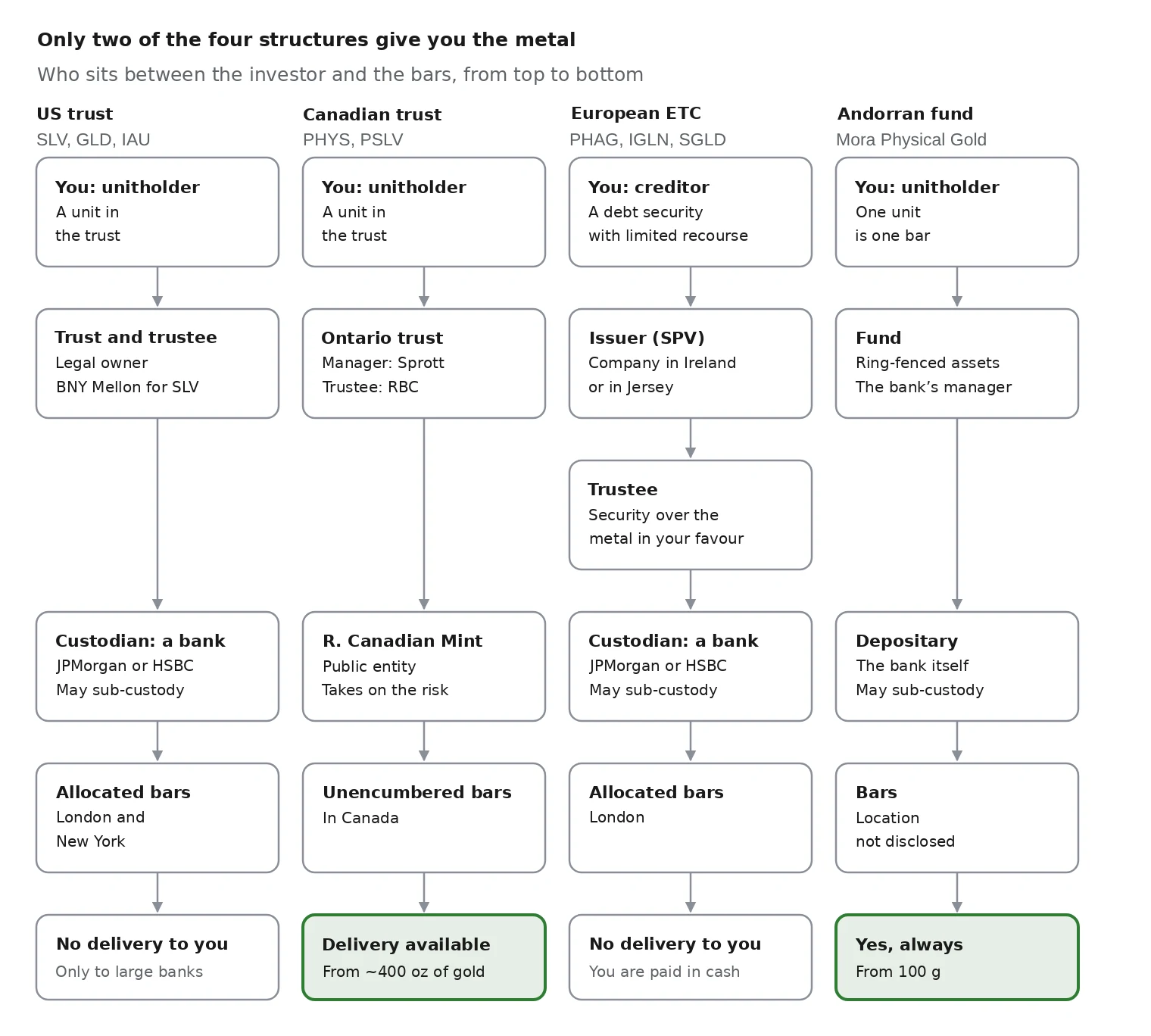
The European ETC is the one that puts the most layers between the investor and the bar: an issuer, a trustee and a custodian bank. But the number of layers does not explain everything: the US trust has as many as the Canadian one or the Andorran fund and, even so, only those last two give the metal back to whoever asks for it.
When those layers matter. In normal conditions they go unnoticed: the ETC tracks gold almost to the cent. They matter in a crisis, which is precisely the scenario gold is bought for:
- If the custodian bank goes bust, the allocated bars still belong to the issuer, but a liquidator can freeze the accounts while it is established what belongs to whom, and redemptions are delayed. The small unallocated balance becomes an ordinary claim against the bank.
- If the issuer goes bust, the trustee sells the metal and distributes the cash. You are paid in euros or dollars, not in bars, and at the price of that moment.
- If the market comes under strain, market makers can step back or widen spreads, and the quoted price can drift away from the value of the metal just when selling is most needed.
- If the issuer decides to close the product. The Spanish KID of WisdomTree Physical Silver warns that the issuer can terminate it unilaterally and, in certain mandatory redemption cases, at very short notice. It adds that the product is not covered by any investor guarantee or compensation scheme and that, if the security interest is not enough, the issuer is only liable for whatever is obtained by selling it.
| Format | What you own | Intermediaries between you and the metal | If the custodian bank goes bust | Indicative annual cost |
|---|---|---|---|---|
| Metal in your own hands | The metal | None | It does not affect you | None (the buying premium does apply) |
| Allocated metal in your name in a private vault | Identified items in your name | The custodian | You get your items back, with possible delays | Annual custody |
| Trust with physical redemption (Sprott) | A unit in a trust with unencumbered metal | The trust and the Royal Canadian Mint | The custodian is a public body, not a bank | 0.39–0.52% |
| US physical ETF (GLD, IAU, SLV) | A unit in a trust | The trust and a custodian bank | Bars can be claimed; possible delays | 0.10–0.50% |
| European ETC | A claim secured on metal | Issuer, trustee, custodian bank and possible sub-custodians | Bars can be claimed by the issuer; if the issuer fails too, you are paid in cash | 0.12–0.49% |
Our reading. The ETC and the physical ETF are good instruments for gaining exposure to the price of gold; they are not good instruments for owning gold. If the reason for buying it is to protect yourself against a crisis of the financial system, it makes little sense to do so through a claim against a company whose metal is held by a large bank of that same system. For that part of your assets, the consistent choice is physical metal in your own name. For trading, rebalancing or tracking the price at low cost, the ETC remains a perfectly valid tool.
Is an ETC like the CDOs of 2008? Only in form
Some analyses compare the structure of a European ETC with that of a CDO (Collateralized Debt Obligation), the secured debt products that blew up in the 2008 crisis. The comparison is right about the form, but it overstates the risk.
| Physical ETC (PHAG, IGLN, SGLD…) | 2008 CDO | |
|---|---|---|
| Issuer | A special purpose vehicle created only to issue | A special purpose vehicle created only to issue |
| What the investor holds | Secured debt, limited recourse | Secured debt, limited recourse |
| What is behind it | Gold or silver bars identified by serial number | Loans (mortgages, car loans, commercial loans) |
| Can the collateral “default”? | No: the metal does not stop paying, it only changes in price | Yes: the loans stopped being paid in a chain reaction |
| Risk tranches | No: all holders have the same right over the same metal | Yes: the lower tranches absorbed the losses first |
| Valuation | Daily market price and an audited bar list | Opaque, based on models and ratings |
| Leverage and derivatives | No | Common, with products repackaged inside one another |
What they do share is what we have already seen in the prospectuses: with an ETC you are not the owner of the metal but the creditor of an issuer, the trustee and the service providers are paid before you if the product is wound up, and in the end you receive cash, not metal. The risk of an ETC is not that gold “defaults”, but that the bank holding it, the legal structure or the issuer itself fails just when you need it most.
What would happen in a crisis: what the prospectuses say
We have read the custody and risk sections of the annual reports of GLD, IAU, SLV and SIVR, of the PSLV prospectus and of Invesco's base prospectus. The conclusion is that the metal is protected against the failure of the custodian bank, but not against delays, and that in a liquidity crisis the funds can suspend redemptions without being liable for it. What follows are tail scenarios, not the base case: they describe what the contracts allow, not what we expect to happen. In the sections reviewed of the GLD, IAU and SLV reports there is no record of any suspension of redemptions, and the rule-change precedents we cite (1980 and 2022) come from futures markets, not from physical ETFs.
The starting point is concentration: JPMorgan is the custodian for the metal of IAU, SLV, GLDM, iShares IGLN and ISLN and Invesco SGLD, for part of GLD's, and is sub-custodian for Xtrackers. HSBC holds the rest of GLD, WisdomTree and Amundi. If either of the two ran into trouble, it would hit tens of billions across funds at once.
Scenario 1: a liquidity crisis or a shortage of physical metal
- Unit creation can seize up. SLV's annual report warns that, if demand exceeds the available supply, authorised participants may not obtain enough silver to create new units.
- The market price can come away from the metal. SLV adds that, if short positions in the fund exceed the units available, the price can shoot up with no direct relation to the price of silver.
- Redemptions can be suspended. GLD, IAU, SLV and SIVR allow redemptions to be suspended or postponed if the exchange closes or if there is an emergency that makes it impracticable to deliver or value the metal. GLD goes further: also whenever the sponsor considers it necessary to protect unitholders. And neither the sponsor, nor the trustee, nor the custodians are liable for the losses that this causes.
- Sprott has its own catch. Asking for PSLV to be redeemed in cash is paid at 95% of the lower of the market price and the net asset value; the good route is to ask for the metal, and for that you need 10 Good Delivery bars.
Scenario 2: trouble at or failure of the custodian bank (JPMorgan or HSBC)
- The allocated bars do not belong to the bank. They are identified by serial number as property of the fund. GLD's report confirms that the trust would keep legal title.
- But they can end up frozen. The same report acknowledges that a liquidator could freeze access to all of the custodian's accounts, including the allocated ones. Regaining control of the bars would have costs, and a claim by the liquidator for unpaid fees could delay creations and redemptions. The Invesco prospectus says the same for its ETCs.
- The unallocated balance is lost like any other claim. Up to 430 ounces of gold or 1,100 of silver at the close of the day, and all the metal in transit during a subscription or a redemption, is not segregated from the bank's balance sheet. There the fund is an unsecured creditor.
- The custodian's liability is very tightly drawn. It is liable only for negligence, fraud or wilful default, and at most for the market value of the metal lost. In SLV, the custodian is not even obliged to replace the silver lost.
- The insurance does not belong to the fund. In GLD, IAU and SLV the custodian insures its business as it sees fit, the fund is not a beneficiary and GLD's insurance does not cover all the gold held in custody. None of them requires insurance from sub-custodians.
- The unitholder cannot claim directly. In GLD, only the trustee can bring actions against the custodians. On top of that, the custody is governed by English law and a US court could have difficulty applying it.
- Sub-custodians are the blind spot. GLD acknowledges that, by London market custom, there are no written contracts with them and that the trustee may have no right to visit them; HSBC is not liable for its sub-custodians except for negligence in choosing them. In SIVR, all the allocated silver sits at a sub-custodian chosen by ICBC, and inspections are limited to two a year and can be carried out by virtual means.
Scenario 3: a decision by a government or a regulator
The custody agreements of IAU and SLV release the custodian from liability if a law or a regulator, of the United Kingdom or of any other country, prevents or forbids it from meeting its obligations. It is a standard clause, but it is worth knowing that it exists: faced with an extraordinary measure affecting the metal held in custody, the fund would have no one to claim against.
The exception: Sprott and the Royal Canadian Mint
The PSLV prospectus explains that the Royal Canadian Mint is a Crown corporation that acts as an agent of the Government of Canada, and that its obligations are, in general, unconditional obligations of that Government. The Mint assumes the risk of loss of or damage to the metal, except for causes beyond its control. The small print: if the manager does not notify it of a loss in time (five business days from discovering it), all claims are deemed waived. The Mint may use Brink's as a sub-custodian in Canada.
| Scenario | US physical ETF | European ETC | Sprott (PHYS, PSLV) | Metal in your own name |
|---|---|---|---|---|
| Shortage of metal in London | Creations seized up; market price at a premium; redemptions can be suspended | The same, and the issuer can close the product | Premium to net asset value; the metal does not leave except on unitholder redemptions | Does not affect you: you already have the metal |
| Failure of JPMorgan or HSBC | The fund's bars, but freezable; delays; unallocated balance at risk | The same; and if the issuer fails as well, you are paid in cash | A Canadian public custodian, not a bank | Depends on where you keep it |
| A government measure | The custodian is not liable | The custodian is not liable | A custodian that is the Canadian State itself | Depends on the jurisdiction |
Sources: 10-K annual reports of GLD, IAU, SLV and SIVR; PSLV prospectus; Invesco Physical Markets base prospectus.
None of this means that these risks are going to materialise: JPMorgan and HSBC are among the most closely supervised banks in the world. It means that, in the scenario for which many people buy gold, a physical fund still depends on a bank, a trustee, an exchange and, sometimes, an issuer all working.
What the WisdomTree prospectus adds (PHAU, PHAG)
The WisdomTree Metal Securities base prospectus, of 6 March 2026, is the most detailed of the European ETCs we have read, and it has strong points and weak ones:
- The metal is in the trustee's name. The allocated accounts are opened in the name of the trustee as mortgagee and on behalf of the holders, and the trustee has full title to the bars. That is why the prospectus states that allocated metal involves no credit risk against the custodian.
- The gold is fully allocated. HSBC advances to WisdomTree the top-up needed to allocate whole bars on each PHAU subscription. In PHAG's silver, less than one bar may be left unallocated, as may the metal in transit on a redemption; that part is indeed an unsecured claim against the bank.
- PHAG's silver is not only at HSBC. It can be kept at up to two sub-custodians; today that is Malca-Amit. The trustee has no contractual right to give instructions to the sub-custodians, only to the custodian.
- An unusual warning. The prospectus acknowledges that the effectiveness of the trustee's security interest over metal held by sub-custodians has not been investigated.
- Custody without specific supervision. HSBC is regulated by the FCA, but metal custody itself is not an activity supervised by that regulator.
- Liability and insurance, as in the others. The custodian is liable only for negligence, fraud or wilful default and up to the market value of the metal; it takes out insurance as it sees fit and no insurance is required of the sub-custodians.
- Forced closure. The issuer can redeem all the securities on 30 days' notice. If HSBC terminates the contract (on 90 days' notice) and no replacement is found, the securities are redeemed. If the issuer becomes insolvent, the trustee can force redemption on just two business days' notice.
- The private investor is paid in dollars. A holder who is not an authorised participant can only ask for redemption if there is no authorised participant left or if the issuer allows it, and then receives the proceeds of the sale of the metal in dollars, not bars.
- The exception within the same house. WisdomTree Core Physical Gold (WGLD), Core Physical Silver (WSLV) and Physical Swiss Gold (SGBS) do allow any holder to ask for physical delivery, from 1 kilo, through a bank that will receive it.
- Audit. Inspectorate International reviews the metal twice a year, one of those on a random date, and reconciles it against the bar list.
What the iShares prospectus adds (IGLN, ISLN)
The iShares Physical Metals plc base prospectus of 2026 covers the largest gold ETC in Europe:
- London only and JPMorgan only. The gold and silver are kept solely in London vaults, with JPMorgan as custodian, which may rely on sub-custodians also in London.
- The metal comes in before the security. The securities are only issued once the metal is already in the allocated account, and JPMorgan undertakes to over-allocate bars so that no metal is left loose.
- Better protection for unallocated metal. Unlike the others, the metal in transit is deposited in the issuer's name and JPMorgan holds it in trust for the issuer. If it could not be identified as such, the issuer would become an unsecured creditor.
- If JPMorgan fails. The allocated metal should be protected because it is segregated, but the prospectus acknowledges that there is no guarantee of being able to recover it in time, or in full, and that claiming it would have costs.
- An Irish legal risk. The prospectus warns that, depending on the control the issuer keeps over the assets, the Irish courts could treat the trustee's security interest as “floating” instead of “fixed”. A floating security interest is paid after other preferential creditors in an insolvency.
- Closure on very little notice. The issuer can redeem the whole series on just 10 days' notice. There is also early redemption if a law makes holding the metal illegal, if a VAT obligation arises or if a service provider (including the custodian) is not replaced within 60 days. In every case you are paid in cash, at whatever price is obtained by selling the metal.
- Redemptions and suspensions. A holder who is not an authorised participant can only get out by selling on the exchange, unless the issuer announces an exceptional buy-back. The issuer can postpone or suspend subscriptions, buy-backs and payments in the face of “disruption events”.
- Insurance and lending. JPMorgan insures its business in general, not the issuer's metal in particular. The prospectus contains no express ban on lending the metal.
What the Amundi Physical Gold prospectus adds
The Amundi Physical Metals plc base prospectus, of 27 April 2026, repeats the Irish structure of iShares with one peculiarity:
- Almost everything is HSBC. HSBC Bank plc is both custodian and counterparty for selling the metal; HSBC Corporate Trustee is the trustee that watches over the security interest, and another HSBC group company runs the administration. The prospectus sums it up by saying that holders depend on the solvency of the custodian, of the sub-custodians and of the metal counterparty.
- London only. All the metal is in the vaults of HSBC or of its sub-custodians in London, and the securities are only issued once the metal is already allocated.
- If HSBC fails. The allocated metal should be protected and legal title remains with the issuer, but the prospectus admits that there is no guarantee of recovering it in time or in full, and that claiming it would have costs.
- The security interest could be “floating”. As in iShares, it warns that the security interest could be treated as floating under Irish or English law, with lower priority against other creditors.
- The private investor never receives metal. The prospectus is categorical: investing does not make you the owner of the metal, and a holder who is not an authorised participant has no right to receive it at any time; they are only paid in cash.
- Closure and suspensions. The issuer can redeem on 30 days' notice, or if it fails to replace a service provider within 120 days. It can suspend or postpone issues, buy-backs and early redemption payments.
- Insurance and lending. The insurance is HSBC's general insurance, not specific to the issuer's metal, and there is no express ban on lending the metal.
The four European ETCs, head to head
| Invesco (SGLD) | iShares (IGLN) | WisdomTree (PHAU, PHAG) | Amundi (GOLD) | |
|---|---|---|---|---|
| Custodian | JPMorgan, London | JPMorgan, London | HSBC, London; silver also at Malca-Amit | HSBC, London (and a trustee from the same group) |
| Metal in transit (unallocated) | Up to 430 oz of gold; unsecured claim | In trust in the issuer's name | Gold 100% allocated; silver, less than one bar unsecured | Issued only after allocation |
| Minimum notice to close the product | As per the terms | 10 days | 30 days (2 days if the issuer is insolvent) | 30 days |
| Risk of a “floating” security interest | — | Yes, warned of | — | Yes, warned of |
| Delivery to a private investor? | In theory only (an account in London) | No | No (yes in WGLD, WSLV and SGBS, from 1 kg) | No, never |
| Sold to retail investors in Spain? | Yes | Yes | Yes | No |
“—” means the prospectus does not mention it in the sections reviewed.
What the Sprott Physical Gold Trust prospectus adds (PHYS)
The PHYS prospectus, of 28 October 2025, confirms that this is the structure closest to owning the metal, with its own small print:
- A public custodian. The gold is at the Royal Canadian Mint, a Crown corporation that acts as an agent of the Government of Canada; its obligations are, in general, unconditional obligations of that Government. The Mint assumes all the risk of loss of or damage to the gold in its custody, except for causes beyond its control.
- Where it can be. At the Mint or in the vaults of a large Canadian bank (one of the so-called Schedule I banks), always in Canada, fully allocated and unencumbered.
- Physical delivery exists and is used. Since launch, more than 129 million units have been redeemed for physical gold, against only 1.5 million in cash.
- How to ask for it. Once a month, with notice before the 15th and a guaranteed signature, for a minimum of one Good Delivery bar (between 350 and 430 ounces). The gold arrives by armoured transport some ten business days after month-end, and the unitholder pays transport and the Mint's fees.
- A practical detail. If the bars are delivered outside a North American entity authorised to hold them in custody, they lose Good Delivery status, which makes them harder to resell on the wholesale market.
- Cash redemption is penalised. It is paid at 95% of the lower of the average market price and the net asset value. To get out, the normal route is to sell on the exchange.
- The market price can come away. The prospectus warns that the price of the unit can become more volatile than the value of the gold behind it.
- If the manager fails. The trust is wound up if the manager becomes insolvent or if a government seizes or confiscates its assets. The manager can also wind it up on 90 days' notice if it ceases to be viable.
- Strict deadlines against the Mint. If the manager does not report a loss within five business days of discovering it, all claims are lost, and any lawsuit must be filed within 12 months.
Sprott Physical Silver Trust (PSLV): the same, in silver and with higher minimums
The PSLV prospectus, of 20 January 2026, replicates the PHYS structure with three differences:
- Where the silver is. At the Royal Canadian Mint, at a facility in Canada that the Mint leases for that purpose, or in the vaults of a large Canadian bank. The Canadian regulators authorised the Mint to use Brink's as a sub-custodian in Canada.
- A higher delivery minimum. You have to ask for at least 10 Good Delivery silver bars, of 750 to 1,100 ounces each: around 10,000 ounces, about half a million dollars at the current price.
- It is used too. Since launch, more than 22.4 million units have been exchanged for physical silver, against around 201,000 in cash.
The rest matches PHYS: unencumbered metal, a custodian that assumes the risk of loss, cash redemption penalised at 95%, a market price that can come away from the value of the silver, dissolution if the manager fails or its assets are confiscated, and strict deadlines for claiming against the Mint.
The physical gold funds of the Andorran banks
Two Andorran banks offer physical gold funds under Andorran law, supervised by the Andorran Financial Authority (AFA). Both invest only in bars, do not lend the gold and do not use derivatives, and in both of them the management company and the depositary belong to the same banking group. Both deliver the gold in bars on redemption, but they work in very different ways: with MoraBanc you come in with money; with Andbank, by contributing your own bars.
| Mora Physical Gold Fund FI (MoraBanc) | AB 24K Gold SICAV (Andbank) | |
|---|---|---|
| Legal form | Andorran investment fund, AFA no. 0002, since 2009 | Andorran SICAV, AFA no. 0187, since 2019 |
| Management company and depositary | Mora Gestió d'Actius and Mora Banc Grup (the management company is 100% owned by the bank) | Andorra Gestió Agrícol Reig and Andorra Banco Agrícol Reig (Andbank group) |
| What it holds | Gold bars only; each unit is equivalent to a 100 g or 1 kg bar | Numbered bars of 999.9 fineness only; you come in by contributing your own bars, not money |
| Where the gold is | At the depositary or at a sub-custodian in Andorra or abroad, in a country with equivalent rules according to the AFA; the location is not published | Held in custody by the depositary in the name of the SICAV; the location is not published |
| Do they deliver the gold to you? | Yes, always: redemption is in bars only, at the bank's head office, within 5 business days (up to 30 if the gold is abroad) | Yes: redemption is in bars only (from 100 g to 12.5 kg), within a maximum of 10 business days except in extraordinary situations |
| Minimum | The value of a 100 g bar | €50,000, contributed in bars; qualified investors only. The shares may only be transferred between spouses and relatives up to the second degree |
| Annual cost | Custody of 2.24% plus IGI, charged directly to the unitholder | Depositary fee of 1.55% plus IGI and expenses (audit, AFA, notary) |
| Entry and exit | Subscription: $60 (100 g) or $200 (1 kg), including the manufacture of the bar. Redemption: 1% plus $16 or $160 | No subscription or redemption fees |
| Currency | Dollar | Euro |
| Date of the document reviewed | Prospectus of June 2021; regulations of April 2019 | Full prospectus, simplified prospectus and articles of association, of November 2022 |
Sources: full prospectus and regulations of the Mora Physical Gold Fund FI; simplified prospectus of AB 24K Gold SICAV.
What happens if the bank runs into trouble. The regulations of the MoraBanc fund are the clearest of all the documents reviewed on this point: the fund is a separate pool of assets, the prospectus states that the gold does not appear on the custodian's balance sheet and, if the management company or the depositary are declared insolvent, the fund is not wound up; the affected entity must be replaced and, if that is not requested within a month, the AFA may appoint a replacement on its own initiative. The trade-off is that, while the fund is without a depositary, redemptions are prohibited. The articles of association of the Andbank SICAV provide for the same thing: the insolvency of the management company or of the depositary does not dissolve the SICAV and requires it to be replaced within a month. In addition, the SICAV is not subject to bankruptcy proceedings; if it were definitively insolvent, it would be wound up under the supervision of the AFA.
When redemptions can be blocked. In the MoraBanc fund, the management company may postpone them if the London gold market closes or restricts trading, or if exchange controls or restrictions on the gold trade make it impossible to operate; the AFA may also suspend them. In the Andbank SICAV, the 10-business-day delivery deadline may not be met in extraordinary and justifiable situations, and the management company may adjust the redemption amount to the bars available. One warning: the simplified prospectus describes redemptions as cash payments, but the full prospectus and the articles of association, of the same date, establish that subscriptions and redemptions are in bars only.
Taxation. The MoraBanc prospectus points out that, under the Andorran rules in force at the date of the document, gains on the redemption or sale of units in collective investment undertakings are exempt from personal income tax and from non-resident income tax, provided the requirements are met. It is worth confirming this with a tax adviser according to each investor's situation.
Our reading. Of all the funds analysed, the MoraBanc fund is the one that comes closest to owning physical gold: you always receive manageable bars and the fund is designed to survive the bank's failure. Its main drawback is the cost: with IGI, custody comes to around 2.45% a year, between 5 and 18 times what the international funds charge. The Andbank SICAV is cheaper and also delivers bars, but it is a different vehicle: you come in by contributing your own gold, it is reserved for qualified investors and its shares can only pass to relatives, which makes it closer to a wealth-holding structure than to an ordinary investment fund.
How much each fund costs
The cost differences are enormous: from EUWAX Gold II's 0% a year to the 2.24% plus taxes of the MoraBanc fund. And in the products that deliver the metal, you have to add what it costs to take it out.
| Product | Annual fee | Entry | Exit and delivery of the metal |
|---|---|---|---|
| Gold – they deliver the metal to the private investor | |||
| Mora Physical Gold Fund FI (MoraBanc) | 2.24% custody + IGI (9.5%) | $60 per 100 g bar or $200 per 1 kg bar, + IGI | 1% + $16 (100 g) or $160 (1 kg), + IGI; collection at the bank's head office |
| AB 24K Gold SICAV (Andbank) | 1.55% depositary fee (maximum 2%) + IGI + audit, AFA and notary costs | No fee, but you can only come in by contributing bars | No redemption fee; delivery in bars |
| Sprott Physical Gold Trust (PHYS) | 0.39% (total expense ratio) | Broker's commission | Royal Canadian Mint fee of up to 1.5% + armoured transport; in cash, you receive 95% |
| Xetra-Gold | No management fee; Clearstream custody of 0.3% a year, which the bank may pass on | Broker's commission | From 1 g; as a guide, around €325 + VAT per 1 kg delivered in Germany, plus the bank's fees |
| EUWAX Gold II | 0% | Broker's commission | Free from 100 g (multiples of 100 g) within Germany |
| Gold – in theory only or with special conditions | |||
| Invesco Physical Gold (SGLD) | 0.12% | Broker's commission | Delivery only with a metal account in London; up to $500 + expenses |
| Gold – they do not deliver the metal | |||
| SPDR Gold MiniShares (GLDM) | 0.10% | Broker's commission | Sale on the exchange only |
| iShares Physical Gold ETC (IGLN) | 0.12% | Broker's commission | Sale on the exchange only |
| Amundi Physical Gold | 0.12% | Broker's commission | Sale on the exchange only |
| iShares Gold Trust (IAU) | 0.25% | Broker's commission | Sale on the exchange only |
| Xtrackers Physical Gold (XAD5) | 0.25% | Broker's commission | Sale on the exchange only |
| WisdomTree Physical Gold (PHAU) | 0.39% | Broker's commission | Sale on the exchange only |
| SPDR Gold Shares (GLD) | 0.40% | Broker's commission | Sale on the exchange only |
| Silver | |||
| Sprott Physical Silver Trust (PSLV) | 0.52% (total expense ratio) | Broker's commission | Delivery from 10 bars (\~10,000 oz); Mint fee of up to 2.5% + transport |
| iShares Physical Silver ETC (ISLN) | 0.20% | Broker's commission | Sale on the exchange only |
| abrdn Physical Silver (SIVR) | 0.30% (0.45% contractual) | Broker's commission | Sale on the exchange only |
| Xtrackers Physical Silver (XAD6) | 0.40% | Broker's commission | Sale on the exchange only |
| WisdomTree Physical Silver (PHAG) | 0.49% | Broker's commission | Sale on the exchange only |
| iShares Silver Trust (SLV) | 0.50% | Broker's commission | Sale on the exchange only |
Fees according to the prospectuses and factsheets cited in this article, as at October 2026 except for the Andorran funds (prospectuses of 2021 and 2022). The broker's commission and, where applicable, the currency conversion depend on each institution. To see the cumulative effect: over ten years, an annual cost of 0.12% consumes around 1.2% of the assets; one of 2.45% (2.24% with IGI), around 22%.
At what price do the funds buy the metal?
The funds buy at wholesale prices, practically at spot, but no prospectus publishes exactly how much they pay for each bar. What changes from one product to another is who buys, at what price the metal is valued and how much you can pay above that value.
| Type of product | Who buys the metal | How it is valued | What you pay compared with the metal |
|---|---|---|---|
| US ETFs and European ETCs (GLD, IAU, SLV, IGLN, PHAG) | The authorised participants (large banks), which contribute Good Delivery bars bought on the wholesale market | Daily LBMA auction (gold: afternoon price; silver: midday auction) | Very close to net asset value, plus the buying and selling spread on the exchange |
| Sprott closed-end trusts (PHYS, PSLV) | The trust itself, with the money from each new issue, at market price | Market price of the metal | There may be a noticeable premium or discount: PHYS was trading at a discount of 2.8% in July 2026 |
| Andorran funds (MoraBanc, Andbank) | The fund or the unitholder, in small bars | London price; at Andbank, including the cost of manufacturing the bars | At MoraBanc, the subscription includes the manufacture of the bar: $60 (100 g) or $200 (1 kg) |
| Coins and bars in a store | You | The store's selling price | Premium over spot, before tax: at Andorra Metals, from 3.7% to 7.6% in gold and around 19–25% in silver (2 November 2026) |
Size is the key. The funds buy gold bars of around 400 ounces, which on the London wholesale market trade practically at spot. A coin or a small bar costs more to manufacture, distribute and sell, and the buyer pays that difference. It is the funds' main cost advantage on entry; in exchange, as we have seen, you give up having the metal.
Sources: annual reports of GLD, IAU and SLV; PHYS prospectus; CEF Connect (PHYS discount); prospectuses of the Andorran funds cited above; coin premium according to Sprott.
The real premiums on physical metal: bars at Andorra Metals
To put concrete figures on it, these are the premiums over the spot price published by the Andorra Metals premium ranking, before tax, as at 2 November 2026 (gold at €3,531/oz and silver at €45.3/oz):
| Product | Premium over spot |
|---|---|
| Gold | |
| Krugerrand 1 oz (assorted years), the lowest | +3.7% |
| 100 g bar | +3.9% |
| 250 g bar | +4.1% |
| 50 g bar | +4.2% |
| 1 oz and 20 g bars | +4.5% |
| 10 g bar | +5.1% |
| 5 g bar | +5.8% |
| 2.5 g bar | +7.6% |
| Silver | |
| 1 kg bar, the lowest | +18.9% |
| Maple Leaf 1 oz | +19.8–20.3% |
| 500 g bar | +20.5% |
| 250 g bar | +22.4% |
Three conclusions:
- In gold, the format matters little from 50–100 g upwards. A 100 g bar or a one-ounce bullion coin cost around 4% over spot. Below 10 g the premium rises quickly.
- In silver, the premium is the big cost. Even the 1 kg bar is paid at almost 19% above the value of the metal, before tax. It is a gap that silver has to make up by rising in price before it shows a profit, and one to bear in mind when comparing it with an ETC that trades almost at the value of the metal.
- Compared with the funds that deliver bars, the premium on physical gold is equivalent to between a year and a half and two years of the custody fee of the MoraBanc fund. Beyond that point, keeping the metal yourself, or with a custodian that charges less, works out cheaper.
As stated in the transparency note at the end of the ranking, Andorra Metals is the store that publishes this blog; we use its premiums because they are public and comparable, and we encourage you to compare them with those of other dealers.
Do physical ETFs track the metal? Ten years of data
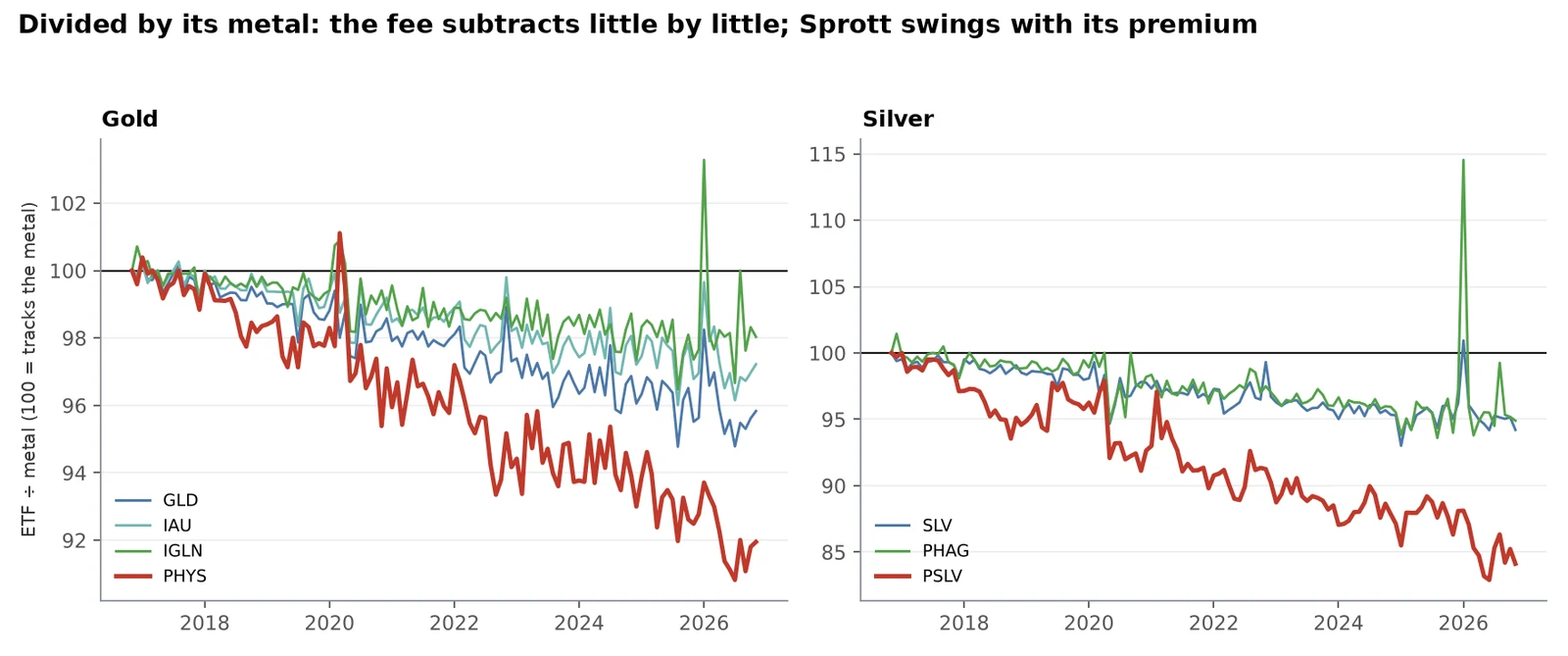
Yes: over the past ten years, the large physical ETFs and ETCs have moved with gold and silver almost to the cent, and the cumulative difference matches their fee. The exception is Sprott's closed-end trusts, whose price has drifted considerably further from the metal behind them.
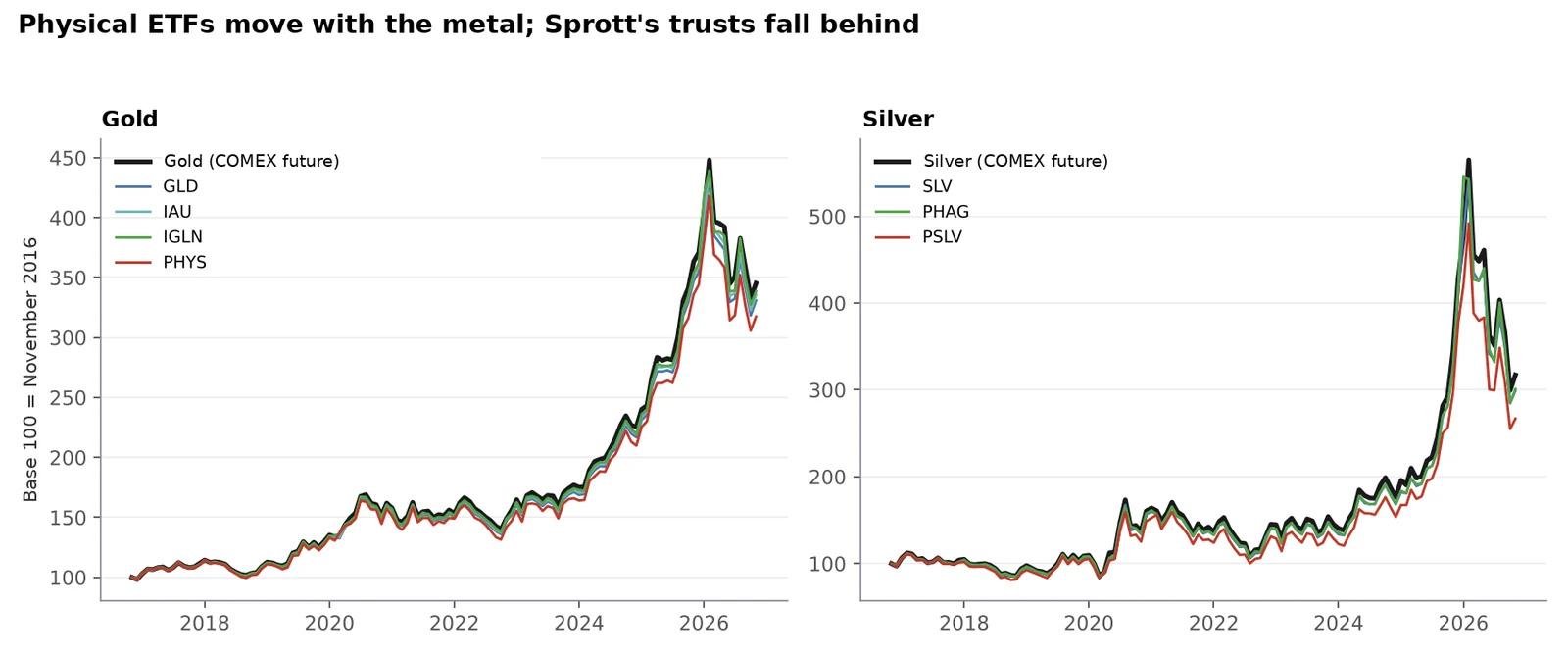
Seen in price terms, the lines almost overlap. The difference shows up better when each ETF is divided by its metal:
| Product | Current fee | Return over 10 years | Metal over 10 years | Annual difference from the metal |
|---|---|---|---|---|
| iShares Physical Gold (IGLN) | 0.12% | +238.5% | +245.3% | −0.22 points |
| Invesco Physical Gold (SGLD) | 0.12% | +238.6% | +245.3% | −0.22 points |
| iShares Gold Trust (IAU) | 0.25% | +235.7% | +245.3% | −0.32 points |
| SPDR Gold Shares (GLD) | 0.40% | +230.9% | +245.3% | −0.48 points |
| Sprott Physical Gold (PHYS) | 0.39% | +217.5% | +245.3% | −0.95 points |
| abrdn Physical Silver (SIVR) | 0.30% | +205.3% | +217.3% | −0.43 points |
| WisdomTree Physical Silver (PHAG) | 0.49% | +201.1% | +217.3% | −0.58 points |
| iShares Silver Trust (SLV) | 0.50% | +198.9% | +217.3% | −0.67 points |
| Sprott Physical Silver (PSLV) | 0.52% | +166.9% | +217.3% | −1.92 points |
Price return in dollars, from the November 2016 close to 4 November 2026. Current fees according to the prospectuses and factsheets cited in this article; some have come down during the period.
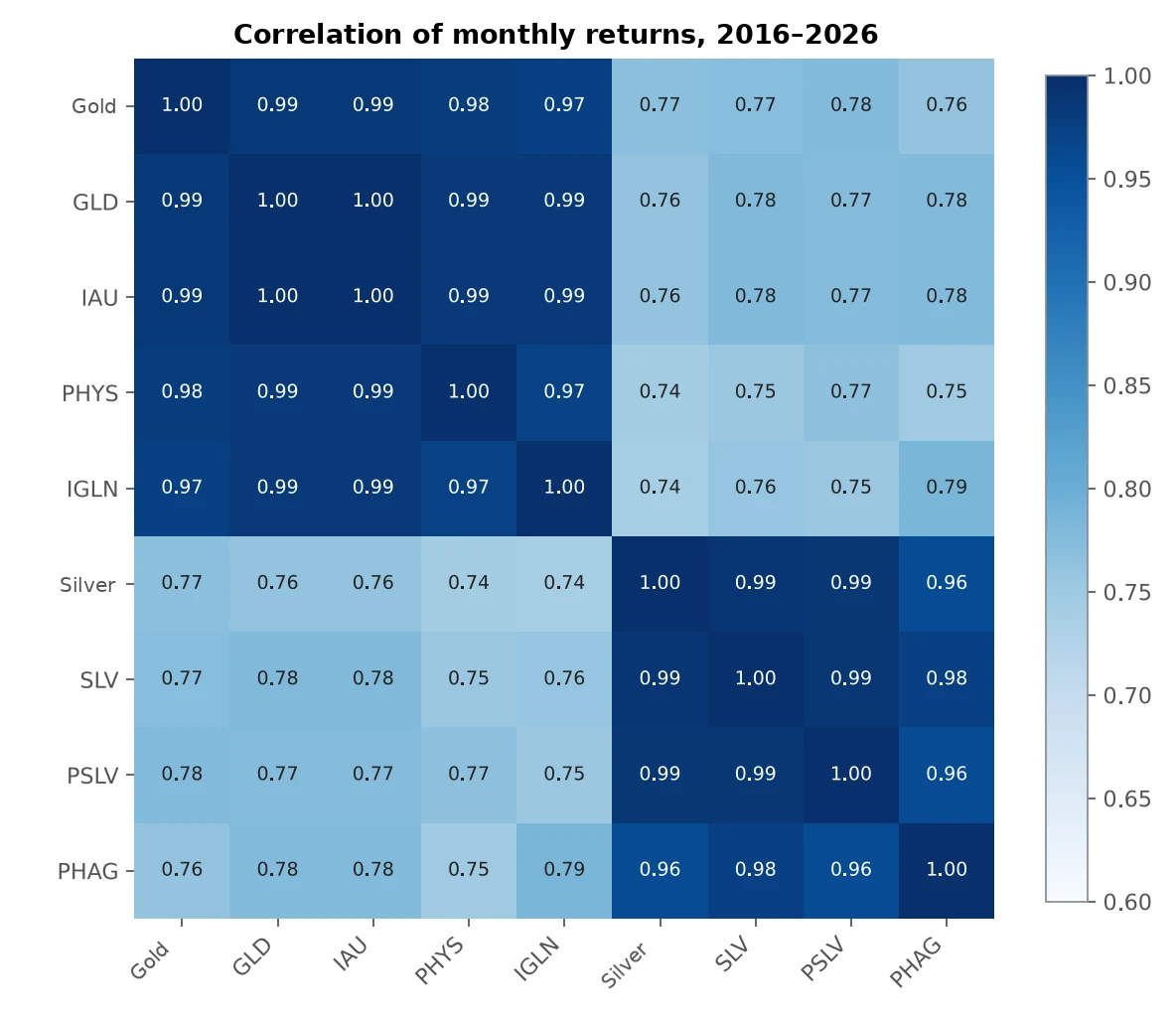
What the data tell us
- Physical ETFs move in step with the metal. The monthly correlation with the metal ranges from 0.96 to 0.99. Between ETFs that trade at the same hours it is practically perfect in daily data: 0.998 between GLD and IAU, 0.999 between SLV and SIVR and 0.996 between IGLN and SGLD.
- The difference from the metal is, basically, the fee. GLD ends up 0.48 points a year behind gold with a fee of 0.40%; IAU, 0.32 with 0.25%; IGLN, 0.22 with 0.12%; SLV, 0.67 with 0.50%. The remaining 0.1 points or so, common to all of them, are probably explained by using the COMEX future as an approximation of the spot price.
- Sprott's closed-end trusts go their own way. PHYS has lost 0.95 points a year against gold and PSLV 1.92 against silver, well above their fee: PSLV has ended up 11% behind SLV. As they have no authorised participants creating and redeeming units every day, their price depends on their own supply and demand and can go from a premium to a discount to the value of the metal. It can be seen in March 2020, when PHYS traded above gold. If you take their difference from the metal and subtract the fee and the part that comes from using the future as a reference (what SLV and GLD lose above their fee: 0.17 and 0.08 points), about 1.2 points a year are left in PSLV and 0.5 in PHYS. That residue is not premium volatility, but the change in the premium or the discount between the start and the end of the sample, together with the cash the trusts hold; we have not measured it directly. It is the flip side of their great advantage, physical delivery.
- The daily correlation misleads if you do not look at the time. Against the future, the daily correlation drops to 0.91, and between GLD (New York) and IGLN (London) to 0.83. It is not a tracking failure: New York, COMEX and London close at different times. On 30 January 2026, when silver crashed (SLV fell 34% on the day), PHAG closed in London before the fall was over and completed it in the next session.
- Gold and silver do not move alike. Their monthly correlation is 0.77: silver rises and falls much more. That is why it makes sense to combine them and manage the weight of each one with the gold/silver ratio.
- Tracking the price well does not answer the custody questions. These data show that, in market conditions, a physical ETF does its job of tracking the metal well. They say nothing about who gives you the metal back if something goes wrong, which is the question the rest of this article deals with.
Method: adjusted closing prices from Yahoo Finance, in dollars, between November 2016 and 4 November 2026. The front-month COMEX future (GC=F and SI=F) is used as the spot price, because the LBMA benchmark series was not accessible; it may deviate slightly from spot at contract rollovers. The correlations are calculated on monthly and daily log returns.
Ranking: the best product for holding real gold you can get back
The criterion for this ranking is not the cheapest product or the one that tracks the price best, but a specific one: that the product holds genuinely physical gold and that you can take it out in bars whenever you want. That is why we rank first by how easy it really is to receive the gold, then by the strength of the custody and, last, by cost. Products that do not deliver the metal are off the podium by definition, even if they are cheaper.
Products that deliver the gold to you
- Mora Physical Gold Fund FI (MoraBanc). It is the only one where redemption is always in bars, from 100 grams, within five business days and in Andorra. The fund is a separate pool of assets that survives the bank's failure. Its big drawback is the price: the most expensive on the whole list. Best for: anyone who wants small bars with fast delivery in Andorra and accepts paying for it.
- Sprott Physical Gold Trust (PHYS). The best custodian of all (the Royal Canadian Mint, a public body) and a low cost, with the most widely used physical delivery. But the minimum is a bar of around 400 ounces (about 1.6 million dollars), it can only be requested once a month and its access from the European Union for retail investors is limited. Best for: large fortunes.
- EUWAX Gold II. No annual fee and free delivery from 100 grams in Germany. Against it: it is a note of the issuer, the gold belongs to the issuer and is not pledged in your favour, and it is not marketed in Spain. Best for: investors with access to the German stock exchange and an account in Germany.
- Xetra-Gold. Delivery from 1 gram, but you have to request it through the custodian bank, collect it at a branch in Germany that accepts the delivery, wait one to two weeks for small bars and pay the manufacturing and shipping costs. Backing of around 95% in physical gold and no security interest for the investor; the CNMV asked for it to stop being sold to retail investors in Spain.
- AB 24K Gold SICAV (Andbank). Delivery in bars, but you can only get in by contributing your own bars, it requires €50,000 and qualified investor status, and the shares can only pass to family members. More than a fund, it is a wealth structure for gold you already hold.
- WisdomTree Core Physical Gold (WGLD) and Physical Swiss Gold (SGBS). They allow delivery to be requested from 1 kilo through a bank that will receive it. We have not analysed their cost in detail.
- Invesco Physical Gold (SGLD). Very cheap and sold in Spain, but delivery requires a metal account in London: not feasible for a private investor.
Products that do not deliver the gold to you (useful for tracking the price, not for owning it), from best to worst structure and cost: iShares Physical Gold ETC (the metal is, incidentally, held in trust and it costs 0.12%); SPDR Gold MiniShares (0.10%); Amundi Physical Gold (0.12%, not sold in Spain); iShares Gold Trust (0.25%); Xtrackers Physical Gold (0.25%); WisdomTree Physical Gold (0.39%) and SPDR Gold Shares (0.40%).
In silver, the only fund that delivers the metal to a private investor is Sprott Physical Silver Trust (PSLV), from around 10,000 ounces.
Outside the ranking: metal in your own name. Buying coins or bars and keeping them at home, in a safe deposit box or allocated in your name in a private vault is not a fund, but it is the benchmark against which to compare everything above: there are no intermediaries between you and the metal, you can get it back whenever you want and the cost is the purchase premium and whatever storage you choose, with no annual fee on the assets.
What if I buy the metal in a store and keep it myself?
It is the only option in the whole article in which there is no issuer, no trustee and no exchange that can settle your contracts in cash: the coins or the bars are yours and you decide when to sell them or take them away. What changes is where you keep them, and each option has its own cost and its own risk.
| At home | Safe deposit box at a bank | Professional custodian (metal allocated in your name) | |
|---|---|---|---|
| What you own | The metal | The metal; the bank does not know what you keep there | Identified pieces, segregated in your name |
| Annual cost | None, apart from a safe and insurance | A fixed rent, which does not depend on the value stored | Usually between 0.5% and 1% of the value, normally with insurance |
| Access | Immediate | During bank hours and only if the branch is open | As per the contract: collection or shipment within an agreed period |
| Main risk | Theft or loss; home insurance usually covers little or requires it to be declared | That the bank closes in a crisis; the contents are usually not insured by the bank | The custodian's solvency and honesty |
| If whoever keeps it fails | Not applicable | The contents are yours, not the bank's, but access may be delayed | If it is allocated and segregated, it is yours; it depends on the contract making that clear |
The safe deposit box risk is not theoretical: when Greece imposed capital controls in 2015, the banks were closed for three weeks. The metal still belonged to its owners, but they could not go and fetch it.
What it costs to get in and out
Physical metal has no management fee, but it has costs that an ETC does not:
- Premium over the spot price. A one-ounce gold coin is paid for above its metal value: in March 2026, Sprott quoted a premium of 4.81% (Sprott). Small pieces and silver carry higher premiums than large gold bars.
- Buyback spread. When you sell, the store pays somewhat less than the selling price.
- Taxes. In Spain, investment gold is exempt from VAT, but silver, platinum and palladium pay 21% (Funds Society). It is the great disadvantage of physical silver against an ETC for a Spanish resident. In Andorra the IGI applies, with its own treatment.
Indicative total cost at 3, 5 and 10 years
| Formula | Entry | Annual cost | 3 years | 5 years | 10 years | On exit, in addition |
|---|---|---|---|---|---|---|
| Cheap ETC (IGLN, SGLD) | Broker commission | 0.12% | 0.4% | 0.6% | 1.2% | Buying and selling spread on the exchange |
| SPDR Gold Shares (GLD) | Broker commission | 0.40% | 1.2% | 2.0% | 3.9% | Buying and selling spread on the exchange |
| Sprott PHYS | Broker commission | 0.39% | 1.2% | 1.9% | 3.8% | Risk of selling at a discount to the metal |
| 100 g gold bar at home | Premium of 3.9% | 0% (plus home insurance) | 3.9% | 3.9% | 3.9% | The dealer's buyback spread |
| 100 g gold bar with a custodian (0.5–1%) | Premium of 3.9% | 0.5–1% | 5.3–6.8% | 6.3–8.6% | 8.6–13.1% | Buyback spread |
| 1 kg silver bar at home | Premium of 18.9% (in Spain, plus 21% VAT) | 0% | 18.9% | 18.9% | 18.9% | Buyback spread |
| Mora Physical Gold Fund (100 g) | \~0.5% ($60 + IGI) | \~2.45% (2.24% + IGI) | 7.6% | 12.1% | 22.4% | 1% + $16 + IGI |
Cumulative cost as a percentage of the amount invested, calculated as 1 − (1 − entry) × (1 − annual cost)^years, without taking the movement of the price into account. It does not include the exit, because the buyback spread varies with the dealer and the moment: always ask what they will buy back at. The premiums are those of Andorra Metals as at 2 November 2026 and the custodian uses the usual range of 0.5–1% a year. To put it in perspective: the entry premium on physical gold, between 3.7% and 7.6% depending on the format, is equivalent to between 9 and 19 years of GLD's fee, but it is paid only once if you keep the metal yourself.
If you choose a custodian, check this
- That the metal is allocated and segregated in your name, with a list of pieces or serial numbers.
- That the contract says the metal is not on the balance sheet of the custodian and that it cannot lend it or pledge it.
- That there are periodic independent physical audits.
- That the insurance covers the full market value, and who the beneficiary is.
- That you can withdraw or receive your metal within a defined period and at a known cost.
- Which jurisdiction the vault is in and which law governs the contract.
Our reading. Buying the metal and keeping it yourself is the formula with the fewest intermediaries between the investor and the metal, and the one in which no issuer, trustee or exchange can turn your gold into cash without your decision. Its annual cost is higher than that of a cheap ETC, but lower than that of the Andorran funds that deliver bars. What it demands in exchange is taking on the purchase premium, the spread on selling and the logistics of storing it properly.
Disclosure: Andorra Metals sells physical gold and silver, so we have an interest in the last format. We have tried to base the ranking only on what the prospectuses of each product say. This article is informative and does not constitute investment advice; every investor should assess their situation, their tax position and, if they need to, consult an adviser.
The other silver vehicles: mixed, debt and leveraged
Outside the physical funds, only one of the most widely cited silver products has any metal behind it, and barely 18%. The rest are shares, bank debt or derivatives.
| Product | What it is | Physical silver? | Main risk | Annual cost | Classification |
|---|---|---|---|---|---|
| PHSP (WisdomTree Physical Silver, London) | The sterling line of the same ETC as PHAG (ISIN JE00B1VS3333) | Yes: the same common pool of allocated silver at HSBC | The same as PHAG | 0.49% | Physical |
| Sprott Silver Miners & Physical Silver (SLVR) | ETF that tracks an index of silver miners with a fixed 17.5% in physical silver | Only \~18%, through PSLV units | That of the miners: costs, management, country | 0.65% | Mixed |
| SLVO (ETRACS Silver Shares Covered Call ETN) | Senior unsecured debt of UBS AG (formerly Credit Suisse) linked to a strategy of selling options on SLV | No: no document mentions silver or any security | UBS's solvency; it gives up gains above \~106%; redeemable early by the issuer | 0.65% | Unsecured debt |
| ProShares Ultra Silver (AGQ) | Commodity pool that seeks 2 times the daily change in silver | No: swaps with banks and futures | Daily reset: with volatility it loses value even if silver does not move | 0.95% | Derivatives |
| ProShares UltraShort Silver (ZSL) | The same, but −2 times (a bearish bet) | No | The same | 0.95% | Derivatives |
| WisdomTree Silver 3x Daily Leveraged (3SIL) | European ETP that seeks 3 times the daily change | No: synthetic replication through a swap | Daily reset and the swap counterparty | \~0.99% | Derivatives |
Data as at 30 October 2026. Those for 3SIL come from an aggregator and not from the official factsheet, which we were unable to open.
Three conclusions for the investor:
- SLVR is not a physical silver fund. More than 80% of it is shares. It can be a good way to bet on the miners, but it behaves like equity.
- SLVO does not hold a single ounce of silver. It is a UBS note whose return depends on an options strategy. If UBS ran into trouble, the holder would be just one more creditor, with no security.
- Leveraged products are for hours or days, not for years. ProShares' own prospectus warns that, over periods of more than one day, the return can depart a long way from the target, and that volatility makes it worse.
Silver: SLV, PSLV and PHAG in a squeeze or a bankruptcy
All three hold real silver; what changes is how they behave when the physical market tightens. SLV is the most liquid, PSLV the closest to the metal and PHAG the most accessible from a Spanish broker.
| SLV (iShares Silver Trust) | PSLV (Sprott Physical Silver Trust) | PHAG (WisdomTree Physical Silver) | |
|---|---|---|---|
| Structure | US grantor trust, outside the 1940 Act | Ontario closed-end trust | Secured limited recourse note (Jersey) |
| What you own | A unit in the trust | A unit in the trust | A claim on the issuer, secured on silver |
| Holdings | 498 M oz | 207 M oz | 44.8 M oz |
| Annual cost | 0.50% | 0.52% | 0.49% |
| Custodian | JPMorgan (London, New York) | Royal Canadian Mint | HSBC |
| Can you ask for the silver? | No | Yes, from \~10,000 oz, fee of up to 2.5% | In practice no |
| How the metal comes in and goes out | The authorised banks create and redeem in lots and arbitrage against the NAV | It only comes in with new issues and only leaves through unitholder redemptions | Like SLV, through authorised participants |
| Price versus NAV | Very close | Can trade at a premium or a discount | Very close |
| Access from Spain | Normally no: no KID for retail investors | Normally no: no KID for retail investors | Yes: passported in Spain and a KID in Spanish on WisdomTree's Spanish website |
Sources: SLV 10-K, SLV factsheet, PSLV F-10 prospectus, PSLV website, WisdomTree Physical Silver. Holdings as at October 2026; PHAG, according to WisdomTree's Spanish website as at 30 October 2026.
In a silver squeeze. When physical silver is in short supply, behaviour depends on how the supply of units adjusts:
- SLV needs the banks to supply bars in order to create new units. If they cannot find them, the arbitrage seizes up and the quoted price can come away from the value of the metal. On top of that, when there are redemptions the silver leaves the trust for the market: SLV can act as a supplier of metal in the middle of a shortage.
- PSLV only loses silver if unitholders claim it physically. Every new unit it issues forces it to buy physical silver, which adds demand to the market. The trade-off is that it is not stable: as a closed-end trust, it can trade at a high premium in a squeeze and at a discount when interest falls away. PHYS, its gold equivalent, was trading at a discount of 2.8% in July 2026.
- PHAG works like SLV, through authorised participants. Its peculiarity shows up in a bankruptcy, not in a squeeze.
A lesson from 1980: the Hunt brothers. Between 1979 and the beginning of 1980, the brothers Nelson Bunker and William Herbert Hunt built up an enormous position in physical silver and in futures, and the price went from around 6 dollars to close to 50 an ounce. The market did not finish them off with more supply, but by changing the rules: in January 1980 COMEX restricted purchases of silver on credit, on margin (the so-called Silver Rule 7), and the chairman of the Federal Reserve, Paul Volcker, encouraged banks to stop lending for speculation in precious metals. The price collapsed and on 27 March 1980, “Silver Thursday”, with silver closing at 10.80 dollars, the Hunts could not meet the margin calls (Wikipedia, BullionVault). The lesson for today's investor is the same one you read in the prospectuses: in a squeeze the rules can change halfway through the game, and suspensions, regulatory changes and force majeure clauses appear just when they matter most. Whoever holds the metal in their own hands is largely outside those decisions.
If the issuer or the custodian goes bankrupt.
- SLV: the allocated silver is not on JPMorgan's balance sheet; the direct risk is limited to the small unallocated balance (up to 1,100 oz). The insurance belongs to the custodian, not to the trust.
- PSLV: the custodian is a Canadian public body, the Royal Canadian Mint, which takes on the risk of loss other than for exceptions such as force majeure.
- PHAG: the trustee enforces the security interest, sells the silver and shares out the cash among the holders. You are paid in money, just when physical metal may be worth more than the price on the screen.
A note on the Dragón Oro Plata analysis. We agree on the essentials, with two qualifications: a mining ETF is not synthetic silver, but shares in companies with their own risk; and PSLV does not stay stable in a squeeze, it tends to trade at a premium. Its advantage is a different one: its metal cannot leave the trust other than through redemption by its own unitholders.
COMEX: what registered and eligible ounces are
In the vaults approved by COMEX (Brink's, Loomis, JPMorgan, HSBC and others) there are, at the end of October 2026, some 23.2 million ounces of gold and some 336 million ounces of silver. But only a part of that can be used to settle futures.
- Eligible: metal that meets COMEX's brand, weight and purity standards and sits in an approved vault, but belongs to someone who is not offering it for delivery. This is where the metal of banks, funds, ETFs and institutional private holders sits.
- Registered: eligible metal to which its owner has assigned a warrant (a warehouse receipt). It is the only metal that can be delivered against a futures contract. Moving from eligible to registered takes one or two business days if the owner decides to do it.
- Pledged: the part of the registered metal that has been handed over as security. At the beginning of September it was some 1.7 million ounces of gold.
| Metal | Registered | Eligible | Total in the vault | Futures open interest | Gross open interest / registered | Gross open interest / total |
|---|---|---|---|---|---|---|
| Gold | 14.8 M oz (461 t) | 8.4 M oz | 23.2 M oz (722 t) | 396,810 contracts = 39.7 M oz (1,234 t) | 2.7 : 1 | 1.7 : 1 |
| Silver | 104.6 M oz (3,254 t) | \~232 M oz | \~336 M oz (10,450 t) | 116,226 contracts = 581 M oz (18,075 t) | 5.6 : 1 | 1.7 : 1 |
Sources: CME Group daily warehouse inventory via The Vault Report (silver) and MetalCharts, 26–28 Oct 2026; open interest from the CFTC COT report of 27 Oct 2026. Gold contract = 100 oz; silver = 5,000 oz. One aggregator was publishing 76.67 M oz of registered silver on 27 October; it does not match the CME report carried by The Vault Report and MetalCharts and we do not use it.
How to read these figures. The ratio of gross open interest to registered metal is an indicator of scale, not of enforceable claims: it counts every open position, including those that will be closed or rolled over without asking for metal. That it is above 1 is normal: the vast majority of contracts are closed or rolled over before expiry. In October 2026 there were deliveries of 6,668 gold contracts, some 667,000 ounces (\~21 t), barely 1.7% of open interest.
What professionals watch is not the ratio itself, but the trend. Gold at COMEX reached a record of 43.3 million ounces in March 2025, when fear of tariffs drew metal to New York, and since January 2026 it has fallen by close to 23%. Part of that September fall was an accounting matter: COMEX removed the 400-ounce contract and stopped counting the vaults that held only those bars. In silver, registered metal has recovered above 100 million ounces after falling below 90 million at the start of the year.
LBMA: how London, the world's great warehouse, works
London holds some 13 times more gold than COMEX: 9,821 tonnes at the end of September 2026 (some 315.7 million ounces and 785,690 bars), valued at 1.3 trillion dollars, plus 28,985 tonnes of silver. These are the official LBMA figures and they include the gold held in custody by the Bank of England.
How it works. The LBMA is not an exchange, but the association that sets the standards of London's over-the-counter (OTC) market. Trades are done directly between banks and are settled through LPMCL, the clearing house run by the four market-making banks. The metal moves in London Good Delivery bars of around 400 oz of gold and around 1,000 oz of silver, kept in seven vaults: the Bank of England, JPMorgan, HSBC, ICBC Standard, Brink's, Loomis and Malca-Amit.
Allocated versus unallocated. Here is the heart of London's “paper gold”. In an allocated account, the client owns specific, numbered bars. In an unallocated account, which is the most common way of trading in London, the client only has a claim on the bank for a number of ounces; the bank can lend or sell that metal and keep only a reserve. It works like a bank deposit in gold.
Not all of London's metal is available. Of those 9,821 t of gold, a very large part belongs to central banks and is held by the Bank of England, and another part to the ETFs. In silver the figure is clearer:
| Silver in London | Tonnes | Millions of oz | % |
|---|---|---|---|
| Total in the vaults (Sep 2026) | 28,985 | \~932 | 100% |
| Committed to ETFs (Aug 2026) | \~21,190 | \~681 | \~73% |
| Estimated free float (Aug 2026) | \~7,000 | \~225 | \~25% |
Sources: LBMA; free float estimate from InProved. The free float is not an official figure: it is worked out by subtracting the identifiable ETF silver from the total.
That free float is the silver genuinely available to lend, lease and cover immediate demand. Its fragility was on show in October 2025: according to the World Silver Survey 2026, it fell to a record low of some 136 million ounces after the massive transfer of silver from London to New York out of fear of tariffs, and lease rates shot up to close to 39%, as reported by Kitco. The market has normalised since then.
Is there as much metal as there is paper?
No, and there never has been: the market works because almost nobody asks for the metal at the same time. London trades more gold in a week than there is in all its vaults, and in silver the free float amounts to less than half a day of trading.
| London market (2026) | Gold | Silver |
|---|---|---|
| Average gross volume traded per day (Jan–Sep) | 47.5 M oz | 552.6 M oz |
| Daily net settlement at LPMCL (August) | 18.6 M oz | 175.1 M oz |
| Total vault stock (Sep) | 315.7 M oz | \~932 M oz |
| Metal not committed to ETFs (free float, unofficial estimate) | Not published | \~136–254 M oz |
| Trading days the total stock “covers” | \~6.6 | \~1.7 |
| Days the free float covers | — | \~0.25–0.45 (illustrative) |
Sources: LBMA, Q2 2026 market report (trading volume), LBMA Clearing Data August 2026 (net settlement), LBMA London Vault Data (stock). The coverage days are our own calculation. The free float is an unofficial estimate that has ranged between around 136 M oz (the October 2025 low, according to the World Silver Survey 2026) and around 254 M oz (July 2026, according to Silvertracker); that is why its coverage in days is only illustrative.
Why this does not amount to fraud, but does amount to a risk:
- Most of the volume nets out. A bank that buys in the morning and sells in the afternoon does not move a single bar. That is why net settlement is less than half the gross volume.
- The metal exists, but it is taken. Central banks, ETFs and large holders do not sell their metal because the price rises 5%. What matters is the available fraction: the registered stock in New York and the free float in London.
- The risk appears when many ask for delivery at the same time. It happened in gold in early 2025, when fear of tariffs emptied London towards New York, and in silver in October 2025. In those episodes the premium of physical metal over the screen price and lease rates shoot up, and whoever holds paper finds out they can only be paid in cash.
In short: paper gold is useful for tracking the price and trading; it is not useful as insurance against a crisis in the financial system itself, which is precisely when gold has to do its job.
Silver: industrial deficit and the risk of forced liquidation
Silver is the metal where the imbalance between paper and physical can hurt soonest, because more than half of its demand is industrial and its supply barely responds to the price. If industry went looking for silver on the futures markets and asked for delivery, the market could be forced to close contracts in cash.
A market in deficit since 2021
| Silver, 2025 | Figure |
|---|---|
| Market deficit | 40.3 M oz, the fifth consecutive year; 2026 forecast: 46.3 M oz |
| Industrial demand | 657.4 M oz, around 58% of demand (−3%) |
| Mine production | 846.6 M oz (+3%); 2026 forecast: flat (−0.3%) |
| Recycling | 197.6 M oz, the highest in 13 years |
| Silver mined as a by-product | \~74%, from lead, zinc, copper and gold mines |
| Withdrawal from inventories since 2021 | around 762 M oz |
Sources: the Silver Institute's World Silver Survey 2026; withdrawal from inventories according to the LBMA market report for Q2 of 2026.
Two key ideas. First: production is not falling, but neither can it grow at the pace of the price, because three out of every four ounces come out as a by-product of other metals; a copper mine does not produce more silver because silver goes up. Second: the deficits have been covered by taking metal out of inventories, so that each year the cushion is thinner.
Is there silver for every contract?
| Market | Open contracts (in metal) | Silver available for delivery | Contracts per available ounce |
|---|---|---|---|
| COMEX (New York) | 581 M oz | 104.6 M oz registered | 5.6 : 1 |
| SHFE (Shanghai) | \~70 M oz (145,363 contracts of 15 kg) | 44.3 M oz in warehouse | \~1.6 : 1 |
| LBMA (London) | Not published: an interbank market | \~225 M oz of free float | — |
Sources: CFTC (27 Oct 2026), The Vault Report (28 Oct 2026), 10jqka (SHFE contracts, 18 Sep 2026), MetalCharts (SHFE warehouse, 30 Oct 2026). The SHFE dates do not match; the figure in ounces is our own conversion.
Adding up New York and Shanghai, there are some 650 million ounces in open contracts, against some 400 million of silver actually available (COMEX registered, the London free float and the Shanghai warehouses). And a single year of deficit is equivalent to almost 40% of all the registered silver at COMEX.
What would happen if industry asked for delivery
Today industry buys mainly through direct contracts with refiners or in London, not on COMEX. But if those channels dried up, nothing stops it from buying futures and asking for the metal: it is a buyer that does not speculate, it wants the silver. What can be expected, in this order:
- The spot price shoots up above futures and physical premiums rise.
- Leasing silver becomes more expensive. In October 2025, with the London free float at an all-time low, the lease cost reached 39% (Kitco).
- The metal travels between London, New York and Shanghai, towards wherever it is paid most.
- The exchanges raise margins and position limits to drive out leveraged speculators.
- If even then there is no metal, forced liquidation. The CME rulebook gives its board, as a discretionary power and only in a declared emergency (rule 230), the ability to limit trading to “liquidation only”, to order the liquidation of the positions of those who cannot deliver or receive, to change the delivery terms and to set the price at which contracts are closed (farmdoc daily). If it were ever used, whoever was expecting metal could be paid in cash. It is a possible scenario, not a prediction; force majeure is dealt with separately, in rule 701.
This is not theory: COMEX moved to “liquidation only” in silver in 1980, and in March 2022 the London Metal Exchange suspended nickel and cancelled a whole day's trades, as WisdomTree's own prospectus recalls.
What holds the scenario back. A very high price also corrects the imbalance: the solar industry is already reducing the silver per panel and replacing it where it can, industrial demand fell 3% in 2025 and recycling is at a high. Forced liquidation is the last tool, not the first. But it exists, it is written in the rulebook and it has already been used. In that scenario, whoever holds a contract or a paper product is paid in cash; whoever holds the metal keeps it.
What to do about this as an investor
Paper and physical do not compete: they serve different purposes, and the sensible thing is to know which part of your wealth serves each one. As you read these conclusions, remember that Andorra Metals, which publishes this blog, sells physical metal.
- The “insurance” part of your wealth, in physical metal. Coins and bars from recognised refineries, in your possession or allocated in your name in a vault outside the banking system. It is the format with the least dependence on intermediaries: no custody counterparty risk, although there are risks of theft, loss, authenticity and selling cost.
- The tactical part, in liquid products. For trading in the short term or rebalancing quickly, a low-cost physical ETF or ETC is efficient. Avoid synthetic products, leveraged products and unallocated accounts if what you are looking for is exposure to the metal.
- Read the prospectus with three words in mind: allocated, unencumbered and physical redemption.
- In silver, physical makes even more sense. Its market is smaller and narrower: COMEX registered covers one in every 5.6 ounces claimed, and the London free float is a fraction of what is traded each day. Combining gold and silver and rebalancing with the gold/silver ratio is one way of managing that exposure.
- Watch three indicators: COMEX registered, the London silver free float and the premium of physical metal over the spot price. When the first two fall and the premium rises at the same time, the market is asking for metal and not paper.
What paper does better
This article focuses on the risks of paper products, but it would be unfair not to acknowledge their real advantages:
- Cost. A gold ETC costs from 0.12% a year and is bought practically at the value of the metal, without the premium of a coin or a small bar.
- Liquidity. It is bought and sold in seconds, during exchange hours, with very narrow spreads in the large products.
- Silver with no VAT. For a resident in Spain, a silver ETC avoids the 21% VAT paid on physical silver.
- No logistics. There is no need to store, insure, transport or verify the authenticity of the metal.
- Portfolio management. It allows you to rebalance quickly, to adjust the weight of gold or silver in a portfolio or to use the gold/silver ratio without moving metal.
That is why it is not a matter of choosing between paper and physical, but of knowing what function each one serves: paper is for tracking the price efficiently; physical, for holding the metal outside the financial system. How much weight to give each one depends on the objective, the horizon, the tax treatment and the storage capacity of each investor, and there is no single proportion that is valid for everyone.
Facts, interpretations and scenarios
So that every reader can separate what is proven from what is open to opinion:
| Statement | Type | Basis |
|---|---|---|
| GLD, IAU, SLV and the European ETCs only deliver metal to authorised participants | Fact | Prospectuses and annual reports of each product |
| PHYS and PSLV allow physical redemption with minimums (\~400 oz of gold, \~10,000 oz of silver) | Fact | Sprott prospectuses |
| In the European ETCs the investor is a creditor of a limited recourse issuer | Fact | Prospectuses and KIDs |
| A liquidator could freeze the accounts of a bankrupt custodian | Fact (stated risk) | GLD annual report; Invesco, iShares and Amundi prospectuses |
| COMEX open interest exceeds the registered metal | Fact, but it is an indicator of scale | CFTC and CME |
| The London silver free float is estimated at between 136 and 254 M oz depending on the source and the date | Unofficial estimate | InProved, from LBMA data |
| Silver has built up five years of deficit | Fact (industry estimate) | Silver Institute |
| In a crisis, paper would be settled in cash | Possible scenario, not a prediction | The exchanges' discretionary powers and the prospectus clauses |
| Physical metal in your name is the most direct way of owning metal | Interpretation | The analysis in this article |
Note on method and cut-off date
The market data (COMEX, LBMA and Shanghai inventories, open interest, prices, fund holdings and premiums) correspond to the end of October and the beginning of November 2026, with the date shown in each table. The product clauses come from the prospectuses, annual reports and KIDs in force that we have been able to consult; for the Andorran funds, from documents from 2021 and 2022. Some figures come from data aggregators and not from the primary source, and prospectuses change: before taking any decision it is worth checking the document currently in force for each product.
Data sheet
| Data point | Source | Reference date |
|---|---|---|
| COMEX inventory (registered and eligible) | CME daily report, via The Vault Report and MetalCharts | 26–28 Oct 2026 |
| COMEX open interest | CFTC, Commitments of Traders | 27 Oct 2026 |
| COMEX deliveries in October | CME, via The Vault Report | 30 Oct 2026 |
| Holdings in the London vaults | LBMA, London Vault Data | End of September 2026 |
| Volume traded and clearing in London | LBMA, Q2 market report and Clearing Data | Q2 and August 2026 |
| London silver free float | InProved, Silvertracker and World Silver Survey 2026 | Unofficial estimate, Oct 2025 to Aug 2026 |
| Shanghai (SHFE) | MetalCharts (warehouse) and 10jqka (contracts) | 30 Oct and 18 Sep 2026 |
| Silver supply and demand | Silver Institute, World Silver Survey 2026 | 2025 data, published in April 2026 |
| Fund holdings and fees | Issuers' websites and factsheets | Oct and Nov 2026 |
| Product clauses | Prospectuses, 10-K filings, AIFs and KIDs linked in the text | In force between 2025 and 2026; Andorran funds, 2019–2022 |
| Physical metal premiums | Andorra Metals | 2 Nov 2026 |
| 10-year prices | Yahoo Finance | Nov 2016 to 4 Nov 2026 |
Sources
- LBMA – London Vault Data, September 2026
- LBMA – Clearing Data, August 2026
- LBMA – Precious Metals Market Report Q2 2026
- LBMA – Precious Metals Market Report Q3 2026
- CFTC – Commitments of Traders, COMEX, 27 Oct 2026
- The Vault Report – COMEX registered gold, registered silver and deliveries
- MetalCharts – COMEX inventory
- BullionStar – COMEX explained
- The Vault Report – ETF flows (GLD, IAU, SLV)
- iShares Silver Trust (SLV) and iShares Gold Trust (IAU)
- Sprott Physical Gold Trust – 2026 interim report (SEC)
- Kitco – London's silver is running out of room
- InProved – the London silver free float
- OCU – Xetra-Gold and the KID in Spanish
This article is for information only and does not constitute investment advice. Inventory figures change daily; the data correspond to the end of October and the beginning of November 2026 unless stated otherwise. Version updated on 4 November 2026.
Work out the gold/silver ratio Our calculator tells you how many ounces of silver an ounce of gold costs today, with live prices, and whether the ratio is high or low against its historical average.
Open the calculator →Would you rather hold the metal in your hand? We see clients by appointment in Andorra la Vella to show gold and silver bars and coins, compare premiums piece by piece and answer your questions with no obligation.
Book an appointment →