Panda 2027: China’s new gold and silver issue arrives with a heart
The People’s Bank of China released the 46th edition of the Panda on 30 October 2026. This year’s motif: two giant pandas whose outlines draw a heart. Gold and silver mintages are unchanged; the only new thing in quantities is platinum, multiplied by five. It also arrives in a year in which Beijing has turned its raw materials, silver included, into a trade policy tool.
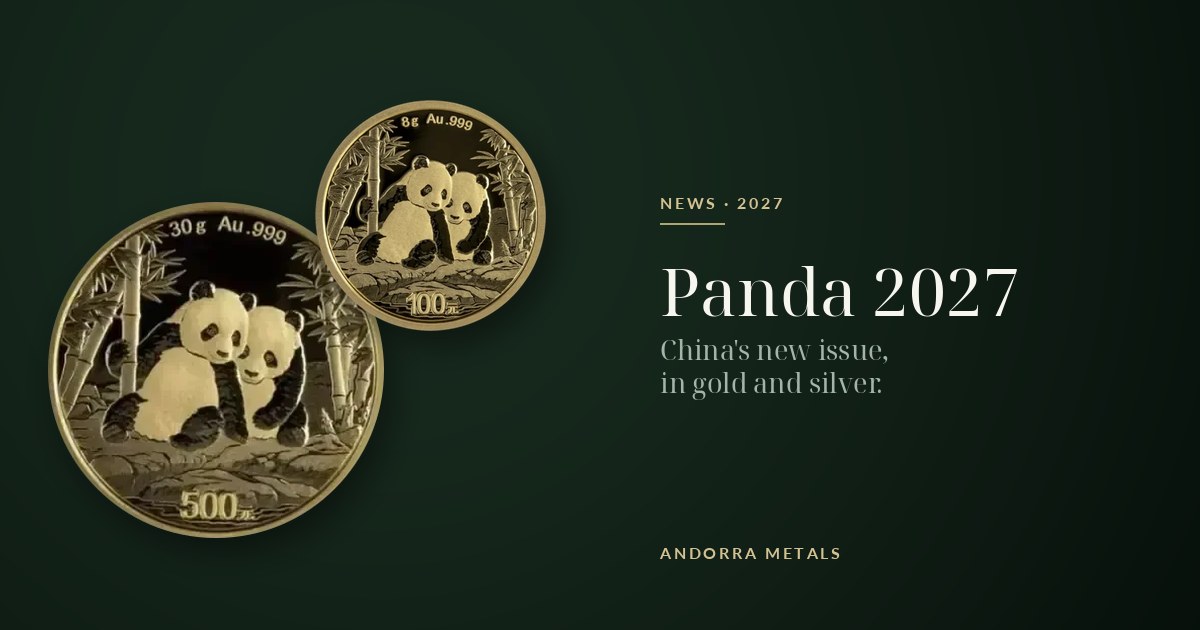
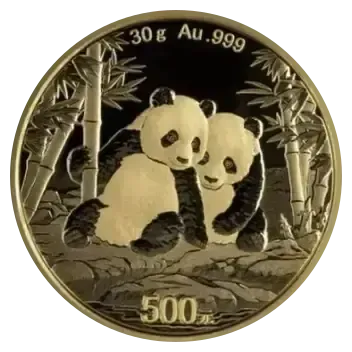
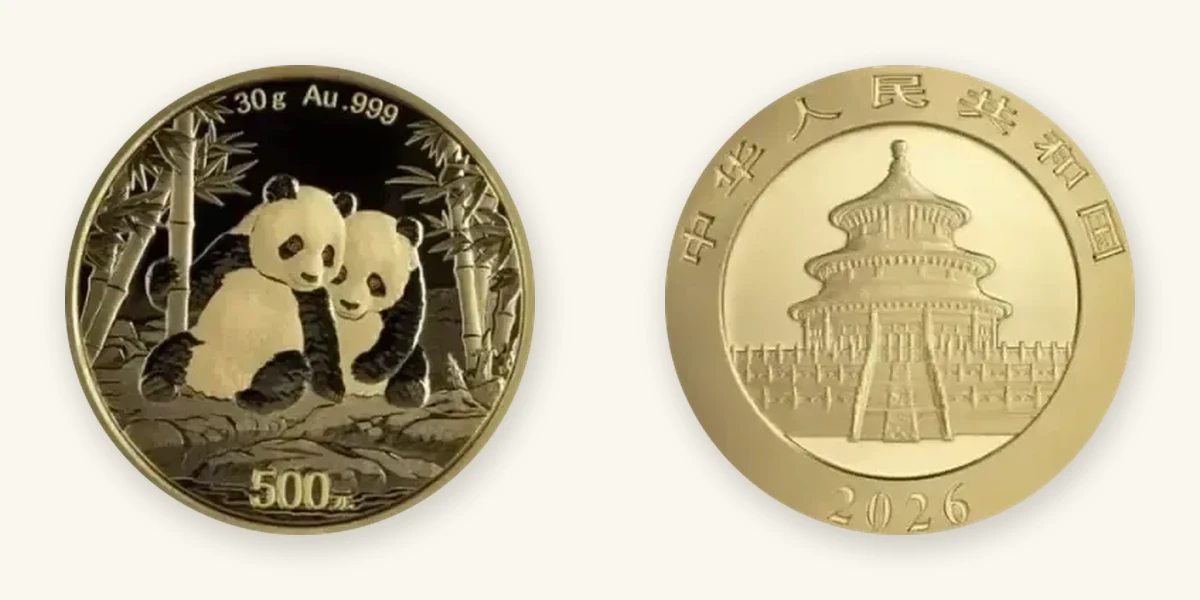
The 2027 Panda is out: the 46th edition of the most recognisable bullion series in Asia. The People’s Bank of China issued it on 30 October 2026, and this year the motif is a striking one: two giant pandas rest their heads together and their outlines draw a heart.
Here we go through what the issue contains, where the series comes from, what changes from 2026, and how all of it fits into a year in which China has used its raw materials — silver included — as commercial leverage.
The issue at a glance
The full issue runs to 15 coins. The ones that matter to an investor are the seven struck to bullion standard, all .999 fine and legal tender in China:
| Coin | Diameter | Face value | Max. mintage 2027 | Max. mintage 2026 |
|---|---|---|---|---|
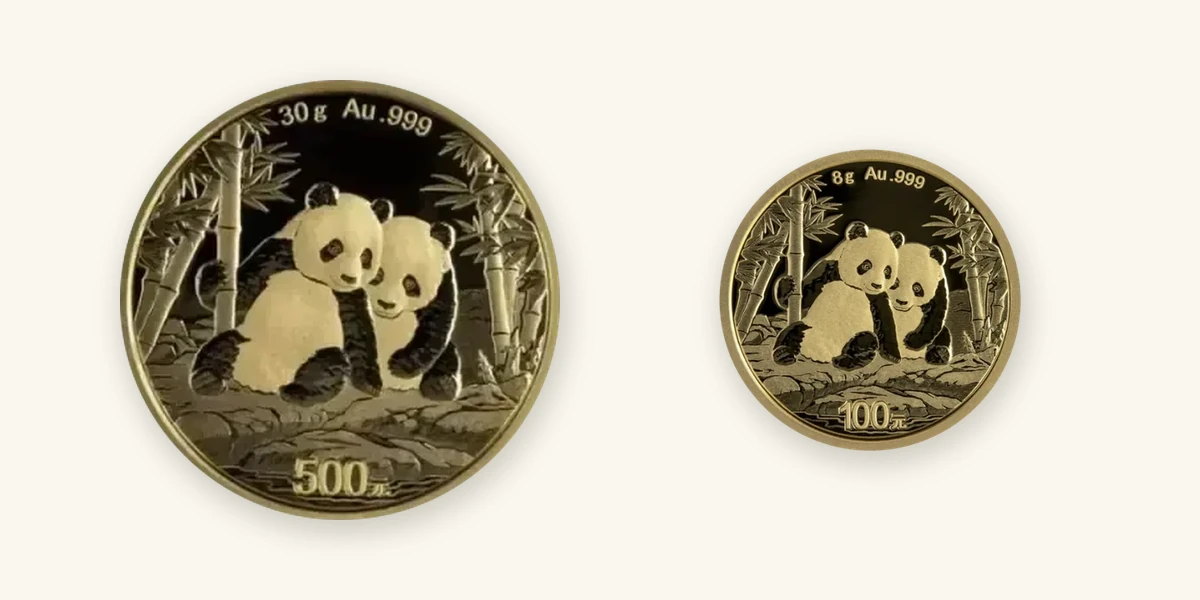
| Gold 30 g | 32 mm | 500 yuan | 500,000 | 500,000 |
| Gold 15 g | 27 mm | 200 yuan | 200,000 | 200,000 |
| Gold 8 g | 22 mm | 100 yuan | 200,000 | 200,000 |
| Gold 3 g | 18 mm | 50 yuan | 500,000 | 500,000 |
| Gold 1 g | 10 mm | 10 yuan | 500,000 | 500,000 |
| Silver 30 g | 40 mm | 10 yuan | 5,000,000 | 5,000,000 |
| Platinum 100 g | 55 mm | 3,000 yuan | 10,000 | 2,000 |
The other eight are proof versions for collectors: gold of 1 kg, 150 g, 100 g and 50 g; silver of 1 kg and 150 g; and platinum of 30 g and 3 g. In gold and silver they carry a colour effect that shifts with the angle of the light.
What matters to the buyer: gold and silver mintages are unchanged from 2026. The only new thing in quantities is platinum.
The design: “The Blossoming of Love”
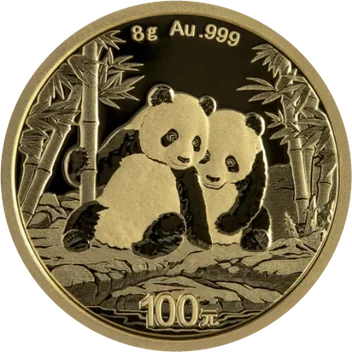
- Reverse: two giant pandas with their heads together and their gazes meeting; their outlines form a heart. In China the motif is presented as “The Blossoming of Love”, and the Chinese press credits the design to Tong Fang.
- Obverse: the usual one, the Hall of Prayer for Good Harvests at the Temple of Heaven in Beijing, with the country name and the year 2027.
- Finish: on the gold and silver bullion coins, bright areas contrasting with frosted areas at several levels.
- A series within the series: since 2019 the designs have told a story of love and family, the “Ten Years of Love” series. 2027 is the ninth chapter; the tenth and last will come in 2028. For a collector, the 2027 coin is the penultimate piece of a closed cycle.
45 years of history
That annual change of design is what gives the Panda its double nature: it has the metal of a bullion coin and the appeal of a collector’s piece, especially among Asian buyers.
| Year | What happened |
|---|---|
| 1982 | The gold Panda is born. China enters the world bullion coin market with a coin that, unlike the Krugerrand or the Maple Leaf, changes design every year. Only 2001 and 2002 repeated a motif. |
| 1983 | The silver Panda arrives. Since then every year brings a new panda: eating bamboo, playing, resting or with its cubs. |
| 2016 | The move to grams. China drops the troy ounce for metric weights: the silver Panda now weighs 30 g (0.96 oz). |
| 2019 | “Ten Years of Love” begins. The designs start telling a story of a couple and a family that will end in 2028. |
| 2026 | The 2027 edition is issued: struck in Shenyang, Shanghai and Shenzhen, distributed exclusively by China Gold Coin Group. |
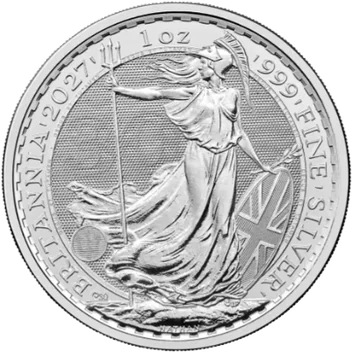
One practical consequence of that 2016 change: when you compare the Panda with other silver coins, always do it by the gram and not by the coin. A Maple Leaf or a Britannia weighs 31.1 g; the Panda, 30 g. That is 3.5% less metal, which you cannot see if you only look at the price per coin.
China and the control of raw materials
The 2027 Panda arrives in a year in which Beijing has used its raw materials as commercial leverage as never before. These are the measures that most affect metals:
| Raw material | What China has done | Status at 15 Nov 2026 |
|---|---|---|
| Silver | Since 1 January 2026, only 44 licensed companies may export it (2026–27), with a minimum output of 80 t a year. The measure also covers tungsten and antimony. | In force until the end of 2027 |
| Gallium and germanium | Export licence since July 2023. China refines almost all of the world’s gallium supply. | Licence in force |
| Gallium, germanium, antimony and superhard materials to the US | Export ban to the United States since December 2024. | Suspended until 27 Nov 2026; military use still banned |
| Rare earths (7 elements) | Licence since April 2025, including dysprosium and terbium for magnets. | In force; never suspended |
| Rare earths (5 more), lithium batteries, graphite and an extraterritorial rule | Announced on 9 October 2025. | Suspended; on 9 Nov 2026 China extended the suspension to 10 Jan 2027 |
The underlying reading is clear: China no longer treats silver as an ordinary commodity but as a strategic material, on the same regulatory footing as rare earths. The two-month-at-a-time extensions also show that these measures are switched on and off in step with the negotiation with Washington.
Does any of this affect the Panda?
Here it pays to be careful, because the temptation to overstate it is strong.
- Silver in Shanghai traded above London and New York for much of 2026.
- The premium on the silver Panda in the US has doubled in a year, from about 18% to 36%, and that while silver was falling.
- The new issue is late to Europe: one German distributor does not expect the 30 g silver before 20 January 2027.
- That the licence is holding Pandas back: it mostly regulates bullion bars, and Asian distributors point out that in practice it has not cut exports.
- That the premium is all geopolitics: part of it is plain collector demand.
- That the backdrop guarantees a price rise. It does not.
In short: the backdrop strengthens the Panda’s appeal as a coin “with a story”, but anyone buying in the expectation that geopolitics will pay for the premium is taking a risk nobody can quantify. One practical consequence is certain for the European buyer, though: the first launch prices tend to be high.
The big change: platinum multiplied by five
The platinum Panda disappeared in 2005, returned in 2022 for the 40th anniversary and has been issued regularly since 2023. In 2026 the 100 g bullion coin was launched with a maximum mintage of 2,000 pieces; in 2027 it rises to 10,000. The total platinum ceiling for the whole issue goes from about 0.53 to 1.33 tonnes.
The official reason is to balance supply and demand, and the Chinese press suggests a regular platinum investment line may be taking shape. One warning: anyone buying the 2027 platinum in the hope of a scarcity premium is doing so against a supply that has deliberately been widened. The 2026 coin remains the scarcest of this format.
Is the 2027 Panda worth it?
It depends a great deal on whether you are buying metal or buying a collection. Both are legitimate, but they do not cost the same.
| Gold Panda | Silver Panda | |
|---|---|---|
| What it is for | Diversifying with a sovereign coin recognised worldwide. | More a collector’s piece than a cheap way to stack silver. |
| Premium | Contained in the large formats; high in 1 g and 3 g. | Far above a Maple Leaf or a Britannia. |
| Tax in Andorra | Investment gold: exempt from IGI. | 4.5% IGI included in the price. |
| Entry point | From 1 g, though it starts to make sense at 8 g. | A single 30 g coin. |
| It makes sense if… | You want physical gold with some extra appeal on resale. | You like the series, you are completing years, or you want a minority part of your silver in coins with numismatic value. |
- Always compare by the gram. It is the only way to see what you are paying for metal and what you are paying for design, and on the Panda it matters more than on other coins, because it weighs 30 g and not one ounce.
- For collectors, a good year: the penultimate chapter of “Ten Years of Love”, a very recognisable motif and mintages that are not growing.
- Patience with the launch price: the first units reaching Europe usually sell dear. If you are not in a hurry, it normally pays to wait until there is more stock.
Commercial information
The 2027 Panda has not reached Europe yet. What we do hold at Andorra Metals is the 2026 issue in gold, priced live against the metal:
- 30 g gold Panda: the large format of the series, 32 mm and .999 fine. It is the most efficient way to buy Panda, because its premium per gram is the lowest of the five gold formats.
- 8 g gold Panda: 22 mm, to start with a smaller budget or to split the purchase across several coins. It pays a higher premium per gram than the 30 g.
- In silver we do not hold a current-year bullion Panda, but an encapsulated, graded piece: a 2015 1 oz silver Panda certified by NGC at MS 70. That is a collecting purchase, not a way to stack silver.
- Tax: in Andorra investment gold is exempt from IGI and silver is taxed at just 4.5%, well below the VAT of neighbouring countries.
- Buy-back: we buy the gold Panda back at the metal’s reference price. It is a liquid coin across the European market.
- Reserving the 2027: if you would like us to tell you as soon as the new issue arrives, say so and we will put you on the list, with no obligation and no deposit.
Frequently asked questions
How much does the 2027 silver Panda weigh?
30 grams of .999 silver (0.96 troy ounces), 40 mm across, with a face value of 10 yuan.
When does the 2027 Panda come out?
It was issued in China on 30 October 2026. It reaches Europe later: some distributors do not expect the silver before January 2027.
Is the gold Panda taxed?
In Andorra, as in the European Union, investment gold is exempt. Silver and platinum are taxed: in Andorra, 4.5% IGI included in the price.
Why does the silver Panda carry a higher premium than a Maple Leaf?
Because its design changes every year, which adds collector demand, above all in Asia, while the Maple Leaf is struck without limit and with the same design. On top of that come the 2026 tensions in the Chinese silver market.
Sources
- Kettner Edelmetalle — China Panda 2027: motif, mintages and platinum
- FindBullionPrices — Panda guide: design, specifications and history · China, India and silver premiums
- Greysheet — The “Ten Years of Love” series
- Scottsdale Mint — China tightens exports of silver, tungsten and antimony · Silver Bullion — The Chinese silver licensing regime
- Fastmarkets — Suspension of the gallium, germanium and antimony ban
- China Briefing — Rare earth export controls · RegFollower — Suspension extended to January 2027