A black October for metals, a record October for oil: the world between a deal and a new attack
Gold falls to a one-year low and silver drops below $50 while oil gains 14% in October. Iran, Ukraine, crude reserves and the gold/silver ratio near 80.
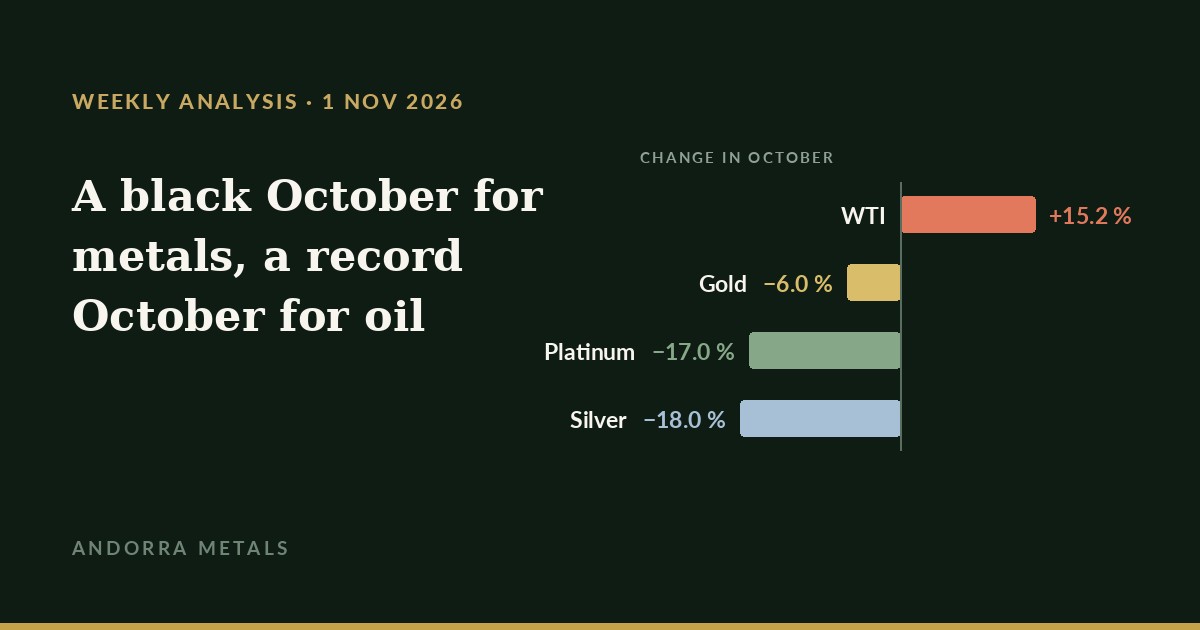
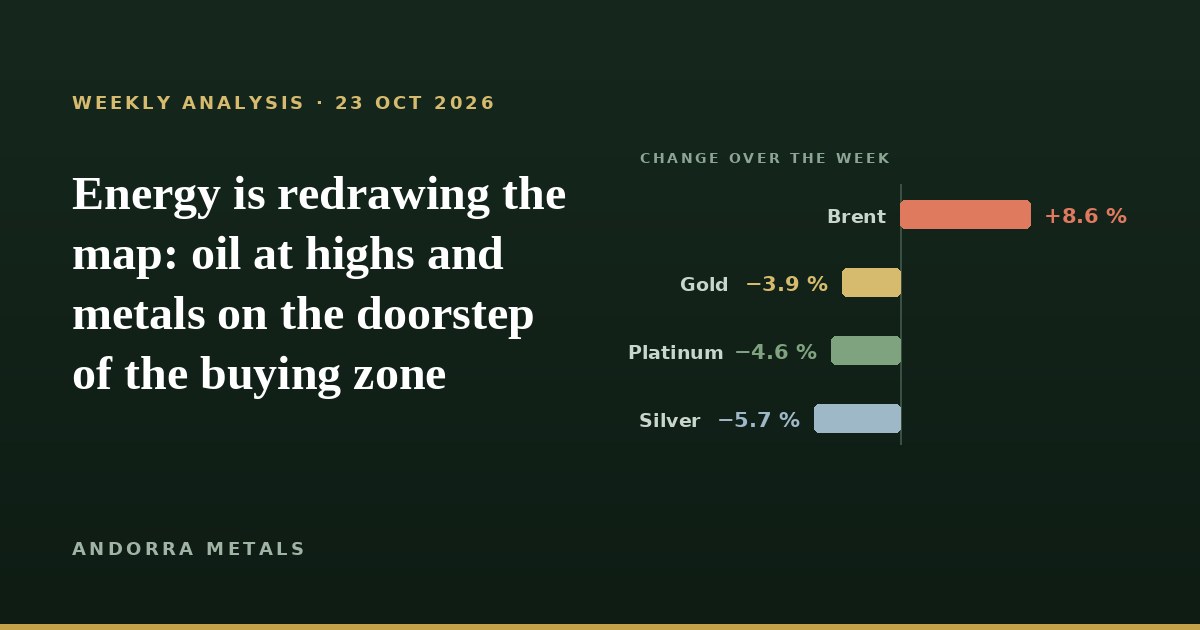
October has left an image that sums up this crisis better than any chart: oil rose 14% over the month while gold had its worst October since 2008, silver lost almost a fifth of its value and platinum did much the same. The war is not over; on the contrary, the Strait of Hormuz has just lived through the worst month of attacks on shipping since it began. But the market did not read "war, therefore gold", it read "oil, therefore inflation, therefore high rates". And in the last week a forced liquidation was added on top: when the tech markets fall, investors sell what they can sell, and gold is the first thing to go.
1. What the markets did
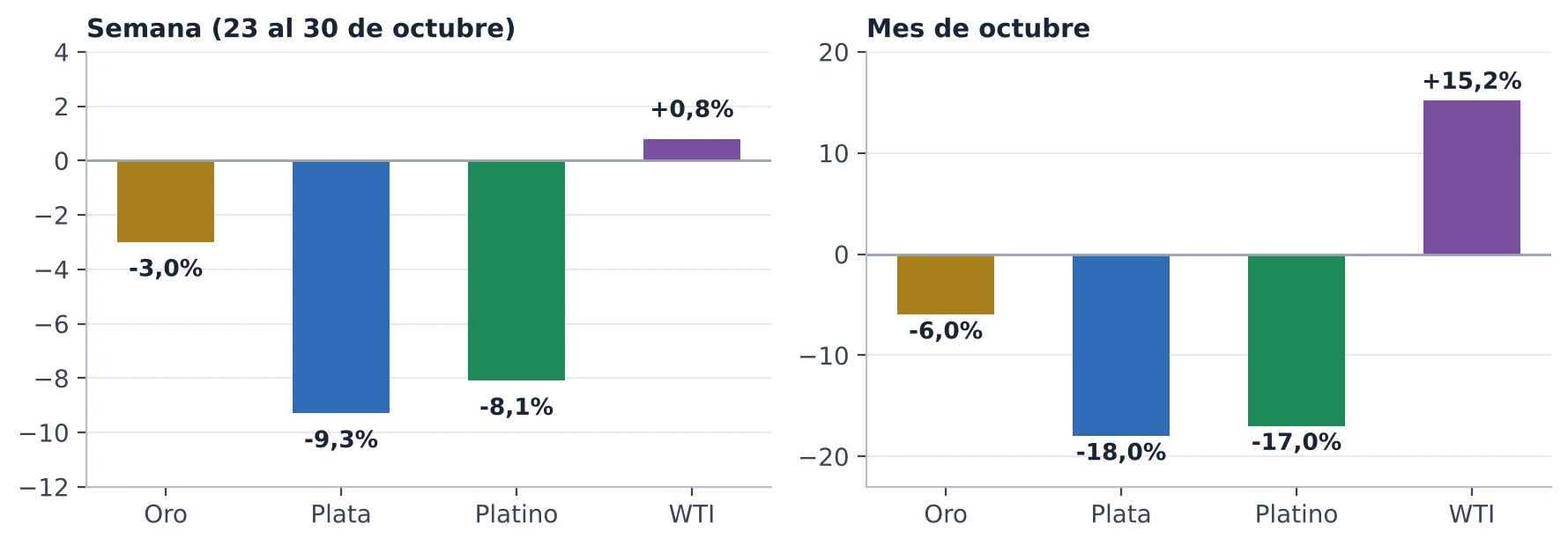
Oil. Brent closed October up 13.6% and WTI up 15.2%, a fourth straight week of gains. The December Brent contract expired on Friday at $117.64; the January one, which now becomes the benchmark, closed at $113.43. Goldman Sachs calculates that supply-disruption risk is adding some $27 to the price of a barrel. On Sunday 1 November, OPEC+ agreed to keep its December quotas unchanged: most Gulf producers are still pumping below target because of the war.
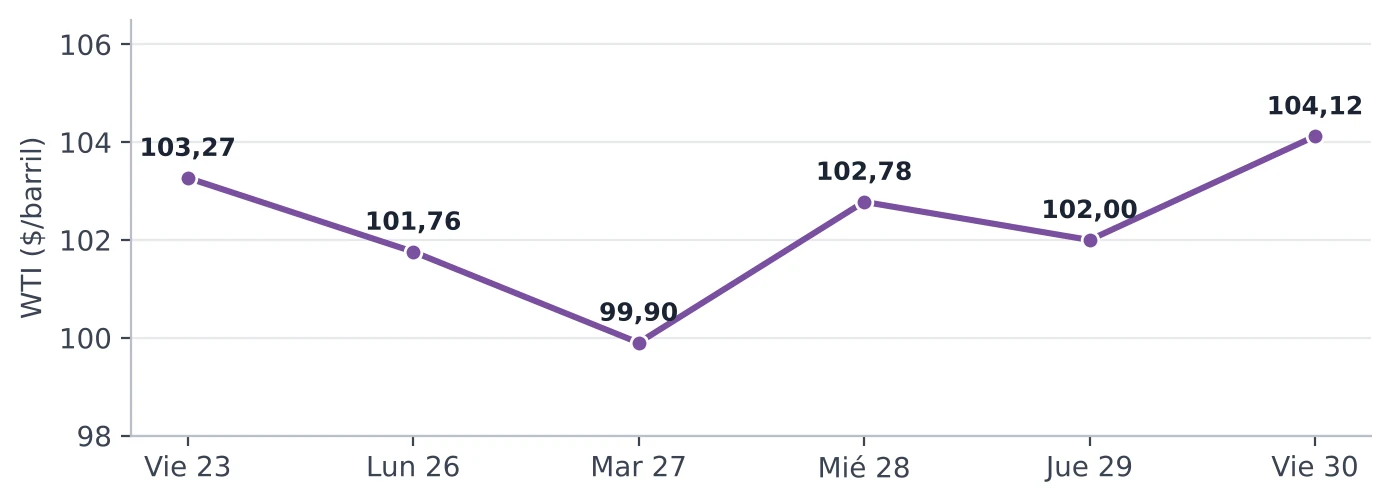
Gold. It fell 3.5% on Friday 30, to around $3,878, its lowest level in a year, and closed October down about 6%. September's PCE inflation reading (3.6% year on year, 3.1% core) and 3.4% third-quarter growth reinforced the idea that the Federal Reserve will raise rates again in December: the Fed held rates on 28 October, but with two of its members voting to hike, and the market puts the odds of that increase at between 70% and 83%. At the same time, the fall in tech equities — the Nasdaq-100 lost $1.2 trillion in October — forced many investors to sell gold to cover losses elsewhere. The money looking for shelter went into Treasuries, not into gold.
Silver and platinum. Silver gave up almost 9% on the week and dropped below $50; platinum, 8%. They are smaller metals, more tied to the industrial cycle, and they fall further in forced selling.
2. Iran: between Doha and an attack window from 4 November
The week had two faces. On one side, the most active diplomacy since June. Qatar presented Iran with a new draft agreement; according to Saudi media it would include the reopening of Hormuz within seven days, a commitment on uranium and a possible guarantor role for China, although neither side has confirmed it. Iranian negotiators travelled to Doha. Vice-President Vance sent a letter to Tehran. And on 26 October, in a scene that was hard to imagine a few months ago, the Saudi defence minister, the head of Turkish intelligence and Pakistan's army chief met in Tehran with President Pezeshkian and agreed that the region's security must be guaranteed "without foreign intervention".
On the other side, preparation for war. According to MS NOW and AP, the United States has asked its Gulf allies to prepare for a "short and fast" round of strikes that could begin on 4 November, the day after the midterm elections. Supreme Leader Mojtaba Khamenei ordered that every US and Israeli asset in the region be kept in the crosshairs, and his military chief says he has set a new target list. Iran is even debating whether to maintain its ban on nuclear weapons. Trump, for his part, says the war will be "settled soon" and that "there is time".
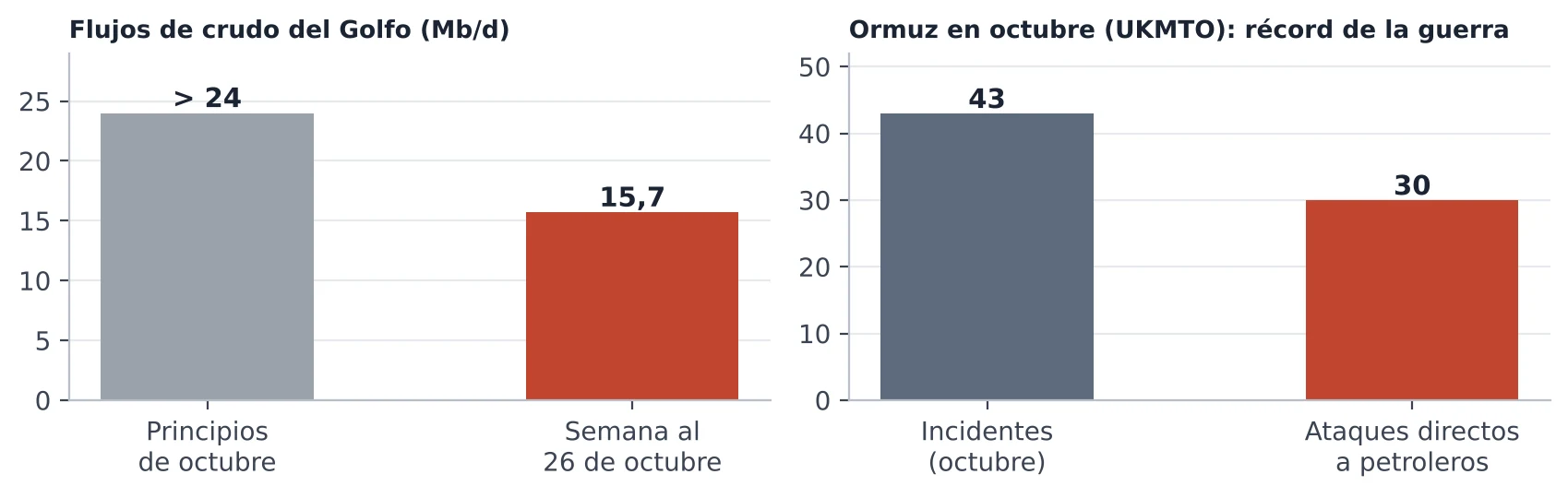
In the strait, October was the worst month of the war: 43 incidents recorded by the British maritime agency UKMTO, 30 of them direct attacks on tankers, and the first successful attack by a limpet mine placed from a speedboat. Traffic is still 70% below its pre-war level, and Gulf crude flows fell to 15.7 million barrels a day in the week to 26 October, down from more than 24 at the start of the month.
Two political developments change the context. In Israel, Netanyahu's bloc fell from 68 to 53 seats in the 27 October election; nobody reaches the 61-seat majority and forming a government could take months, with Netanyahu staying on as caretaker. And in Moscow, Putin received Pezeshkian and declared that June's Islamabad agreement "remains valid" as a basis for negotiation.
3. The Houthis, the Gulf and the other fronts
The Houthis kept launching drones and missiles at Riyadh, the Eastern Province, Jizan and Najran, and at the presidential palace in Aden. Even so, ship-tracking data show that Saudi Arabia exported more crude in October than in September, thanks to its pipeline to the Red Sea. In the Horn of Africa, the tension between Ethiopia and Eritrea remains unresolved. And in the eastern Mediterranean the clash between Greece and Turkey continues over the maritime memorandum ratified on 20 October by the parliament of eastern Libya, which affects the Greece-Cyprus-Israel power cable and the exploration blocks south of Crete. Europe, meanwhile, is rearming: France and ten other countries are negotiating the deployment of nuclear-capable fighters as a deterrent against Russia.
4. Ukraine strikes Russian refineries again
After the energy truce announced by Trump on 11 October, Ukraine scaled back its strikes on refineries: Zelensky acknowledged a 72-hour pause and, according to the Wall Street Journal, the suspension was informally extended under US pressure. That pause ended on 30 October. Russian Deputy Prime Minister Alexander Novak admitted attacks on three refineries and a gas-chemical complex: "We had a brief pause, but today they have resumed." One of them is Novokuibyshevsk, in Samara, owned by Rosneft, with capacity for 8.8 million tonnes a year; the Ukrainian maker of the drone says it hit its diesel hydrotreating unit. On 31 October the Bashneft refineries in Ufa were attacked. Russia, for its part, keeps hitting the Ukrainian power grid on the doorstep of winter.
The paradox is that, while Ukraine goes back to punishing Russian refining, the United States has suspended sanctions on Russian diesel until April 2027 to ease its own prices. The conclusion for the market is the same one we have been pointing to: the problem is not so much crude as refining, and every refinery that stops in Russia or in the Gulf tightens diesel further.
5. World oil reserves at lows
Observed oil stocks worldwide are some 509 million barrels below their February level, and those held on land are at their lowest since at least 2016, according to the International Energy Agency. In the US, crude inventories have fallen for four straight weeks to 410.6 million barrels, the lowest since July, and distillate stocks — diesel — are 8.3% below where they were a year ago. The summer's withdrawals from the US strategic reserve have ended, and OPEC+'s real spare capacity is minimal, around 0.27 million barrels a day.
Governments' answer is to keep emptying reserves: the European Union has authorised the release of 42 million barrels over three months, half of it diesel, and France will deliver the first tranche at cost. It is temporary relief, not a solution. And there is a less visible bottleneck that affects metals directly: according to Kpler, sulphur exports through Hormuz are running at 55% of their pre-war pace. No sulphur means no sulphuric acid, and without sulphuric acid copper and nickel extraction suffers. Since 70% of silver is obtained as a by-product of other metals, that shortage eventually reaches its supply too.
6. Europe on the streets
The cost-of-living protests have not died down. France deployed 70,000 officers for the demonstrations of the weekend of 31 October, after the riots in the middle of the month, and in Italy the unrest in Milan and the hauliers' blockades over diesel prices are still fresh. In the US, seven out of ten citizens say petrol is becoming unaffordable and Trump's approval rating is around 31-33%. Energy is no longer only a market matter: it is a matter of the street and of the ballot box.
7. Where is the world heading with energy?
The week reinforced three ideas. First, that crude adapts but refining does not: oil keeps leaving the Gulf by alternative routes, but diesel, kerosene and refined products are scarce. Second, that energy is now a national-security matter: the US has invoked the Defense Production Act for oil production and refining, Europe is emptying its reserves and negotiating its own nuclear umbrella, and South Korea is already testing routes through the Russian Arctic. Third, that the supply horizon is narrow: analysts such as Dennis Coyne put the peak of US shale oil — the source that has underpinned the growth of global supply since 2012 — towards the end of 2027, and estimates such as those of the Rayo Negro blog suggest that genuinely accessible oil is far smaller than official reserves. These are estimates, not certainties, but they sketch the same scenario described by the researcher Antonio Turiel: a world in which every barrel costs more energy and in which scarcity shows up first in diesel.
8. The metals in the short term: why they are falling
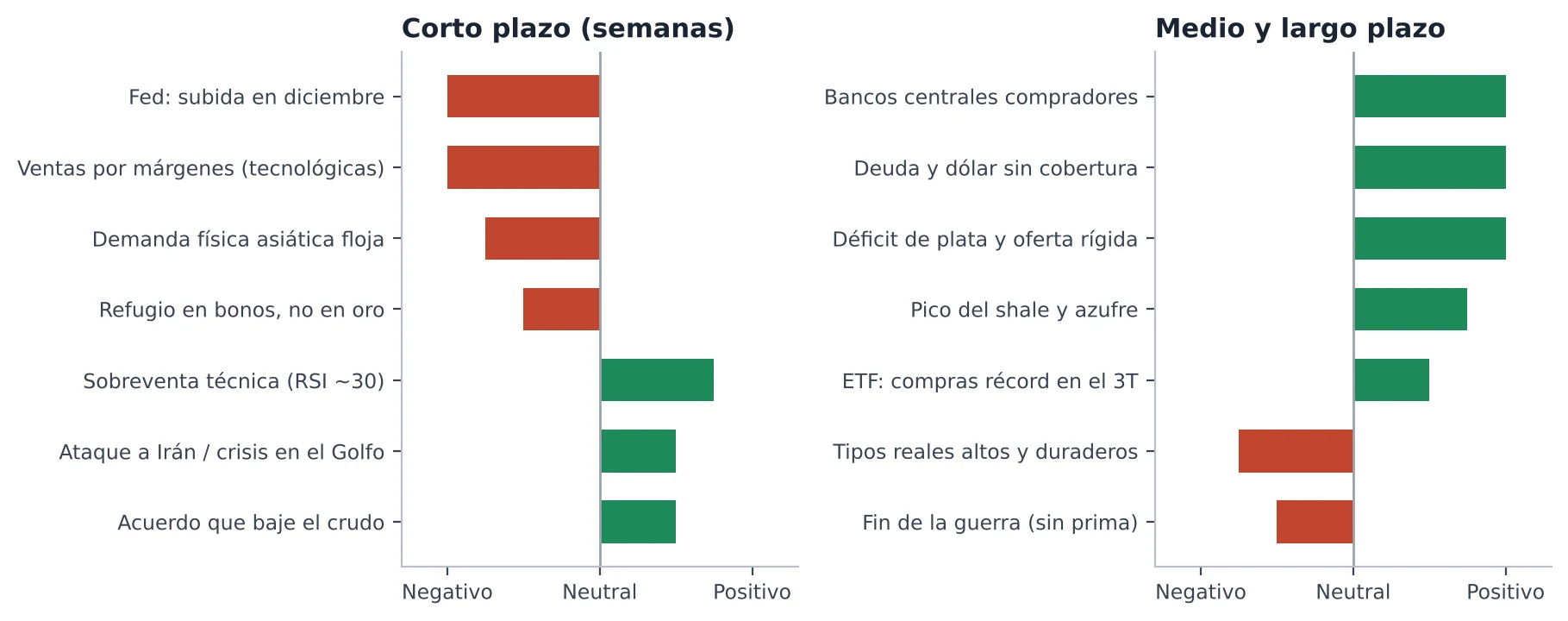
October's fall has four causes that reinforce one another. Rates: with oil above $100, inflation picks up and the Fed is preparing to hike, which makes the dollar and bonds more attractive than an asset that pays no interest. Liquidity: forced selling in tech equities has led investors to sell gold and silver to cover margin. Asian physical demand: premiums in India and China have narrowed and buyers are waiting for lower prices, so physical demand has stopped supporting the price. Official sellers: Kazakhstan wants to reduce the weight of gold in its reserves. As one analyst put it this week, "gold is liquid, so it is the first thing people sell when they need cash".
9. Where the floors are
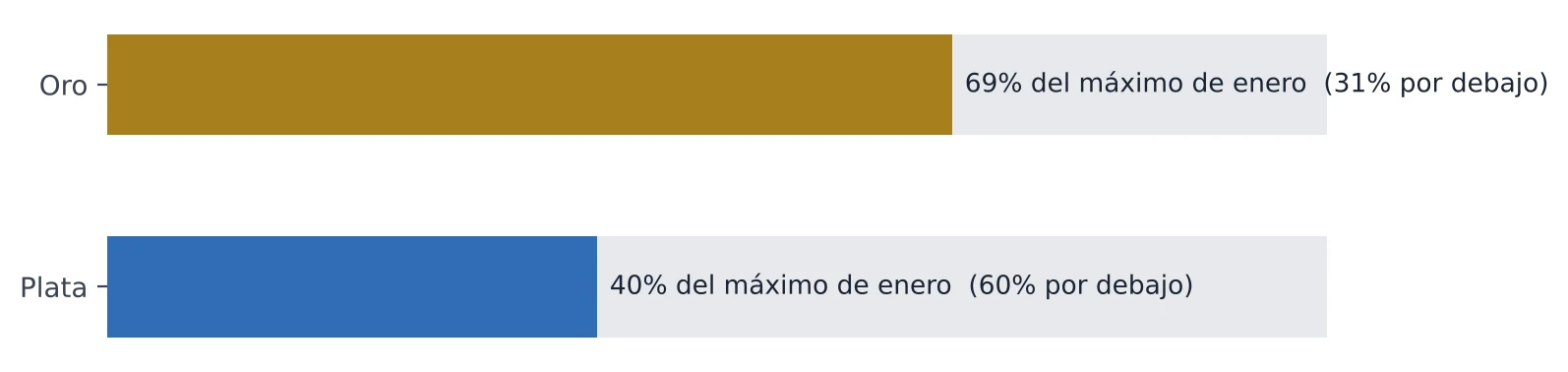
Gold. It trades around $3,878, 31% below its January record and some 13% below its 200-session average, an unusually wide gap. Its relative strength index (RSI) is around 30, the technical oversold threshold, and some sentiment indicators are at very pessimistic levels, something that has historically worked as a contrarian signal. Technical analysts place the next supports in the $3,850 and $3,800 area. Below $4,000, our reading is that gold is in an accumulation zone, although we cannot rule out that the liquidation continues for a few more weeks.
Silver. It has lost 60% from its record of $121.62 in late January and has dropped below $50. It is by far the most punished metal. Its floor is harder to pin down because of its volatility, but the fall is already pricing in a very negative scenario for industrial demand.
Platinum. Around $1,436, 18% below the $1,750 level that our models mark as the accumulation zone.
Against those prices, the underlying buyers have not gone away: central banks bought a record 288.9 tonnes in the second quarter, China's has been buying for 23 months in a row, India keeps repatriating its gold and gold ETFs took in a record $31 billion in the third quarter.
10. What would happen if the US and Israel attack Iran again?
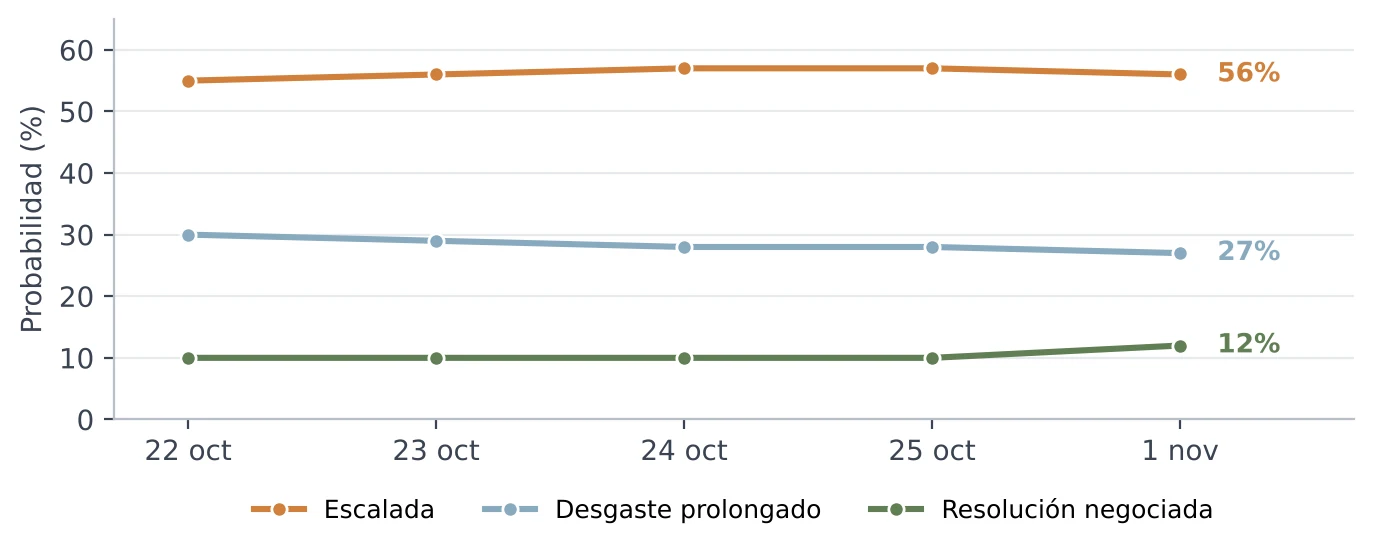
The risk window is specific: between 3 November, election day, and the arrival of the new Congress in January. Polls give the Democrats an 82% probability of winning the House and 62% of winning the Senate, which would let them control the financing of the war. That creates an incentive to act sooner. In Israel, a Netanyahu without a majority but still in office is the one who decides. If the attack happens, our reading, based on what has happened since February, distinguishes three phases:
Crude spikes on the risk to Hormuz. The metals would probably suffer at first, through the same inflation-and-rates chain as in October.
If Iran carries out its threat against US assets or its neighbours' infrastructure, the crisis stops being an energy crisis and becomes a financial and security one. That is where gold tends to recover its safe-haven role.
More military spending, more debt and more central banks looking for assets outside the dollar. That is the ground on which metals have historically worked best.
A deal, by contrast, would push oil sharply lower. In the short term that could ease inflation and the pressure on rates and, paradoxically, help the metals, although part of the safe-haven demand would disappear.
11. The gold/silver ratio near 80: what happened the other times
The gold/silver ratio — the ounces of silver needed to buy one ounce of gold — has risen from 74 to almost 80 in a week, and in January it was below 45. A ratio at 80 means silver is historically cheap against gold. What happened the other times it reached that area?
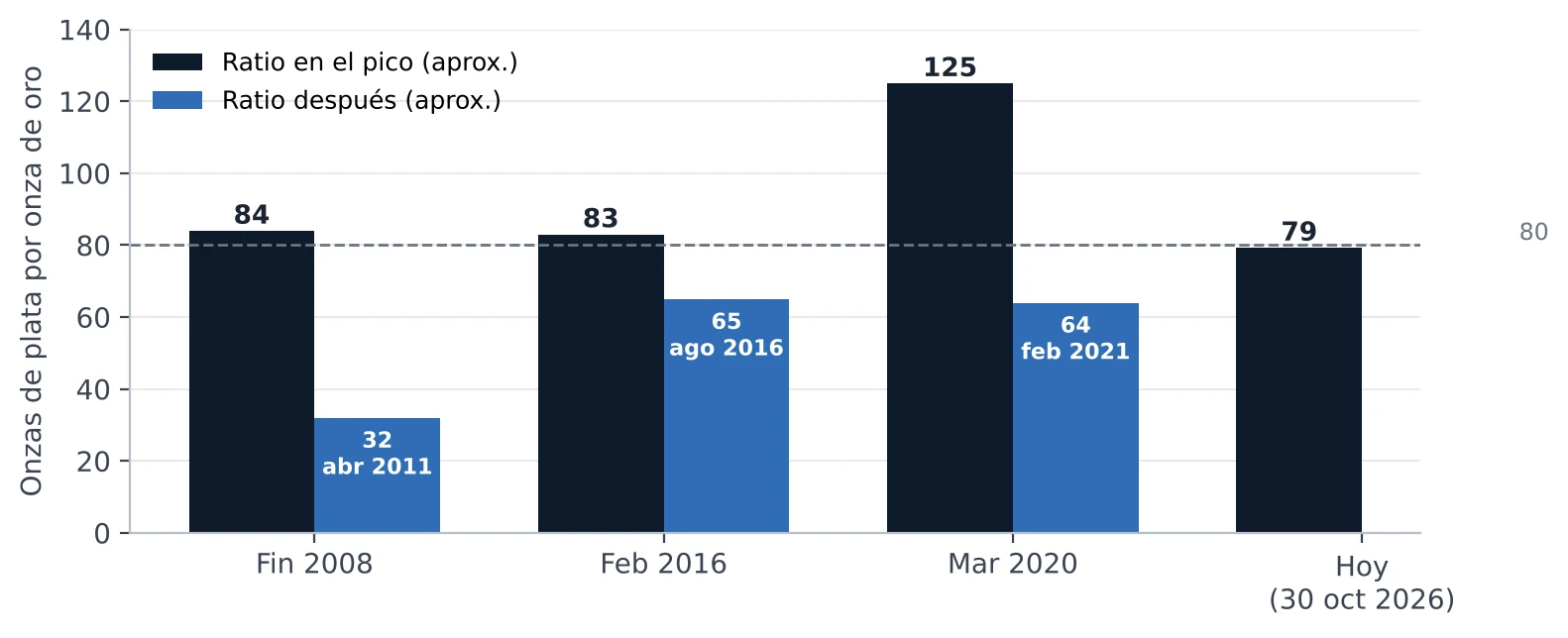
- Late 2008. In the middle of the financial crisis, forced selling drove the ratio to the 84 area. Over the following two and a half years silver multiplied its price fivefold (from about $9 to almost $49) and the ratio fell to the 32 area in April 2011.
- February 2016. After years of a bear market in metals, the ratio reached the 83 area. Within six months it was down to the 65 area.
- March 2020. The liquidation at the start of the pandemic sent it up to the 125 area, a record. A year later it was in the 64 area.
The pattern is clear: ratios in the 80 area tend to coincide with phases of liquidation and fear, in which silver falls more than gold, and they tend to be followed by phases in which silver recovers more strongly. But there are two important caveats. First, the ratio can keep rising before it turns, as in 2020, when it went from 80 to 125 in weeks. Second, the turn usually arrives when liquidity comes back, that is, when the Fed stops tightening or financial stress recedes. That is why our rules do not rotate gold into silver until the ratio reaches more extreme levels and corporate credit shows no stress. Today the ratio favours silver as gradual accumulation, not as a concentrated bet.
Follow the ratio live. In the Andorra Metals Gold/Silver Calculator you can see the current ratio, its history since 1971 and its statistical bands.
Open the Gold/Silver Calculator →12. How we see gold and silver in the medium term
Gold. In the medium term our view is positive. The reasons that support it — central-bank buying, record public debt, a dollar whose foreign investors are poorly hedged against its fall, and an energy crisis that is making the world more expensive — have not changed; October was a liquidation, not a change of thesis. The risk to watch is that the Fed raises rates more than expected and keeps real rates high for a long time.
Silver. In the medium term, a positive view but with more volatility than gold. In its favour: six years of deficit, a mine supply that does not respond to price and is contracting in Mexico, the shortage of sulphuric acid and a gold/silver ratio that leaves it cheap in relative terms. Against it: it is the one that suffers most when the economy or liquidity weakens, and its solar demand has fallen this year.
Platinum. A positive view in the long term, but dependent on the market deficit returning and on industrial demand.
Conclusion
The world is entering a phase in which energy is both the cause and the victim of conflicts: wars in the Gulf, in Yemen and in Ukraine, tensions in the eastern Mediterranean and protests in the streets of Europe and at the ballot box in the US. In the short term, that same energy crisis punishes the metals through inflation and rates, and next week — elections on the 3rd, a possible attack window from the 4th, the jobs report on the 6th and the swearing-in of the Knesset on the 10th — could bring a lot of volatility. But in the medium and long term, the reasons that support gold, silver and platinum remain intact and, in some cases, reinforced. With gold at a one-year low, silver 60% below its record and the gold/silver ratio near 80, our reading is that we are in an accumulation phase that is best approached in stages, with patience and with enough cash to take advantage of further falls.
Sources
- Kitco – gold at a one-year low · XTB – the end-of-October fall · Trading Economics · Finimize – Asian demand
- Oil Monitor – weekly crude summary · FinanceFeeds – Brent and OPEC+ · ANI/Reuters – OPEC+
- Fox Business – the Fed · Ynet – Doha and the 4 November window · CBS News · Khaleej Times · Iran International
- Daily Sabah – the Tehran summit · Times of Israel – the election · TASS – Putin and Pezeshkian · RFE/RL
- Kyiv Independent – Novokuibyshevsk and Novak · Kyiv Independent – the pause · Bloomberg – Bashneft
- Kpler – sulphur · Rayo Negro · Peak Oil Barrel · Time – Defense Production Act
- Meduza/WSJ – European nuclear deterrence · gCaptain – the Arctic · Greek Ministry of Foreign Affairs
- Al Jazeera – Trump's approval rating · Decision Desk HQ · Bloomberg via Bloomingbit – dollar hedging · World Gold Council – ETFs