Rising inflation, war on two seas and metals in the support zone
Andorra Metals weekly analysis: the US inflation print, the Fed and bonds, Iran and Hormuz, the Houthis, Russia and the Horn of Africa, diesel and gas reserves, and what it all means for gold and silver.
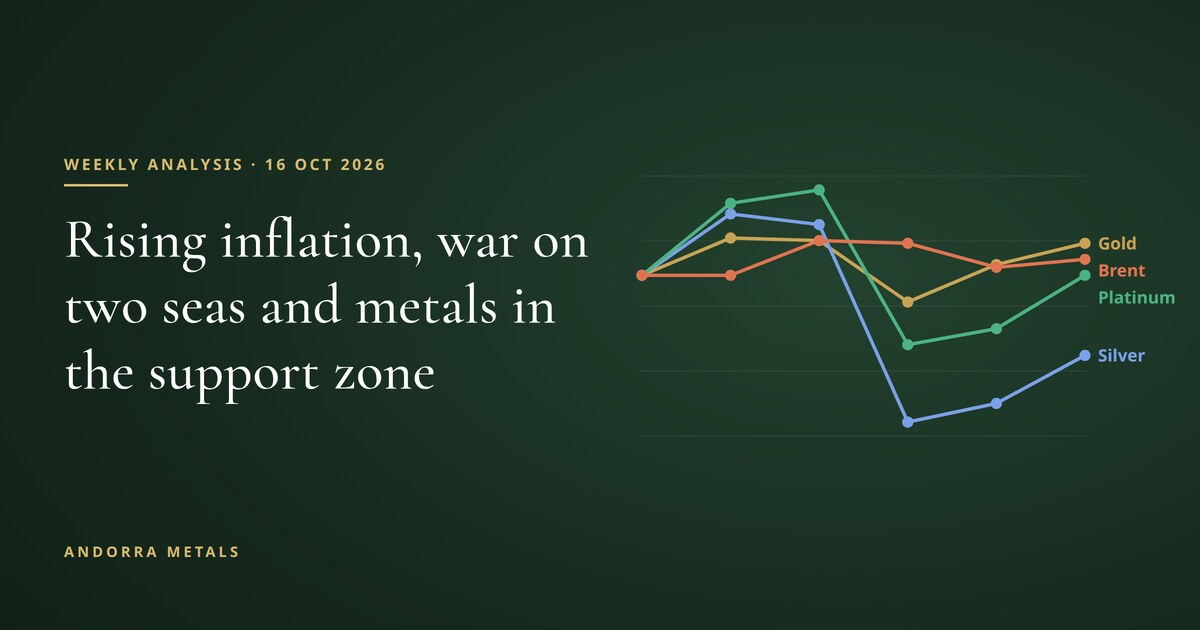
It has been a two-sided week for precious metals. On Wednesday, a hotter-than-expected inflation print sank silver by 5% and took gold to its lowest level since the start of the month. Two days later gold had recovered everything, pushed by falling equity markets, lower bond yields and a military escalation that shows no let-up. We go through what happened, why, and which factors now work for and against the metals.
Inflation: oil is already in the prices
The key data point of the week landed on Wednesday the 14th. The US consumer price index (CPI) rose 0.6% in September and the annual rate went from 3.4% to 3.7%, above the 3.6% the market expected. Core inflation, which excludes energy and food, rose to 2.6%. On Thursday came producer prices, which measure what companies pay, and they were even more striking: +1.3% in a single month and +6.3% over the year, the biggest rise since December 2022.
The cause is clear: energy. Petrol rose 9.1% in September and on its own explains more than half of the increase in CPI. In producer prices, petrol jumped 20.3% and energy as a whole explains more than 80% of the advance. The rest of the basket is relatively contained: food did not rise over the month and housing rose 0.4%.
This matters because producer prices tend to lead what reaches the consumer. If companies are paying 6.3% more for what they buy, part of that will end up in final prices over the coming months, above all through transport. And transport depends on diesel, the weakest link in this crisis, as we will see below.
The Fed and bonds: from the scare to the flight to quality
After the CPI, the market went as far as pricing a 50% probability that the Federal Reserve would raise rates again at its 27-28 October meeting, up from 22% before the print. The official range is 3.75%-4.00% after September's hike. But the probability deflated: 34% after producer prices and less than 15% after Fed chair Kevin Warsh spoke on Friday at the IMF meeting without giving any hint ("I do not prejudge what we will decide"). What does not change is December: the market still prices around 90% for a hike before year-end.
The US 10-year bond lived through the same swing. It touched 5.30% right after the CPI, but on Thursday fell to 5.05%. Paradoxically, the fall happened on the very day producer prices shot up. The reason was a broad sell-off in equities, above all technology, on doubts about artificial-intelligence spending: money left the stock market and sought refuge in bonds and gold. Bloomberg also reported that China is buying Treasuries through non-US custodians, which helped calm fears.
The backdrop, however, remains fragile. US federal debt is above 40 trillion dollars and the Congressional Budget Office calculates that, with rates a percentage point higher than projected, it would reach 222% of GDP by 2056. In Europe, France will not meet its 5% deficit target this year and the spread of its bond against the German one is around 140 basis points, the highest since the euro crisis. These are signs of pressure, not of rupture, but they feed demand for assets that do not depend on the solvency of any state.
The war fronts
Iran and the Strait of Hormuz
October is becoming the most dangerous month for shipping since the war began. According to the New York Times, 26 vessels have been hit so far this month. The British maritime agency UKMTO counted 12 attacks between 5 and 11 October alone, a weekly record. Two ships have sunk this week: the container ship GFS Pride, hit by a projectile (its 21 crew were evacuated), and the bulk carrier Cape Dao, damaged in September. Iran has changed tactics: it is now also attacking in the Gulf of Oman and near Qatar and the Emirates, with the declared aim of preventing oil prices from falling.
The flow of crude through the strait fell to 12.6 million barrels a day on 13 October, against 15 at the end of September and 17 before the war. The United States maintains the blockade of Iranian ports and escorts convoys: its military command in the region says that more than 19 million barrels passed through in a single day. Iran, for its part, has not loaded a single barrel of crude in September or October, something that had not happened since 1979, and its oil revenues are heading towards zero.
Diplomatically, the talks are stuck on the order of the agenda: Iran wants to start with reopening Hormuz and the United States insists on starting with the nuclear programme. The speaker of the Iranian parliament, Qalibaf, has said his country must "prepare for war" even while negotiating. And according to CNN, the Pentagon has plans ready that include using the largest non-nuclear bomb in its arsenal (the MOAB) if Trump decides to resume strikes, before or after the 3 November elections. Bloomberg also reported that Iran retains its missile and drone factories and is receiving missiles from Russia.
The Houthis and Saudi Arabia
The second front has heated up considerably. The Houthis of Yemen, allies of Iran, hit a building at Aramco's headquarters in Dhahran on Tuesday the 13th and have attacked Riyadh airport some twenty times in October; 14 people died in one of those attacks. The airport remains closed and more than 4,000 flights to Saudi Arabia have been cancelled in a week. On Thursday the Houthis also struck the presidential palace in Aden, seat of the recognised Yemeni government, and Saudi Arabia intercepted a missile over Medina. Riyadh has responded by bombing Houthi oil facilities and Trump is weighing whether to join those strikes. What matters for the market is that Saudi Arabia depends more and more on the Red Sea and the Bab el-Mandeb strait to export its crude, precisely the area the Houthis threaten.
Russia and Ukraine
Trump announced an "energy truce" between Russia and Ukraine on 11 October and a deal with Putin for Russia to sell 4.8 million tonnes of diesel to the world market. The truce lasted three days: on Thursday the 15th Ukraine again attacked Russian refineries and set fire to the one at Ryazan, which processes close to 5% of Russian crude. The diesel deal is also small: it amounts to less than two weeks of US consumption, and 3 of those 4.8 million tonnes depend on the state of refineries that are still being attacked. In the Black Sea incidents are multiplying: a cargo ship sunk by drones off Bulgaria and a tanker set alight in Romanian waters, both NATO countries.
The Horn of Africa
On the other side of the Red Sea, Ethiopia is going through a new phase of instability. Since the end of September, seven armed groups have allied against Abiy Ahmed's government, Ethiopia has taken Mekelle (capital of Tigray) and has broken with Eritrea, which fears for its port of Assab. It is a less visible conflict, but it is unfolding right opposite Bab el-Mandeb, one of the two great routes by which Gulf oil leaves the region.
With all of that, we have been raising the probability of the Escalation scenario through the week, from 50% to 52%, against 33% for prolonged attrition and 10% for a negotiated resolution.
Diesel, distillates and gas: the cushion narrows
The International Energy Agency (IEA) confirmed in its monthly report of 14 October what we have been pointing out: the problem is not so much crude as what comes out of the refineries. Wholesale diesel set records in September, around 220 dollars a barrel in Europe and the United States, world diesel exports fell by 700,000 barrels a day against a year ago and the IEA expects the market to stay tight "well into 2027". World oil stocks have fallen by some 509 million barrels since February.
The weekly US data confirm it. In the week to 9 October, commercial crude reserves fell by 8.6 million barrels and distillates (diesel and heating oil) by 2.5 million. Distillates are 12% below their five-year average, the equivalent of about 26 days of consumption, just as the heating season begins.
There is some relief. The IEA has decided to speed up the release of the 100 million barrels left in its emergency reserves (more than 20 million of them diesel), China suspended its October fuel exports to protect its own market and the United States is considering easing sanctions on tankers to bring down freight rates that are at record levels. At the European pump, diesel has come down from the record of 2.24 euros a litre at the end of September to 2.14, but it still almost doubles the price of crude.
Gas is the other weak point, above all for Europe. EU storage is at 74%, about 15 points below normal for this time of year, and Germany is barely above 60%. Qatar, which lost 17% of its liquefied gas export capacity in the March attacks, will take about three years to repair two of its trains. In Spain, Red Eléctrica has had to ask heavy industry to cut consumption ten times this year to balance the system, against four in 2024 and none in 2025.
What does this imply for inflation? That the risk is to the upside through the winter. Scarce diesel makes transporting almost everything more expensive and expensive gas makes electricity and industry more expensive. Both effects reach prices with a few months' lag, which makes it hard for inflation to return quickly to levels central banks are comfortable with.
Central banks keep buying gold
While financial investors come and go, central banks keep accumulating. The People's Bank of China added some 23 tonnes in September, its largest monthly purchase since 2023 and the 23rd consecutive month of buying, to around 2,410 declared tonnes. Globally, central banks added 39 net tonnes in August according to the World Gold Council. We have found no evidence that Gulf central banks are selling gold despite the blockade of their trade routes.
The pattern is revealing: China accelerated its purchases precisely while the price was correcting. A buyer with a horizon of decades does not chase rallies, it takes advantage of falls. That official demand is one of the most solid supports gold has today.
What all this means for gold and silver
We do not make price forecasts, but we can set out the factors working for and against each metal. The two charts below sum up our qualitative reading as of today: the length of each bar indicates the relative weight we give it, not a quantified effect.
The relationship between the two metals has also moved. The gold/silver ratio, which shows how many ounces of silver it takes to buy one ounce of gold, went from 69 to close to 73 this week. It is still far from the levels at which silver is considered historically cheap against gold, but it shows that silver has suffered more.
Are we in an accumulation phase?
Our analytical framework divides the current cycle into three phases. Within the stabilisation phase, our internal models define price zones in which, historically and according to our methodology, the risk-reward of accumulating improves: below $4,200 for gold, with a more attractive zone below $4,000, and below $1,750 for platinum.
Accelerated selling and vertical falls from the January peak. It is the phase in which price disconnects from fundamentals because the need for liquidity is in charge.
A wide range, plenty of volatility and structural buyers taking advantage of the falls while speculative players have already cut positions.
It requires real rates to stop rising. Nobody can set the date; what you can do is recognise the change when it happens.
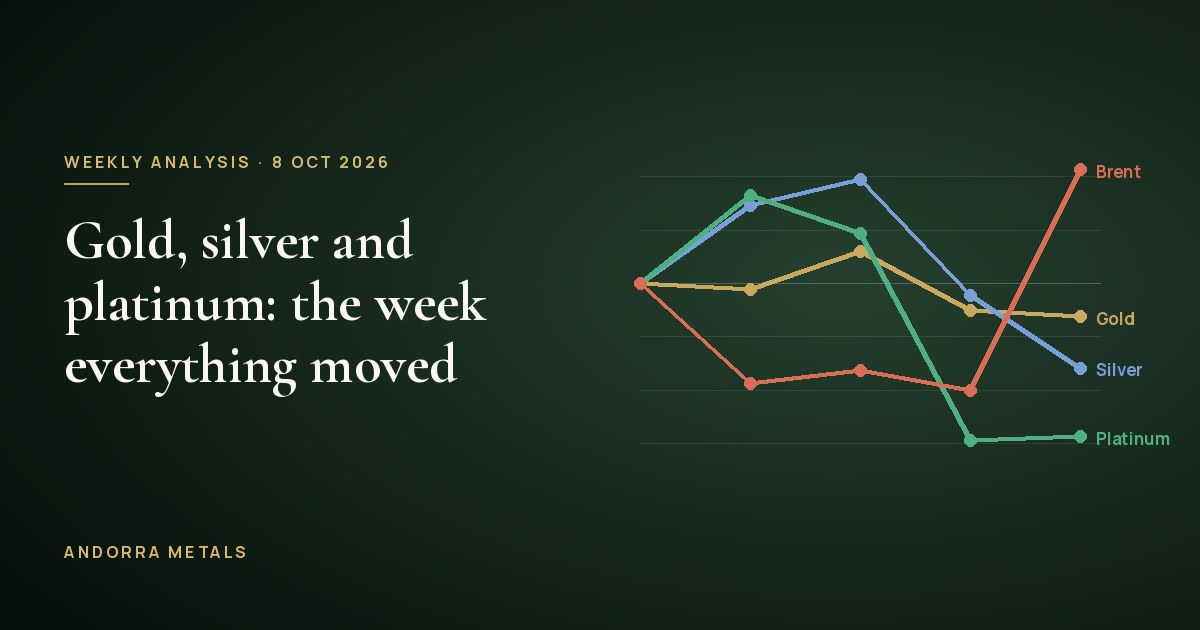
This week gold traded inside that zone the whole time, with a low of $4,093 on Wednesday, less than 3% away from the $4,000 level. Platinum has been below $1,750 for several weeks. Silver tested the $56 area, its lowest level since July, and is bouncing.
Why do we talk about accumulation and not about a bottom? Because nobody can guarantee where the low is. What we do observe is a combination of several elements that in other cycles have accompanied accumulation phases: official buyers taking advantage of falls, speculative investors who have already cut positions, a geopolitical environment that is not improving and cost inflation that is unlikely to disappear soon. The main risk remains the Fed: as long as inflation data surprise to the upside, there will be sessions like Wednesday's.
And a warning we repeat every week: a safe-haven asset is not a risk-free asset. Gold and silver can fall, and fall hard, as was seen on Wednesday. What they offer is not short-term stability, but long-term independence from the solvency of any state or institution.
What is coming
- Saturday 17 October: scheduled reopening of Riyadh airport. The Fed enters its blackout period ahead of the meeting.
- Coming days: Iran's response to the latest US proposal, via Qatar and Pakistan.
- 27-28 October: Fed meeting. The market expects a pause, with a hike likely in December.
- 3 November: US midterm elections, seen as a turning point for the military decision on Iran.
- Winter: how European gas storage and diesel inventories evolve as the cold arrives.
📄 Download this analysis as a PDF
Sources
- CNBC – September CPI · FXStreet · Seoul Economic Daily – producer prices · Breitbart – PPI detail
- FinanceFeeds – Fed probabilities · Bloomingbit – Warsh · AP – Warsh at the IMF
- Trading Economics – 10-year bond · Quartz · Rothschild & Co – France
- BBC Verify – attacks and flows in Hormuz · Reuters via Outlook India – sunken ships and Qalibaf · CNN via WGEM – MOAB plans
- Bloomberg via Times of Israel – missile factories · Vortexa via Iran International – Iranian exports
- Al Jazeera – Yemen · Khaleej Times · Gulf News – Aden · Soufan Center
- OilPrice – Ryazan · CBS – the diesel deal · CNBC · Al Jazeera – Black Sea
- Energy News Beat – IEA and diesel · OGJ – EIA inventories · The National – IEA reserves · IndexBox – EU diesel
- GIE AGSI+ via Global Energy Flow – EU gas · LNG Prime – Ras Laffan · Infojúcar – Red Eléctrica
- Guardian Gold – metals and the PBoC · Kitco – China's purchases · Trading Economics – gold, silver and platinum · USAGOLD